
Beyond the Chatbot: OpenAI's Pivot to Physical Science Signals a New AI Arms Race
OpenAI is using GPT-5 to run biology experiments. PRISM's analysis reveals why this is a strategic pivot to dominate the future of automated scientific R&D.
The Lede: OpenAI is Moving From Code to Molecules
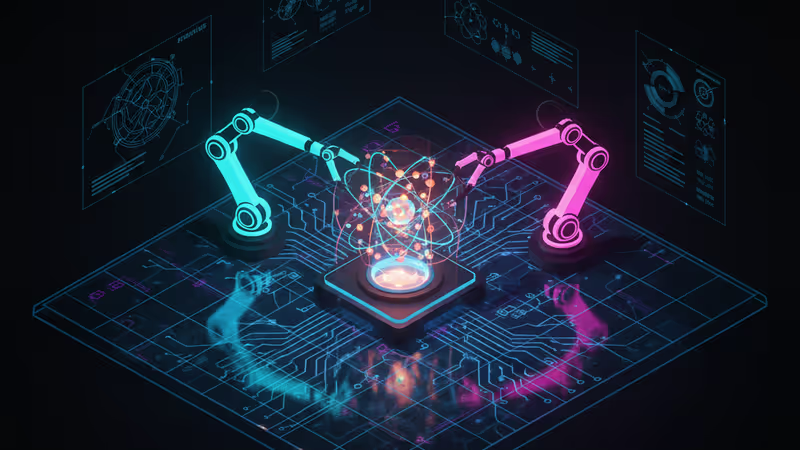
OpenAI just revealed it's using its next-generation model, GPT-5, to run wet lab experiments. While optimizing a molecular cloning protocol might sound niche, don't be mistaken. This isn't just another AI-for-science project; it's a strategic declaration that the next frontier for AI dominance lies not in digital bits, but in physical atoms. For executives and investors, this signals a fundamental shift in the AI landscape: the race is on to build the operating system for the automated lab of the future, a multi-trillion dollar prize.
Why It Matters: The End of R&D as We Know It
This development transcends a single experiment. It's the first concrete public step by a frontier AI lab to create a closed loop between a large-scale AI model, human scientific intent, and physical-world execution. The implications are profound.
- Second-Order Effect #1: The Commoditization of the Hypothesis. For decades, the value in R&D was in the brilliant scientist's hypothesis. OpenAI's framework suggests a future where AI can generate and test thousands of protocols or hypotheses autonomously. The new competitive advantage won't be having the best idea, but having the most efficient AI-driven physical infrastructure to validate ideas at scale.
- Second-Order Effect #2: A New Battleground for Big Tech. The AI war has, until now, been fought on computational benchmarks and chatbot performance. This move drags the fight into the real world. Expect rivals like Google DeepMind and Anthropic to accelerate their own "AI for Science" initiatives, competing not just on model intelligence, but on their ability to translate that intelligence into tangible, physical outcomes in materials science, biology, and chemistry.
- Second-Order Effect #3: The Biosafety Conversation Just Got Real. OpenAI explicitly mentions evaluating "risks." This is a deliberate and critical admission. An AI that can optimize a life-saving therapy protocol could, with malicious intent, be used to design a more dangerous pathogen. This experiment will force regulators and safety researchers to move from theoretical discussions to creating practical guardrails for AI-driven physical science.
The Analysis: It's the Framework, Not Just the Model
From Prediction to Active Participant
The first wave of modern AI in biology, epitomized by DeepMind's AlphaFold, was about prediction. It brilliantly solved the protein folding problem, but it was a passive tool that gave scientists a static map. This OpenAI project represents the leap to participation. GPT-5 isn't just predicting an outcome; it's actively designing the steps of the experimental process. It's an agent in the lab, not just a calculator. This is a qualitative shift from computational biology to true AI-driven discovery, where the model is part of the scientific method itself.
The Real Moat: An 'API' for the Physical World
The genius of this move isn't that GPT-5 is suddenly a world-class molecular biologist. The real innovation is the "real-world evaluation framework." In essence, OpenAI is building the software layer—the API—that connects a general-purpose AI brain to the specialized machinery of a lab. This has been the missing link. While companies like Ginkgo Bioworks and Recursion Pharmaceuticals have built impressive integrated platforms, they are largely bespoke and closed. OpenAI's approach hints at creating a standardized, scalable playbook for any lab to connect to a powerful AI model. Owning this protocol, this 'operating system for science', is a far greater prize than creating a single drug.
PRISM Insight: The Strategic & Investment Implications
Investment Thesis: Bet on the Infrastructure, Not Just the AI
For investors, the takeaway is clear: the most durable value may not be in the AI models themselves, which are quickly becoming commoditized, but in the enabling infrastructure. The companies that build the "picks and shovels" for this new gold rush will win big. This includes:
- Cloud Lab Automation: Companies that provide robotic lab services (like Strateos or Emerald Cloud Lab) which can execute AI-generated protocols on demand.
- Data Integration Platforms: Tools that can seamlessly translate data between AI models and legacy lab equipment (LIMS, ELNs).
- Specialized Hardware: Next-generation sensors and robotics designed for high-throughput, AI-driven experimentation.
The primary investment risk shifts from "will the AI work?" to "can the physical lab infrastructure keep up with the AI's speed and scale?"
Strategic Outlook: OpenAI's Platform Play
This is a classic platform strategy. By being the first major AI player to publicize a framework for real-world lab evaluation, OpenAI is attempting to set the industry standard. They are defining the rules of engagement for how AI interacts with the physical sciences. If they succeed, they won't just be a model provider; they will be the essential bridge between digital intelligence and physical creation, forcing the entire biotech and materials science industries to route through their ecosystem.
PRISM's Take
OpenAI's lab experiment is a trojan horse. On the surface, it's a project to accelerate biology. In reality, it's a strategic beachhead in the physical world. The company that successfully bridges the gap between AI reasoning and robotic execution will not only revolutionize scientific R&D but will also have the blueprint to disrupt manufacturing, logistics, and every other industry grounded in the physical world. This is OpenAI's declaration that their ambition isn't just to own the chatbot on your screen, but to power the robots that will shape our world. The era of purely digital AI is over; the age of physical AI has just begun.
관련 기사
OpenAI가 GPT-5를 활용한 생물학 연구 가속 프레임워크를 공개했습니다. 이는 AI가 과학 발견의 패러다임을 바꾸는 신호탄이자 새로운 '이중용도' 위험의 시작입니다.

OpenAI가 과학적 추론 능력을 측정하는 '프론티어 사이언스' 벤치마크를 공개했습니다. 이것이 왜 단순한 테스트를 넘어 AI 산업의 미래와 투자 지형을 바꾸는 신호탄인지 심층 분석합니다.

스페인 거대 은행 BBVA가 12만 전 직원에게 ChatGPT를 도입합니다. 이는 단순 기술 도입을 넘어 금융 산업의 'AI 네이티브' 전환을 알리는 신호탄입니다.

OpenAI가 AI 코딩 비서 'Codex'를 활용해 단 28일 만에 Sora 안드로이드 버전을 개발했습니다. 이는 소프트웨어 개발 패러다임의 파괴적 혁신을 의미합니다.