
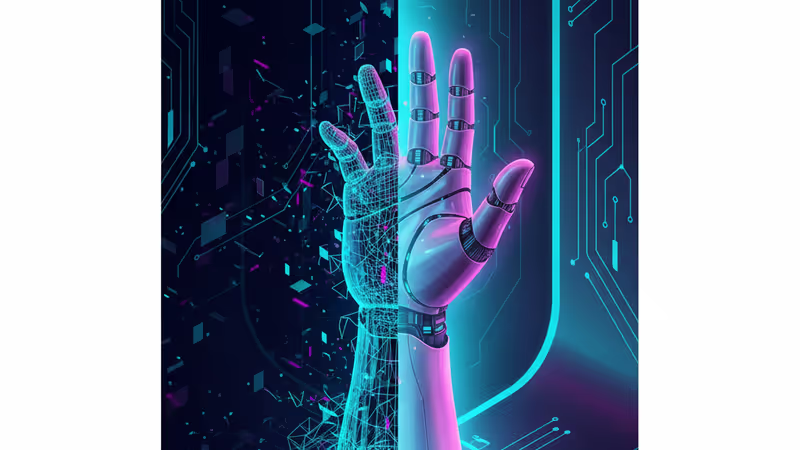
Beyond Six-Fingered Hands: AI Imagery Has Crossed the Uncanny Valley
AI image generators are no longer a joke. They now create imperceptible fakes, challenging our concept of digital trust and reshaping creative industries. Here's why.
The Lede: The AI Joke Is Over
For years, the subtle flaws in AI-generated images—an extra finger, a distorted limb, a nonsensical shadow—were a comforting tell. They allowed us to chuckle at the technology's clumsiness while maintaining a firm grip on reality. That era is definitively over. As The Verge recently noted with an almost-perfect AI image of a Washington State ferry, we have silently crossed a critical threshold. The joke is no longer on the AI; it's on anyone who still believes they can easily spot a fake. This isn't a niche concern for digital artists; it's a fundamental shift in our relationship with visual information, with profound implications for every industry that relies on digital trust.
Why It Matters: The End of Visual Trust as We Know It
The transition from comically flawed to imperceptibly fake AI imagery has second-order effects most are not prepared for. The default assumption for any digital image is rapidly shifting from "real until proven fake" to "synthetic until proven authentic."
- The Misinformation Super-Spreader: The same tools creating beautiful art can generate hyper-realistic political propaganda, fake evidence for legal cases, or fraudulent marketing materials at zero marginal cost.
- Creative Industry Upheaval: This goes beyond threatening stock photography. It redefines the roles of photographers, illustrators, and designers. The premium is no longer on pure creation but on curation, concept, and the difficult-to-replicate human touch.
- The Authenticity Crisis: Brands, media outlets, and even individuals now face a new challenge: how do you prove your visuals are real in a world saturated with convincing fakes? The value of verified, authentic content is about to skyrocket.
The Analysis: Navigating a Post-Photographic World
The Uncanny Valley Is Now a Minefield
We have largely conquered the uncanny valley for static images. The new frontier for detection isn't anatomical correctness but contextual integrity. In the example of the AI-generated ferry, the ship itself is uncanny in its realism, but locals know Mount Rainier doesn't appear that large from that vantage point. This is the new 'tell'—a subtle violation of real-world physics, geography, or culture that AIs, trained on vast but decontextualized datasets, still struggle with. Spotting fakes is no longer a game of 'Where's Waldo?' with six-fingered hands; it's a high-level test of nuanced, local, and expert knowledge.
From Prompt Engineering to Reality Curation
The skillset for top-tier creative work is evolving. Simply writing a clever text prompt is becoming a commoditized skill. True professionals are now 'Reality Curators'—using a combination of AI generation, in-painting, complex layering, and traditional post-production to achieve a specific vision. This hybrid workflow blurs the line between AI artist and digital editor, creating a new class of creator who can generate entire worlds, not just single images. This professionalization of the toolset is widening the gap between casual users and those who can produce truly undetectable synthetic media.
PRISM Insight: The Inevitable Arms Race
Technology Outlook: Detection vs. Provenance
The knee-jerk reaction is to demand better detection tools. This is a losing battle. For every advance in AI detection, a new generation of AI models will be trained to circumvent it. The long-term solution isn't detection, but provenance. Initiatives like the C2PA (Coalition for Content Provenance and Authenticity), backed by Adobe, Microsoft, and others, aim to create a verifiable 'chain of custody' for digital content, embedding metadata that tracks an image's origin and edits. Expect to see a major push for OS-level and platform-level integration of these standards, turning content provenance from a niche feature into a core pillar of digital trust.
Business Implications: Adapt or Become Irrelevant
For businesses, this is both a massive opportunity and an existential threat. Marketers can now create endlessly customizable ad campaigns at a scale previously unimaginable. However, the reputational risk from using AI-generated imagery improperly—or being the victim of a deepfake smear campaign—is immense. Companies must urgently develop clear internal policies on the use of generative AI and invest in media literacy training for their teams. The new corporate mantra must be: verify, then trust.
PRISM's Take
We have entered the post-photographic era. The casual trust we once placed in images is a relic of a bygone technological age. The burden of proof has now permanently shifted from the creator to the consumer. This is not a distant, futuristic problem; it is a present-day reality that demands a fundamental rewiring of how we process visual information. The most valuable skill of the next decade won't be content creation, but content discernment. For industries built on the bedrock of authenticity—from news media to e-commerce—fortifying digital trust is no longer a competitive advantage; it is a matter of survival.
관련 기사

BBVA가 12만 전직원에 ChatGPT를 도입합니다. 이는 단순한 기술 계약을 넘어, 'AI 네이티브 은행'의 미래를 여는 청사진이 될 수 있습니다. PRISM의 전문가 분석을 확인하세요.
FTC와 23개 주가 우버를 상대로 대규모 소송을 제기했습니다. 단순 과징금 문제를 넘어, 구독 경제의 어두운 민낯 '다크패턴'에 대한 전면전이 시작되었습니다.
구글 자금에 의존하며 생존 위기에 처한 모질라. 이는 단순한 브라우저의 문제가 아닌, 웹 다양성과 인터넷의 미래가 걸린 중대한 기로입니다. PRISM이 심층 분석합니다.
![보안 재앙의 주범 'RC4', MS는 왜 26년간 방치했나? [PRISM 분석]](https://prism.r2.liabooks.com/thumbnails/microsoft-kills-a-26-year-old-vulnerability-a-nece-1765902837275.avif)
마이크로소프트가 26년간 유지해온 취약한 RC4 암호를 폐기합니다. 단순한 기술 업데이트가 아닌, 대형 해킹과 정치적 압박이 만든 이 결정의 숨겨진 의미를 심층 분석합니다.