
AI is Spinning Trash into Cashmere, and It Could Kill Fast Fashion's Dirtiest Secret
Everbloom's AI turns waste into biodegradable cashmere that's cheaper than virgin materials. Is this the end of fast fashion's unsustainable model?
The Lede: The End of the 'Sustainable Premium'
The idea that sustainable goods must cost more—the so-called 'sustainable premium'—is one of the biggest roadblocks to a greener economy. A materials science startup named Everbloom is aiming to demolish that roadblock with an AI platform called Braid.AI. By upcycling protein-based waste like chicken feathers and wool scraps into high-performance, biodegradable textiles that are nearly indistinguishable from virgin cashmere, they're not just creating a new fabric. They're challenging the fundamental economic model that has pitted sustainability against affordability for decades.
Why It Matters
This isn't another niche, eco-luxe material destined for a few high-end boutiques. Everbloom's strategy is a direct assault on the heart of the global textile industry. By designing their process as a “drop-in replacement” for existing polyester manufacturing equipment, they’ve eliminated the single greatest barrier to adoption: retooling. This means massive manufacturers could switch to Everbloom’s materials with minimal friction, potentially triggering a rapid, industry-wide shift away from resource-intensive virgin materials. The second-order effect is a fundamental disruption to global supply chains, from Mongolian goat herders to petrochemical giants producing polyester.
The Analysis
The $50 Cashmere Paradox
The fast fashion industry’s insatiable demand for cheap luxury created an environmental and ethical disaster. To produce $50 cashmere sweaters, goat herds are expanded unsustainably, leading to overgrazing and desertification, while goats are shorn too frequently, degrading the quality of the fiber. This created a market paradox: the more accessible cashmere became, the less sustainable and lower quality it was. Everbloom isn’t trying to fix this broken system; it’s aiming to replace it entirely by decoupling the material from its destructive source.
Braid.AI: A Digital Weaver for Physical Materials
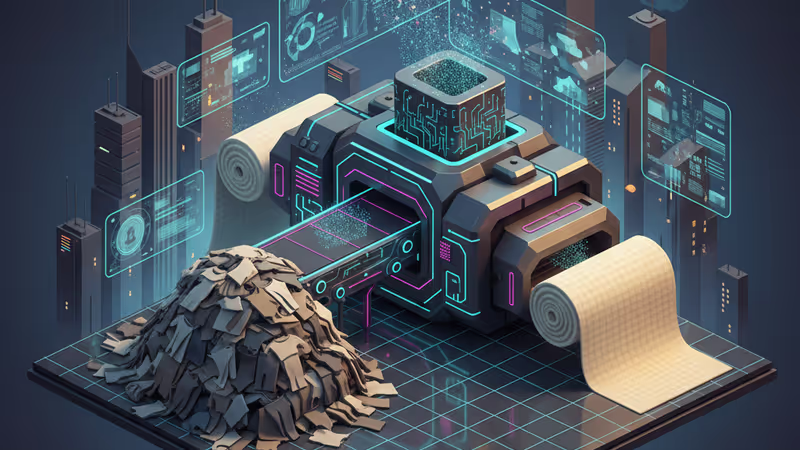
While recycled materials are not new, they often suffer from degradation. Recycled polyester (rPET) sheds microplastics, and recycled cotton has shorter fibers, resulting in a weaker fabric. Everbloom’s innovation lies in its AI-driven approach. Braid.AI is the core intellectual property here. It acts as a digital materials scientist, precisely tuning chemical formulations and extrusion parameters to transform a heterogeneous waste stream (keratin) into a consistent, high-performance output. This moves beyond simple recycling into the realm of “molecular upcycling.” The ability to create fibers that mimic everything from cashmere to polyester from the same waste feedstock suggests a future of materials-on-demand, a platform play that is far more valuable than a single new fabric.
A Direct Challenge to Chemical Giants and Niche Eco-Startups
Everbloom's stated goal of being cheaper than virgin materials places it in a unique competitive position. Most material-tech startups, from Bolt Threads (mushroom leather) to Modern Meadow (bio-fabricated leather), have struggled to escape the “sustainable premium” trap, limiting their market to the luxury sector. By targeting cost parity or better, Everbloom competes directly with commodity producers like DuPont and Invista. If their claims on cost and biodegradability hold up under third-party scrutiny and at industrial scale, they could make both virgin polyester and expensive eco-alternatives obsolete.
PRISM Insight
For Investors: Is This a Materials Company or an AI Company?
The $8 million seed round from Hoxton Ventures and SOSV is a bet on a powerful narrative, but the long-term value proposition depends on the business model. Is Everbloom a materials manufacturer, requiring massive capital expenditure to build factories? Or is it a technology licensor, selling access to the Braid.AI platform and its proprietary compounds to existing textile giants? The latter is a far more scalable and higher-margin business. Key risks to monitor are the true cost of scaling production, the scientific validation of their biodegradability claims (a notoriously difficult area), and their ability to defend their IP against reverse-engineering by incumbent chemical behemoths.
For Brands: The End of the ESG Compromise
For fashion and apparel brands, this technology could solve their biggest ESG (Environmental, Social, and Governance) headache. They are currently trapped between consumer demand for low prices and investor pressure to clean up their supply chains. Everbloom offers a potential escape route: a material that checks the sustainability box, delivers the desired quality and feel, and—critically—does not hurt the bottom line. Brands should be aggressively pursuing pilot programs to validate performance and marketing claims. Early adopters could gain a significant competitive advantage, rewriting their brand story from one of environmental liability to one of innovation.
PRISM's Take
Everbloom isn't just making a better sweater; it's building a blueprint for the future of industrial materials. The true disruption here is the use of AI to transform waste from a liability into a high-value, infinitely tunable resource. While the journey from an $8M seed round to displacing a trillion-dollar industry is long and fraught with peril, the company's core premise is sound. By rejecting the 'sustainable premium' and focusing on seamless integration into existing infrastructure, Everbloom has the potential to move circularity from a niche marketing term to the default operating system for the entire textile industry.
관련 기사

인스타카트가 AI를 이용해 일부 고객에게 식료품을 23% 더 비싸게 판매한 사실이 드러났습니다. 이것이 '디지털 가격 차별'의 시작이며, 소비자가 알아야 할 대응법을 심층 분석합니다.

우버의 '다크패턴' 구독 서비스가 24개 주로부터 집단 소송을 당했습니다. 이것이 구독 경제의 종말을 의미하는지, 당신의 지갑에 미칠 영향을 심층 분석합니다.

AI 붐의 이면, 데이터센터가 당신의 전기요금을 폭등시키고 있습니다. 미 상원의 칼끝이 빅테크를 향한 이유와 이것이 투자자와 시장에 미칠 영향을 심층 분석합니다.

그라인더가 단순 데이팅 앱을 넘어 AI와 헬스케어를 결합한 '게이 수퍼앱'으로 변신을 선언했다. 이 야심 찬 계획의 성공 가능성과 숨겨진 위험을 심층 분석한다.