
Thundersnow, Giant Snowflakes, and Desert Blizzards: Winter's Wildest Secrets
From snow in the Sahara Desert to giant 15-inch snowflakes and the rare phenomenon of thundersnow. Discover the most surprising and bizarre scientific facts about winter weather.
Winter is more than just cold weather and cozy sweaters. It’s a season of bizarre and awe-inspiring phenomena, where the rules we think we know about nature get beautifully broken. What if you were told that nearly 32 inches of snow once fell on the world's driest desert, or that giant, 3-foot snowballs can form all by themselves?
Snow often appears where you'd least expect it. In 2011, a rare cold front from Antarctica blanketed Chile’s Atacama Desert—the driest place on Earth—with an astonishing 32 inches of snow. Snowfall has also been recorded everywhere from the Sahara Desert to Hawaii, proving that winter’s reach is far greater than we assume.
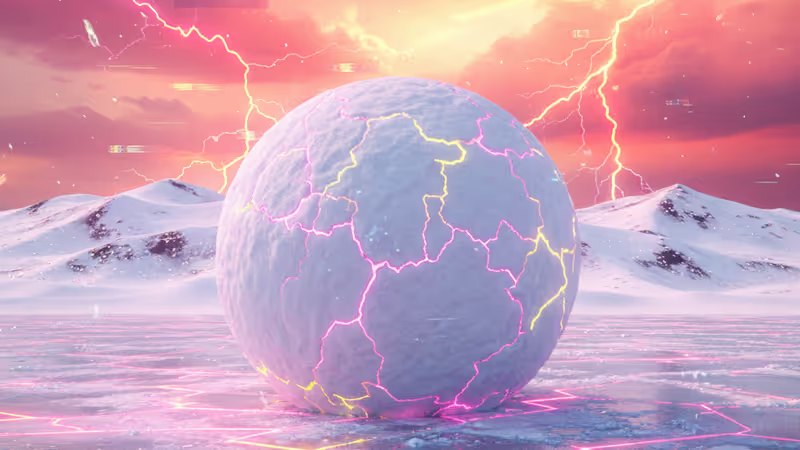
The size of snowflakes can be equally mind-boggling. While most are dime-sized, witnesses to a snowstorm in Fort Keogh, Montana, in 1887 claimed to see crystals 15 inches wide fall from the sky. More recently, in 2016, a beach in Siberia became home to hundreds of mysterious, naturally formed snowballs. These icy spheres, shaped by wind and water, grew up to nearly 3 feet in diameter.
Sometimes, the sky rumbles during a blizzard. This rare phenomenon, known as 'thundersnow,' is most common near a large lake. It occurs when columns of warmer air rise into colder cloud layers, creating atmospheric instability. But you could miss it happening right over your head; the thick snowfall often dampens the sound of thunder, making it an eerie, muffled roar.
One of the most common winter myths is that it's cold because Earth is farther from the sun. In reality, the opposite is true. Every January, during the Northern Hemisphere's winter, Earth reaches perihelion, the point in its orbit where it’s closest to the sun. The seasons are a result of the planet's axial tilt, not its distance from our star.
Ultimately, winter reveals the dynamic, and sometimes strange, physics of our world hiding in plain sight.
본 콘텐츠는 AI가 원문 기사를 기반으로 요약 및 분석한 것입니다. 정확성을 위해 노력하지만 오류가 있을 수 있으며, 원문 확인을 권장합니다.
관련 기사

세스 마이어스의 '레이트 나이트 쇼'가 크리스마스 주간에 휴방하고 재방송을 편성한다. 다사다난했던 2025년 심야 토크쇼 포맷의 현주소와 정치적 영향력을 짚어본다.

ABC의 간판 토크쇼 ‘지미 키멜 라이브’가 연말 휴식기에 들어갔다. 2026년 새 에피소드로 돌아오기 전, 재방송 일정과 지미 키멜이 눈물로 한 해를 마무리한 이유를 알아본다.

미국 리얼리티 쇼 '빅브라더 27' 출신 미키 리가 연쇄 심정지로 위독한 상태에 빠졌습니다. 가족들은 의료비 마련을 위해 고펀드미를 통해 모금을 시작했으며, 동료 출연자들의 응원이 이어지고 있습니다.

MTV '더 챌린지'의 카라 마리아 소르벨로와 CBS '빅브라더'의 레이첼 라일리가 홀리데이 로맨틱 코미디 영화 '미슬토 맨션'에 공동 주연으로 출연한다. 가상 리얼리티 쇼를 배경으로 한 영화의 줄거리와 두 스타의 역할을 자세히 알아본다.