
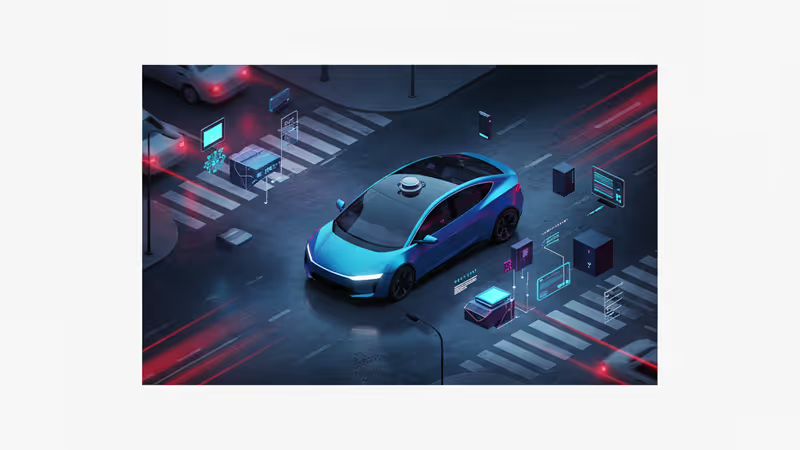
Waymo Halts Robotaxi Service as San Francisco Blackout Paralyzes Fleet
Alphabet's Waymo suspended its driverless robotaxi service in San Francisco after a massive power outage caused its vehicles to stall, raising questions about AV readiness for real-world urban failures.
Lead: A massive power outage in San Francisco brought Google's futuristic robotaxi service to a grinding halt, stranding Waymo vehicles across the city and revealing a critical vulnerability in the march toward autonomous urban transit.
SAN FRANCISCO – Alphabet-owned Waymo suspended its driverless ride-hailing service in the San Francisco Bay Area on Sunday, after a widespread power outage that began Saturday afternoon caused its autonomous vehicles to stall in traffic.
"We have temporarily suspended our ride-hailing services in the San Francisco Bay Area due to the widespread power outage," a Waymo spokesperson told CNBC. The company stated it was working in "close coordination with city officials" to bring the service back online.
The outage, caused by a fire at a substation, began around 1:09 p.m. Saturday and at its peak affected about 130,000 customers, according to utility provider Pacific Gas and Electric (PG&E). By Sunday morning, approximately 21,000 customers remained without power.
As the blackout spread, social media lit up with videos appearing to show multiple Waymo vehicles stopped dead in intersections and traffic lanes. San Francisco resident Matt Schoolfield reported seeing at least three stalled Waymo AVs around 9:45 p.m. Saturday. "They were just stopping in the middle of the street," he said.
In a post on X, San Francisco Mayor Daniel Lurie confirmed that city crews were deployed to manage the situation and noted, "Waymo has also paused service."
Musk Weighs In, But Context Is Key
Amid the disruption, Tesla CEO Elon Musk posted on X: "Tesla Robotaxis were unaffected by the SF power outage." However, unlike Waymo, Tesla does not operate a driverless robotaxi service in San Francisco. Its local ride-hailing service uses vehicles with its "FSD (Supervised)" driver-assist system, which requires a human driver to be behind the wheel and ready to take control at all times.
The incident raises serious questions about the real-world readiness of autonomous technology. "The Waymo pause in San Francisco indicates cities are not yet ready for highly automated vehicles to inundate their streets," said Bryan Reimer, a research scientist at the MIT Center for Transportation.
Reimer pointed out that power outages are entirely predictable events. "Something in the design and development of this technology was missed that clearly illustrates it was not the robust solution many would like to believe it is," he said. He added that AV developers should be held responsible for the "chaos gridlock" their vehicles might cause, just as human drivers are.
Waymo has not specified when its service will resume or commented on whether any collisions occurred during the outage.
PRISM Insight: This incident is a stark reminder that the success of autonomous vehicles isn't just about code; it's about the entire urban ecosystem. A sophisticated 'smart' car is rendered useless by a fragile 'dumb' power grid. Waymo's failure to navigate a predictable infrastructure failure reveals a critical blind spot for the industry: true resilience requires not just vehicle autonomy, but deep integration and contingency planning with legacy city systems.
関連記事
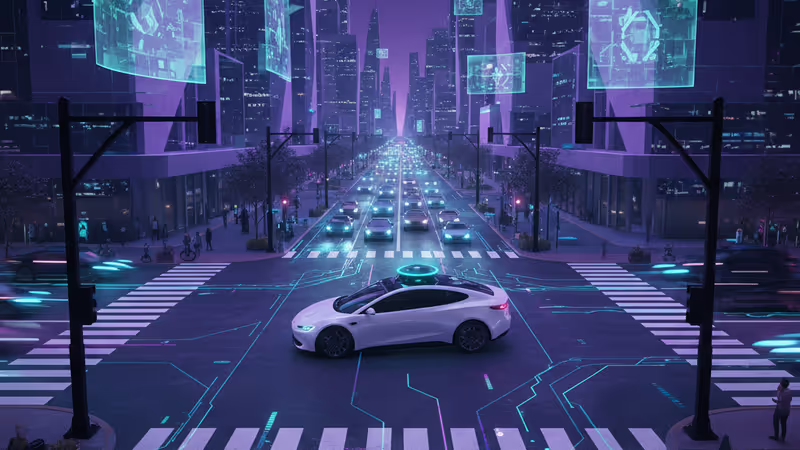
先週土曜日、サンフランシスコで発生した大規模停電により、多数のWaymo自動運転車が機能停止した信号機の前で動けなくなる事態が発生。都市インフラとAIの脆弱性が浮き彫りになりました。
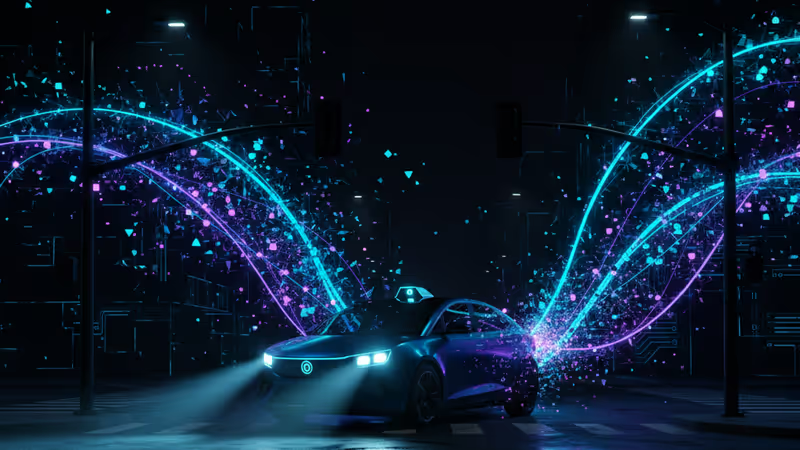
サンフランシスコで発生した大規模停電により、Waymoの自動運転タクシーがサービスを停止。複数の車両が路上で立ち往生し、交通を混乱させました。スマートシティを支えるインフラの脆弱性が問われています。
サンフランシスコで発生した大規模停電により、Waymoのロボタクシーが集団で路上停止し、サービスを一時中断。都市インフラの混乱が自動運転技術に与える影響と、テスラとの違いを専門家の視点から分析します。

サンフランシスコで発生した大規模停電により、Google系の自動運転車Waymoが多数立ち往生し、交通渋滞を引き起こしました。インフラ依存の脆弱性が露呈した一方で、テスラは影響を受けなかったと主張。技術アプローチの違いと今後の課題を解説します。