
The Specialist Is Over. In the AI Era, Adaptable Generalists Win.
The age of the hyper-specialist is ending. As AI accelerates the pace of change, companies are discovering that adaptable generalists—not narrow experts—are the most valuable talent. Here's why the future of work belongs to them.
In the 2010s, the tech industry had a clear playbook for talent: hire specialists. Backend engineers, data scientists, system architects—experts with deep, narrow knowledge built predictable careers on stable foundations like cloud infrastructure. That model worked when technology evolved slowly. Then AI went mainstream, and the playbook was torched.
“The pace of change has exploded,” writes Tony Stoyanov, CTO and co-founder of EliseAI. “You can’t hire someone who has been building AI agents for five years, as the technology hasn’t existed for that long.” In today’s landscape, the most valuable players aren’t those with the longest résumés; they’re the ones who learn fast, adapt quickly, and act without waiting for direction. This transformation is most visible in software engineering, a field now evolving faster than almost any other.
AI has lowered the barrier to complex technical work while simultaneously raising the bar for what constitutes real expertise. According to McKinsey, this shift has massive economic implications: by 2030, up to 30% of U.S. work hours could be automated, and 12 million workers may need to transition to entirely new roles. While technical depth still matters, the future favors people who can figure things out as they go.
Stoyanov sees this firsthand at his own company. “Engineers who never touched front-end code are now building UIs,” he notes, “while front-end developers are moving into back-end work.” The tools are getting easier, but the problems are getting harder because they span more disciplines. In this environment, being great at just one thing isn’t enough. What’s critical is the ability to bridge engineering, product, and operations to make smart decisions with imperfect information.
Despite the hype, only 1% of companies consider their AI adoption to be truly mature. Many are still operating with structures built for a slower era: layers of approvals, rigid roles, and a dependency on specialists who can’t move outside their lane.
So, what defines the “strong generalist” that this new era demands? It’s not a jack-of-all-trades, but a master of learning. They cultivate depth in one or two domains while staying fluent across many. As David Epstein argued in his book *Range*, true expertise comes from connecting the dots, not just collecting them. These individuals share a few key traits: end-to-end ownership over outcomes, first-principles thinking to question assumptions, and the agency to act without waiting for permission.
“If you’re a builder who thrives in ambiguity, this is your time,” Stoyanov concludes. “The AI era rewards curiosity and initiative more than credentials.” The message for hiring managers is just as stark. The people who will drive your company forward might not have the perfect résumé for today’s job. They’re the ones who can grow into what your company will need tomorrow. The future belongs to the generalists—and the companies smart enough to trust them.
PRISM Insight: The pivot to generalists is more than a hiring trend—it's the organizational equivalent of the shift from waterfall to agile development, now supercharged by AI. Companies are no longer just building cross-functional teams; they are being forced to hire cross-functional *individuals*. This demands a complete overhaul of talent strategy, from rigid job descriptions to siloed org charts, favoring a model of fluid, mission-oriented 'builders' who can learn and execute at the speed of AI.
関連記事
サンフランシスコで発生した大規模停電により、Waymoの自動運転タクシーがサービスを停止。複数の車両が路上で立ち往生し、交通を混乱させました。スマートシティを支えるインフラの脆弱性が問われています。
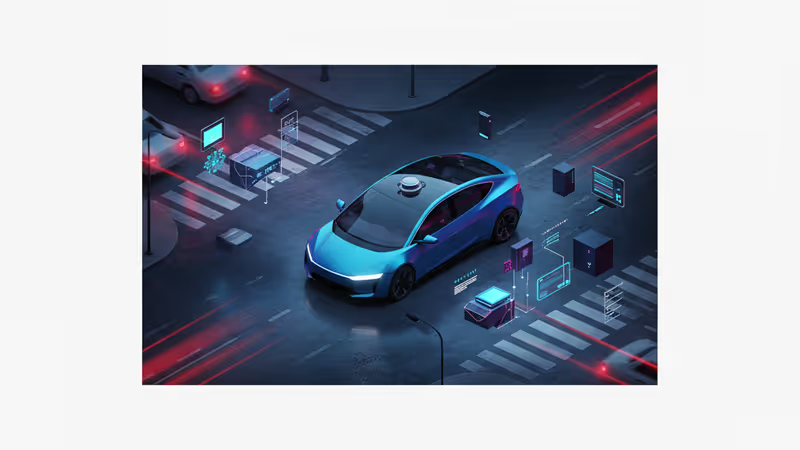
サンフランシスコで発生した大規模停電により、Waymoのロボタクシーが集団で路上停止し、サービスを一時中断。都市インフラの混乱が自動運転技術に与える影響と、テスラとの違いを専門家の視点から分析します。

サンフランシスコで発生した大規模停電により、Google系の自動運転車Waymoが多数立ち往生し、交通渋滞を引き起こしました。インフラ依存の脆弱性が露呈した一方で、テスラは影響を受けなかったと主張。技術アプローチの違いと今後の課題を解説します。
80年間、物流の現場で高速に動作してきた最適化アルゴリズム「シンプレックス法」。なぜ理論上の最悪ケースが現実には起こらないのか?その長年の謎を解き明かす画期的な研究成果が登場した。