
U.S. Blacklists China's Top Chipmaker SMIC, Dealing Severe Blow to Beijing's Tech Ambitions
The U.S. has added Chinese chipmaker SMIC to its trade blacklist, cutting it off from key American technology. We analyze the impact on SMIC, the global semiconductor supply chain, and what it means for investors.
The Lead: Washington's Decisive Move
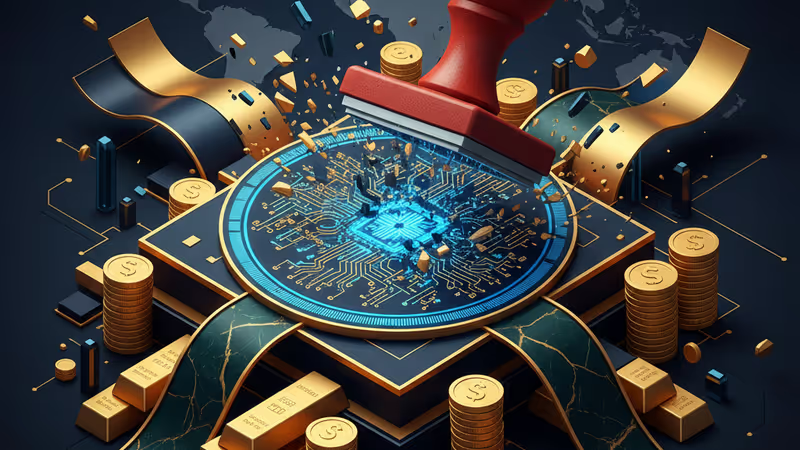
The U.S. Commerce Department on Friday added China's largest semiconductor manufacturer, SMIC (Semiconductor Manufacturing International Corporation), to its trade blacklist. The move effectively cuts SMIC off from critical U.S. technology, severely hindering its ability to produce advanced chips and dealing a major blow to China's goal of technological self-sufficiency.
What Happened and Why It Matters
Citing national security concerns, the Commerce Department stated it has evidence of SMIC's collaboration with the Chinese military-industrial complex. "We will not allow advanced U.S. technology to help build the military of an increasingly belligerent adversary," said Commerce Secretary Wilbur Ross in a statement. SMIC was among more than 60 Chinese entities added to the so-called Entity List in the Trump administration's latest move against Beijing.
The restriction is surgically precise and highly damaging: it specifically targets SMIC's ability to acquire technology for semiconductor production at or below `10 nanometers`. The department will enforce a "presumption of denial" for license applications to export such technology to the company. This effectively freezes SMIC's roadmap to catch up with industry leaders like Taiwan's TSMC and South Korea's Samsung Electronics.
Investor Takeaway: A Crippled Competitor
For investors, this action fundamentally alters SMIC's growth trajectory. The company is heavily reliant on U.S. equipment from suppliers like Applied Materials, Lam Research, and KLA. Without access, its long-term viability as a leading-edge foundry is now in serious doubt. While Beijing will likely double down on support, overcoming the technological gap without U.S. tools is a monumental, if not impossible, challenge in the short to medium term.
Ripple Effects Across the Global Supply Chain
The blacklisting of SMIC sends shockwaves beyond the company itself. Here's what to watch:
- Competitors Gain: Rivals like TSMC, Samsung, and even UMC could see a near-term benefit. Customers who relied on SMIC, or planned to, will likely shift orders to more stable suppliers to de-risk their supply chains.
- Supply Chain Scramble: The move accelerates the trend of economic "decoupling" between the U.S. and China. Global tech companies are now under even greater pressure to diversify their manufacturing and sourcing away from China.
- Risk of Retaliation: Beijing is unlikely to let this move go unanswered. Potential retaliation against U.S. firms operating in China remains a significant risk, adding another layer of volatility to the market.
PRISM Insight
This isn't just a sanction against a single company; it's a strategic chokehold on China's entire "Made in China 2025" blueprint. By targeting SMIC, Washington is aiming at the foundational layer of China's tech ambitions. The key question now is how the incoming Biden administration will handle these sanctions. While a complete reversal is unlikely, they could be used as a powerful point of leverage in future negotiations. For now, the tech cold war just got significantly colder.
関連記事
日本政府が1100兆円の家計貯蓄を国債の新たな買い手として注目。日銀の金融政策正常化に伴う国債購入縮小に備え、デフレマインドからの転換を促す。
サムスンバイオロジクスがGSKから米国の医薬品生産施設を2.8億ドルで買収。世界最大の北米市場でのCDMO事業を強化し、グローバルな供給能力を拡大する戦略的な動きを解説します。

米バイデン政権が「インフレ抑制法」に基づき、メディケア対象の医薬品10品目の価格交渉を本格開始。BMS、J&Jなどが対象。製薬業界は訴訟で対抗しており、投資家は収益への影響と訴訟リスクを注視する必要がある。

米石油大手コノコフィリップスが、マラソン・オイルを負債込み225億ドルで買収すると発表。米シェール業界で続く大型再編の最新動向と、投資家への影響を解説します。