
Yeri's Drama Debut Reveals the Quiet Strategy Behind Korean Cable TV
MBN's six-episode healing drama Azure Spring starring Yeri (Red Velvet) isn't just a fan service project — it's a case study in how Korean cable channels survive the OTT era.
Six episodes. That's not a creative choice — it's a survival calculation.
MBN has released a new teaser for Azure Spring, a six-episode healing romance set to air in May 2026. Yeri (Kim Ye Rim of Red Velvet) plays Seo Anna, a former athlete frozen by fear of the future. Kang Sang Jun plays Yoon Deok Hyun, a man who can't let go of his past. They meet on Jeju Island, where the sea — and a male haenyeo, or diving woman — becomes the backdrop for their mutual reinvention.
On the surface, it's a gentle romantic drama. Underneath, it's a precise piece of industrial engineering.
The OTT Blind Spot Korean Cable Is Exploiting
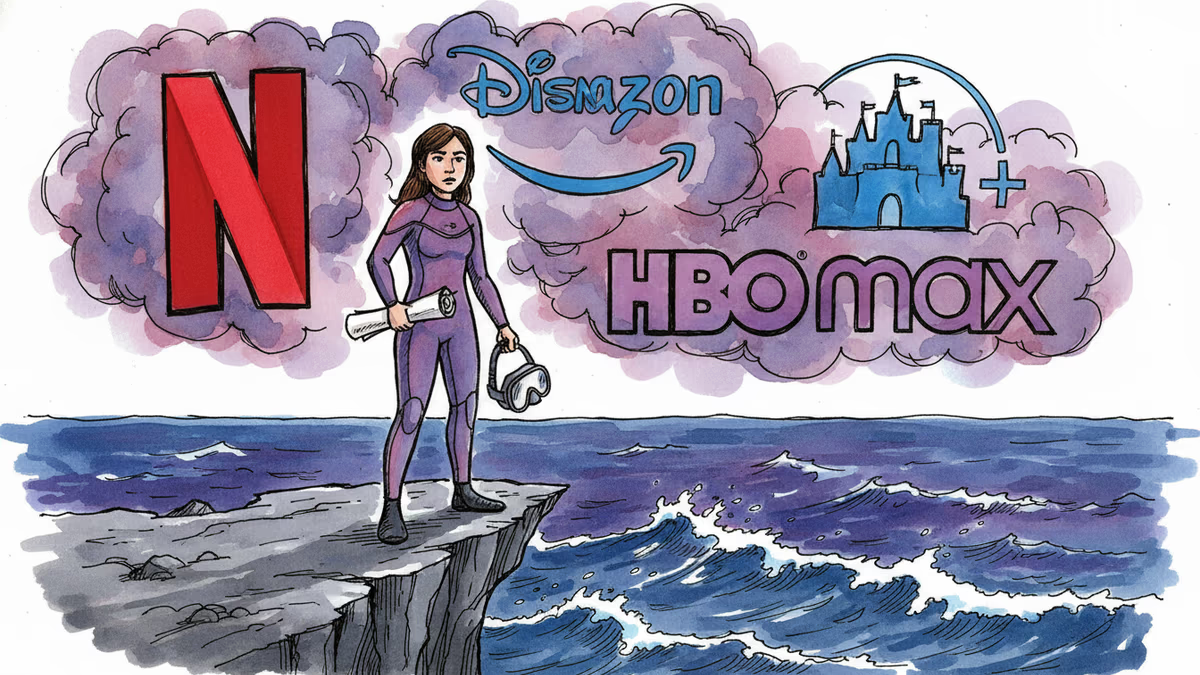
By 2026, Netflix effectively owns the prestige end of K-drama. Pollock (폭싹 속았수다), its 16-episode flagship this season, has dominated global charts. Disney+ and Tving are competing with their own high-budget genre productions. In this landscape, a cable channel like MBN has two options: compete head-on, or find the gap.
Azure Spring is firmly the latter. A six-episode complete-arc drama doesn't chase Netflix's autoplay algorithm — it targets weekend binge viewers who want a story that starts and ends in one sitting. The formula is familiar: webtoon IP for a built-in fanbase, idol casting for instant buzz, compressed runtime to minimize production risk. This triangle has been cable drama's survival grammar since at least 2022. What's notable isn't that MBN invented something new. It's that the formula keeps working.

What the Idol-to-Actor Pipeline Actually Measures
Yeri's casting as lead is the most scrutinized element of this production, and not just by fans. Since IU's breakout performance in Hotel Del Luna (2019), the idol-to-lead-actress transition has become a recognized career track in Korean entertainment. But the industry has also accumulated enough data points to know where it tends to succeed and fail.
The dividing line is usually character density relative to episode count. Long-form dramas — 16 episodes or more — give a character room to breathe, contradict herself, and grow. That's where acting range gets demonstrated. A six-episode format is excellent for fan mobilization, but structurally narrow for proving dramatic depth. Whether Yeri can use this platform to shift industry perception depends almost entirely on how well Seo Anna is written — not just how well she's performed. The teaser doesn't yet answer that question.
Why Haenyeo, Why Now
The choice of Jeju's haenyeo culture as a setting isn't incidental. Since UNESCO inscribed the haenyeo tradition as Intangible Cultural Heritage in 2016, the imagery has become a recurring motif in Korean content — but the framing has shifted. Azure Spring isn't interested in preservation or documentary authenticity. It uses the haenyeo as a metaphor for recovery through physical immersion: the body relearning trust after failure.
This lands squarely in a broader emotional current running through Korean drama since the early 2020s. My Liberation Notes (2022) gave language to white-collar burnout. Castaway Diva (2023) centered an industry dropout's comeback. Azure Spring adds a sports-elite injury narrative to the same shelf. All three place a person who has been pushed outside the system at the center of the story. That's not a coincidence — it reflects a genuine social appetite for narratives that give permission to stop.
The male haenyeo (haennam) subplot is the drama's most structurally interesting gamble. Gender role reversal in Korean drama has a mixed track record: sometimes it becomes the central tension, sometimes it's decorative. In six episodes, there isn't much runway to do both.
This content is AI-generated based on source articles. While we strive for accuracy, errors may occur. We recommend verifying with the original source.
Related Articles

MBC's action-comedy Fifties Professionals introduces Kwon Yul as an unpredictable new antagonist. Here's why this drama's premise matters beyond the casting news.
tvN's Spooky in Love teaser drops with Park Eun Bin as a ghost-seeing hotel heiress. Behind the occult romance lies a calculated industry strategy worth unpacking.
JTBC's Reborn Rookie pairs veteran actor Son Hyun Joo with idol-turned-actor Lee Jun Young in a body-swap drama. A look at the genre's industrial logic and what it signals about Korean TV's audience strategy.

JTBC's upcoming comedy crime drama Apartment casts Ji Sung, Ha Yoon-kyung, Park Byung-eun, and Moon Sori in a story where an ex-gangster enters a residents' committee election. What does the project reveal about JTBC's 2026 strategy?
MBC's action-comedy Fifties Professionals introduces Kwon Yul as an unpredictable new antagonist. Here's why this drama's premise matters beyond the casting news.
tvN's Spooky in Love teaser drops with Park Eun Bin as a ghost-seeing hotel heiress. Behind the occult romance lies a calculated industry strategy worth unpacking.
JTBC's Reborn Rookie pairs veteran actor Son Hyun Joo with idol-turned-actor Lee Jun Young in a body-swap drama. A look at the genre's industrial logic and what it signals about Korean TV's audience strategy.
JTBC's upcoming comedy crime drama Apartment casts Ji Sung, Ha Yoon-kyung, Park Byung-eun, and Moon Sori in a story where an ex-gangster enters a residents' committee election. What does the project reveal about JTBC's 2026 strategy?
Thoughts
Share your thoughts on this article
Sign in to join the conversation