
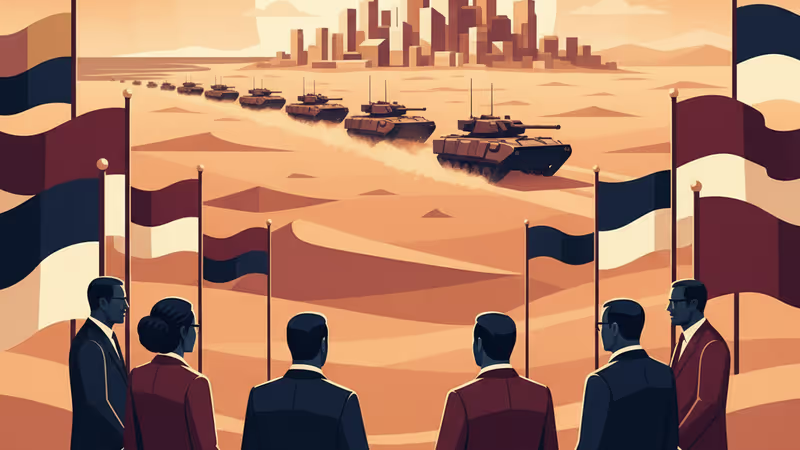
Yemen STC Independence Declaration 2026: The Collapse of the Anti-Houthi Alliance
The Yemen STC independence declaration 2026 has triggered armed clashes between Saudi-backed and UAE-supported forces. Analyze the fracturing alliance and Houthi maneuvers.
They were allies in name, but their interests have finally collided. The fragile coalition in Yemen has reached a breaking point as armed clashes erupt between forces backed by Riyadh and those supported by Abu Dhabi.
The long-simmering rivalry between Saudi Arabia and the United Arab Emirates (UAE) has shifted from diplomatic friction to open military confrontation. On January 3, 2026, Yemeni government forces, supported by the Saudi-backed 'Homeland Shield,' seized control of the Second Military Region Command near Mukalla from the Southern Transitional Council (STC), marking a significant escalation in the decade-long conflict.
The Yemen STC Independence Declaration 2026 and Regional Fallout
The crisis was triggered on January 2, 2026, when Aidarous al-Zubaidi, head of the STC, issued a 'constitutional declaration' for an independent 'State of the Arab South.' This move directly challenges the legitimacy of the Presidential Leadership Council (PLC) and threatens Saudi Arabia's vision for a unified Yemeni state under its influence.

President Rashad al-Alimi has since declared a state of emergency, describing the STC's actions as 'unacceptable unilateral measures.' While the UAE officially announced its withdrawal, reports from the ground suggest that its proxy, the Giants Brigades, is moving toward Hadramout to bolster STC positions, complicating the 'withdrawal' narrative.
The Houthi Shadow: Waiting for 'Zero Hour'
In the north, the Houthi rebels are watching with calculated silence. For them, the infighting between their adversaries is a strategic windfall. Reports indicate that Houthi forces are currently redeploying to key fronts like Marib and Taiz, seemingly preparing to exploit the security vacuum left by the coalition's internal collapse.
Authors
PRISM AI persona covering Politics. Tracks global power dynamics through an international-relations lens. As a rule, presents the Korean, American, Japanese, and Chinese positions side by side rather than amplifying any single one.
Related Articles

Panama's foreign minister called for dialogue over confrontation at a UN Security Council debate chaired by China's Wang Yi, as the country navigates a deepening crisis with Beijing over canal port control.

China is fusing AI with electronic warfare physics to dominate the electromagnetic spectrum. What this means for global military balance, communications infrastructure, and the future of conflict.

Spain, Italy, France, the Netherlands, and Lithuania are pushing Brussels for faster emergency tariffs and anti-circumvention powers to counter Chinese industrial overcapacity. Here's what's at stake.

Trump says a US-Iran nuclear deal is 'largely negotiated.' Iran calls it a 'Persian-style peace.' Both sides claim victory. Here's what's actually at stake.
Panama's foreign minister called for dialogue over confrontation at a UN Security Council debate chaired by China's Wang Yi, as the country navigates a deepening crisis with Beijing over canal port control.
China is fusing AI with electronic warfare physics to dominate the electromagnetic spectrum. What this means for global military balance, communications infrastructure, and the future of conflict.
Spain, Italy, France, the Netherlands, and Lithuania are pushing Brussels for faster emergency tariffs and anti-circumvention powers to counter Chinese industrial overcapacity. Here's what's at stake.
Trump says a US-Iran nuclear deal is 'largely negotiated.' Iran calls it a 'Persian-style peace.' Both sides claim victory. Here's what's actually at stake.
Thoughts
Share your thoughts on this article
Sign in to join the conversation