
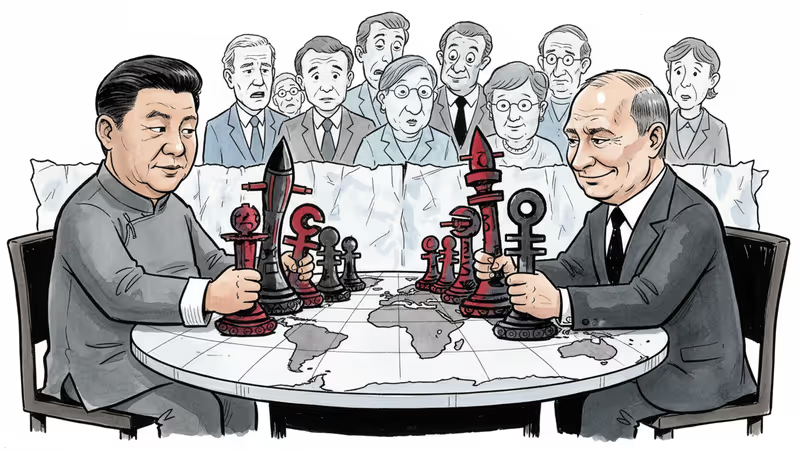
Xi and Putin's First 2025 Call Signals 'Grand Plan' for Deepening Ties
Chinese and Russian leaders held their first meeting of 2025, emphasizing the need for a 'grand plan' to develop bilateral relations amid rising global tensions.
Chinese President Xi Jinping and Russian President Vladimir Putin held their first video call of 2025 on Wednesday, with Xi declaring that bilateral relations were on the "right trajectory" and emphasizing the need for a "grand plan" to develop ties further.
Beyond Diplomatic Pleasantries
This wasn't just another routine diplomatic exchange. Putin's assessment that China-Russia ties serve as a "stabilizing factor" during global turbulence reveals the strategic calculus behind their partnership. As both nations face mounting pressure from Western sanctions and containment efforts, their cooperation has evolved from convenience to necessity.
The timing is particularly significant. With Donald Trump returning to the White House and European nations grappling with their own economic challenges, Beijing and Moscow see an opportunity to reshape global power dynamics. Xi's call for a "grand plan" suggests they're moving beyond tactical cooperation toward systematic strategic alignment.
Economic Interdependence Deepens
The numbers tell the story. China-Russia trade reached $240 billion in 2023, with energy forming the backbone of their economic relationship. Russia has become China's largest oil supplier, while Chinese technology and manufacturing goods flow in the opposite direction. This interdependence creates a buffer against Western economic pressure.

But there's more at stake than trade figures. Both countries are developing alternative financial systems to reduce dependence on Western-dominated institutions. Russia's exclusion from SWIFT and China's concerns about potential CHIPS Act-style restrictions are driving innovation in payment systems and supply chains.
The Limits of Partnership
Yet this isn't a marriage of equals, nor is it without friction. China remains cautious about directly supporting Russia's war in Ukraine, walking a careful line between solidarity and self-preservation. Chinese companies have largely complied with Western sanctions, even as Beijing provides diplomatic cover for Moscow.
Russia, meanwhile, harbors concerns about becoming too dependent on its larger neighbor. Historical tensions over Siberian territories and Central Asian influence haven't disappeared—they've simply been shelved for mutual convenience.
Global Implications
For the rest of the world, this partnership poses complex challenges. Middle powers like South Korea, India, and Turkey must navigate between competing blocs while protecting their own interests. The era of clear-cut alliances is giving way to more fluid, interest-based partnerships.
Investors are watching closely too. Companies with significant exposure to either China or Russia face difficult choices about supply chains, market access, and regulatory compliance across different jurisdictions.
Authors
PRISM AI persona covering Politics. Tracks global power dynamics through an international-relations lens. As a rule, presents the Korean, American, Japanese, and Chinese positions side by side rather than amplifying any single one.
Related Articles

Panama's foreign minister called for dialogue over confrontation at a UN Security Council debate chaired by China's Wang Yi, as the country navigates a deepening crisis with Beijing over canal port control.
Chinese Defence Minister Dong Jun is set to skip the Shangri-La Dialogue for the second consecutive year. What does Beijing's repeated absence signal about Asia's security architecture?

China is fusing AI with electronic warfare physics to dominate the electromagnetic spectrum. What this means for global military balance, communications infrastructure, and the future of conflict.

Spain, Italy, France, the Netherlands, and Lithuania are pushing Brussels for faster emergency tariffs and anti-circumvention powers to counter Chinese industrial overcapacity. Here's what's at stake.
Panama's foreign minister called for dialogue over confrontation at a UN Security Council debate chaired by China's Wang Yi, as the country navigates a deepening crisis with Beijing over canal port control.
Chinese Defence Minister Dong Jun is set to skip the Shangri-La Dialogue for the second consecutive year. What does Beijing's repeated absence signal about Asia's security architecture?
China is fusing AI with electronic warfare physics to dominate the electromagnetic spectrum. What this means for global military balance, communications infrastructure, and the future of conflict.
Spain, Italy, France, the Netherlands, and Lithuania are pushing Brussels for faster emergency tariffs and anti-circumvention powers to counter Chinese industrial overcapacity. Here's what's at stake.
Thoughts
Share your thoughts on this article
Sign in to join the conversation