
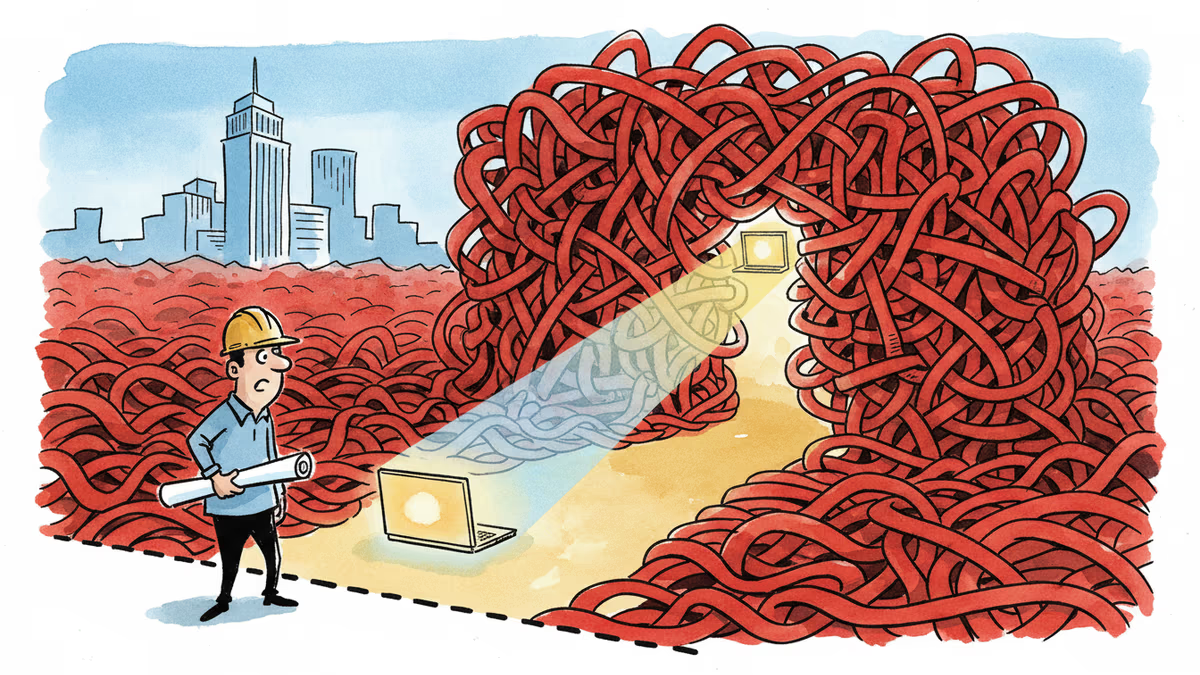
The 3-Year Void Before Construction Begins — Google X Has a Fix
Alphabet's X moonshot factory has spun out Anori, a $26M-funded platform targeting the costly pre-development phase of real estate. But can tech actually fix permitting?
The Most Expensive Phase of Construction Is the One Before It Starts
Nothing has been built yet. Not a wall, not a foundation, not even a hole in the ground. And yet, the money is already bleeding out.
For every major real estate project, there's a window — typically two to four years — between the moment a developer commits to building something and the day the first shovel breaks soil. Industry insiders call it "pre-development." Everyone else just calls it waiting. During that window, architects revise plans, engineers recalculate, lawyers review filings, and city officials compare submitted documents against municipal codes — sequentially, slowly, and at enormous cost. When something doesn't align, the whole carousel reverses.
Astro Teller, the head of Alphabet's X moonshot factory, puts it plainly: this dysfunction is "at least half of why buildings cost so much and nobody's getting what they want out of the built environment."
On Thursday, X announced that Anori — its platform designed to compress this process — has spun out as an independent company with $26 million in funding. The round was led by Prologis, one of the world's largest real estate owners, and Builders VC, a construction-tech-focused firm. X's own spin-out vehicle, Series X Capital, also participated.
Why Permitting Is Broken — and Why It Stays Broken
The dysfunction isn't mysterious. It's structural.
Building a single mid-rise apartment block involves an extraordinary cast: the developer, the architect, structural engineers, geotechnical engineers, insurers, lenders, future operators — all circling each other in what Teller describes as "a ring trying to talk." Wrapped around that ring is a second one: the overlapping regulatory frameworks of city, state, and federal governments, each with its own rules about what can be built, where, and how.
The fatal flaw is sequencing. Today, these parties work in series, not parallel. An architect changes a floor plan; everyone retreats to their corners, recalculates, and reconvenes — sometimes months later. The completed package then goes to the city, which takes another six months to a year just to compare submitted documents against its own codes. If anything is out of compliance, the process resets.
Anori's proposed fix is deceptively simple: bring every stakeholder — including the city — onto a unified platform from day one, so compliance conflicts surface in weeks rather than years. Its initial focus is 3-to-6-story multifamily buildings of 5 to 100 units, the category Teller calls "the most efficient way for people to live" and the one cities most urgently need more of.
Third Time's the Charm — If the Industry Comes With You

This is not X's first attempt at this problem. About 13 years ago, it spun out a company called Vannevar Technologies — later renamed Flux — that tried something similar and failed to gain traction. A second attempt, focused on factory automation for building components, never made it to market.
Teller's diagnosis of those failures is instructive: "We were just too early, and we hadn't solved this particular problem about getting the buy-in."
What's different this time, he argues, is that the industry came to X rather than the other way around. When Anori's team began its standard outreach to industry experts, the response broke from the usual pattern. Normally, Teller says, experts say: "Interesting. Come find us when you're ready." This time: "We want in now."
Representatives from major owner-operators, large architecture firms, and top contractors didn't want to be sold a finished product. They wanted to help build it. That shift in posture is why X is pushing Anori out the door earlier than originally planned — and why making industry players investors rather than future customers was a deliberate strategic choice.
The logic solves a classic two-sided market problem: cities will adopt the platform if developers are on it; developers will adopt it if cities require it. By making Prologis and others financial stakeholders in Anori's success, X has given them a direct incentive to push adoption from both sides.
The same logic underpins Anori's first major public partnership: Rio de Janeiro has signed on to modernize its urban licensing process using the platform. Mayor Eduardo Paes had already made permitting reform a municipal priority before X came calling — making Rio a willing first mover rather than a reluctant test case. (No building has yet been approved through the platform.)
What the Skeptics Will Say
Not everyone in the industry is convinced that software can untangle what is fundamentally a political and institutional problem.
Permitting delays are rarely caused by a lack of coordination tools. They're caused by underfunded planning departments, politically contentious zoning decisions, community opposition, and legal challenges — none of which a shared platform resolves. The city of San Francisco, for instance, has spent years and millions on digital permitting modernization with mixed results, not because the technology was wrong, but because the bureaucratic and political incentives weren't aligned.
There's also the question of who benefits when development accelerates. Prologis — Anori's lead investor — is one of the world's largest warehouse and logistics real estate owners. Faster permitting is unambiguously good for large-scale developers with capital ready to deploy. Whether it translates into more affordable housing for the people who need it most depends on policy decisions that sit well outside Anori's platform.
And then there's the chicken-and-egg problem at the city level. A platform is only as useful as the number of municipalities that adopt it. Rio de Janeiro is a high-profile first partner, but scaling to hundreds of cities — each with different codes, languages, political cultures, and legacy systems — is a challenge that has defeated many well-funded govtech startups before.
The Bigger X Story
Anori is the latest graduate from what Teller calls the "extended X family." Previous alumni include Waymo (self-driving vehicles) and Wing (drone delivery, now expanding to 150 cities in partnership with Walmart). Last year's spin-out was Taara, a wireless optical communications company. Teller says he expects X to graduate roughly two companies per year going forward — though he's quick to add: "It'll be lumpy."
Also notable: the Rio partnership brought together not just Anori but three other X alumni — Taara, Tapestry (AI-powered electrical grid management), and Materra (AI-driven plastic recycling). The city's mayor didn't want one moonshot. He wanted a bundle. That's a different kind of go-to-market strategy than any of these companies would pursue alone — and a signal of how X is thinking about deploying its portfolio at the city scale.
Series X Capital, the spin-out fund run by former YouTube and Facebook CFO Gideon Yu, is currently deploying roughly $500 million through its debut vehicle. Alphabet holds only a minority stake in the fund, keeping spin-outs structurally independent from the parent company.
Authors
Related Articles

Mexico City launched Xoli, a WhatsApp chatbot guiding visitors through 3,000+ daily events ahead of the 2026 FIFA World Cup. Here's what it does, who it's for, and what it might miss.

Smart Bricks raises $5M from a16z to bring Goldman Sachs-level real estate analysis to everyday investors. The proptech revolution is just getting started.

After his $20M-funded home design startup Atmos failed, founder Nick Donahue is back with Drafted, an AI-powered software to solve the same problem. Can lessons from his first failure lead to success?

Samsung Electronics' union branch revealed that 84% of survey respondents oppose the government's roughly $290 billion (₩400 trillion) semiconductor megaproject in Gwangju. Government, management, the union and shareholders are all reading the same national project in sharply different ways.
Mexico City launched Xoli, a WhatsApp chatbot guiding visitors through 3,000+ daily events ahead of the 2026 FIFA World Cup. Here's what it does, who it's for, and what it might miss.
Smart Bricks raises $5M from a16z to bring Goldman Sachs-level real estate analysis to everyday investors. The proptech revolution is just getting started.
After his $20M-funded home design startup Atmos failed, founder Nick Donahue is back with Drafted, an AI-powered software to solve the same problem. Can lessons from his first failure lead to success?
Samsung Electronics' union branch revealed that 84% of survey respondents oppose the government's roughly $290 billion (₩400 trillion) semiconductor megaproject in Gwangju. Government, management, the union and shareholders are all reading the same national project in sharply different ways.
Thoughts
Share your thoughts on this article
Sign in to join the conversation