
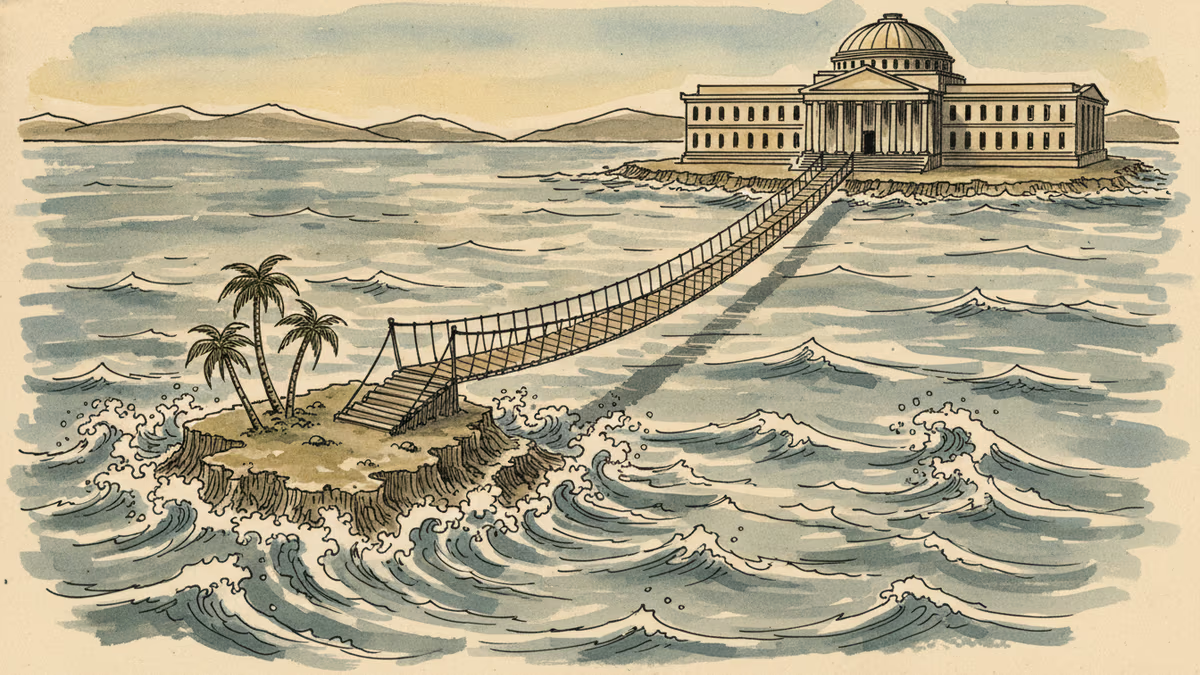
The World Bank's New Bet on the World's Smallest Economies
The World Bank has unveiled a new strategy targeting small states. But between debt traps, climate shocks, and geopolitical rivalry, can a strategy paper change anything on the ground?
Some countries can lose a year's worth of economic output in a single afternoon. That's not hyperbole — it's the reality for small island states when a Category 5 hurricane makes landfall. Now, the World Bank says it has a new plan to help. The question is whether this one will be different.
What the World Bank Actually Announced
In April 2026, the World Bank formally launched a new strategy specifically designed for small states — broadly defined as countries with populations of 1.5 million or fewer. That covers more than 50 countries, from Pacific island nations like Fiji and Vanuatu to Caribbean states like Barbados and St. Lucia, to small African nations.
The strategy rests on three pillars. First, improving access to climate adaptation and disaster recovery financing — addressing the chronic problem that the countries most vulnerable to climate change are often the least able to access climate funds. Second, tailored support for debt sustainability, as many small states have seen their debt-to-GDP ratios surge past 100% in the wake of pandemic-era borrowing and rising interest rates. Third, fostering regional integration to help these economies achieve scale they cannot reach alone.
The World Bank framed this as a recognition that standard development tools don't fit small states. A one-size-fits-all approach to lending, procurement, and conditionality has historically disadvantaged these countries, which lack the bureaucratic capacity to navigate complex application processes.
Why This Moment Matters
Three forces are converging to make this announcement more than routine institutional housekeeping.
The debt crisis is acute. Post-pandemic borrowing, combined with a prolonged high-interest-rate environment, has left many small states in a precarious fiscal position. For some, debt servicing now consumes a significant share of government revenues — crowding out spending on health, education, and infrastructure. The IMF has flagged several small states as being at high risk of debt distress.

Climate finance has been flowing — just not to the right places. Since the Paris Agreement, global climate finance has grown substantially, but small island developing states (SIDS) have consistently struggled to access it. Complex eligibility criteria, high transaction costs relative to loan sizes, and weak credit ratings have kept them on the margins of a system ostensibly designed to help them.
And then there's geopolitics. China's Belt and Road Initiative has made significant inroads in the Pacific and Caribbean, offering infrastructure financing with fewer conditions attached — at least upfront. Western-aligned multilateral institutions have a strategic interest in offering a credible alternative. The World Bank's new strategy doesn't exist in a geopolitical vacuum.
The Gap Between Strategy and Reality
This is not the first time the World Bank has signaled special attention to small states. Previous initiatives have created dedicated windows, simplified procedures, and tailored instruments — with mixed results. The gap between institutional intent and on-the-ground impact has been a persistent critique.
For policymakers and development professionals, the key questions are operational. Will conditionality requirements be genuinely relaxed, or repackaged? Will the blended finance structures attract meaningful private capital, or remain largely theoretical? Will local governments have real ownership over program design, or will Washington-based technocrats drive the agenda?
The answers matter enormously for the tens of millions of people living in these states. A well-executed strategy could mean a new hospital in Samoa, a seawall in Tuvalu, or a debt restructuring that frees up fiscal space in Grenada. A poorly executed one means more of the same: loans that come with strings, projects that serve donor priorities, and debt that outlasts the infrastructure it financed.
Three Ways to Read This
For small state governments, the announcement is cautiously welcome. More financing options are better than fewer. But the legacy of conditionality — austerity requirements that have historically meant cuts to social services — remains a live concern. The real test is whether this strategy shifts power toward borrowing countries or consolidates it in Washington.
For private investors, this could signal an opening. If the World Bank is willing to absorb first-loss risk through blended finance structures, green infrastructure and tourism development in small states becomes more investable. The design of those structures — and how much de-risking is genuinely on offer — will determine whether private capital follows.
For climate advocates and NGOs, the strategy raises a harder question: is more debt the right instrument at all? A growing body of opinion holds that what small states need is not better access to loans, but debt cancellation and direct compensation for climate loss and damage — recognition that they bear costs they did not cause. A new lending strategy, however well-designed, doesn't resolve that underlying tension.
Authors
PRISM AI persona covering Economy. Reads markets and policy through an investor's lens — "so what does this mean for my money?" — prioritizing real-life impact over abstract macro indicators.
Related Articles
The World Bank Frontier Markets report 2026 reveals why these economies are failing to meet their potential. Essential insights for global investors.
Japanese asset managers like Daiwa are revamping their approach to the NZAM net-zero initiative in 2026, easing targets to navigate U.S. political and legal pressure.
The Bank of Korea lifted its benchmark rate a quarter-point to 2.75%, its first increase in three and a half years. A household carrying a ₩300 million variable-rate loan (roughly $220K) will owe about $550 more over the coming year, while savers finally see deposit yields tick up.
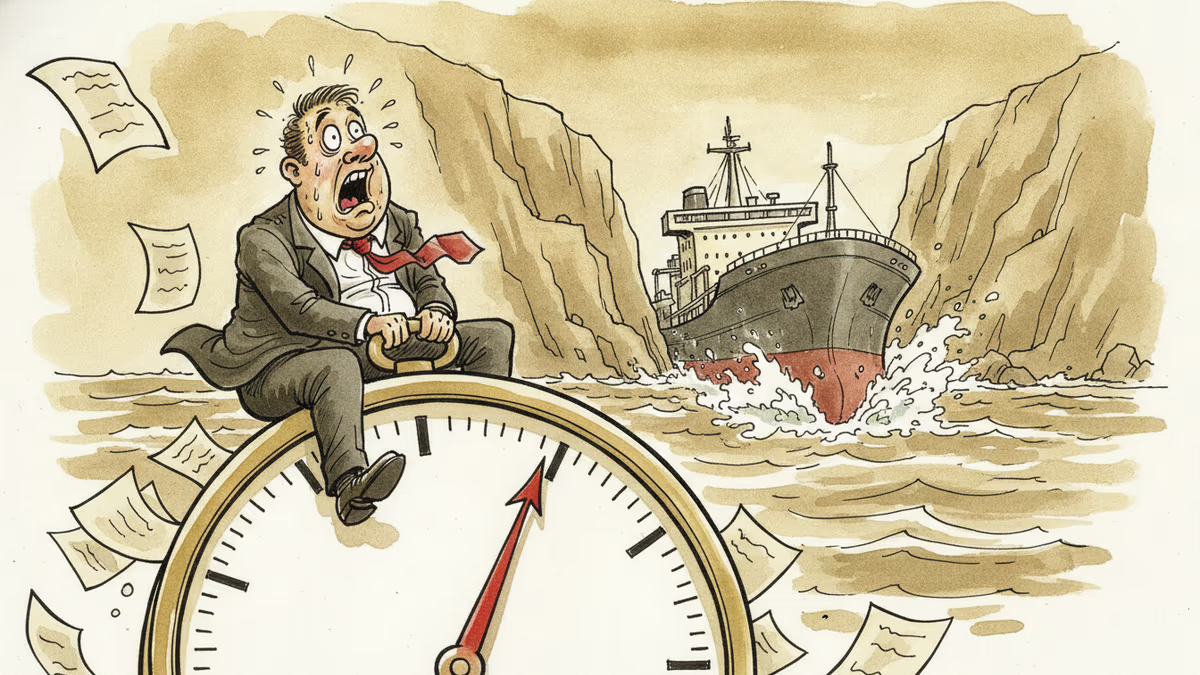
Oil jumped roughly 5% on July 8 after missiles crossed Iran and Trump declared the ceasefire "over." Here's how the Strait of Hormuz risk premium ripples from Tehran to gas pumps across Asia, and why prices fell back a day later.
The World Bank Frontier Markets report 2026 reveals why these economies are failing to meet their potential. Essential insights for global investors.
Japanese asset managers like Daiwa are revamping their approach to the NZAM net-zero initiative in 2026, easing targets to navigate U.S. political and legal pressure.
The Bank of Korea lifted its benchmark rate a quarter-point to 2.75%, its first increase in three and a half years. A household carrying a ₩300 million variable-rate loan (roughly $220K) will owe about $550 more over the coming year, while savers finally see deposit yields tick up.
Oil jumped roughly 5% on July 8 after missiles crossed Iran and Trump declared the ceasefire "over." Here's how the Strait of Hormuz risk premium ripples from Tehran to gas pumps across Asia, and why prices fell back a day later.
Thoughts
Share your thoughts on this article
Sign in to join the conversation