
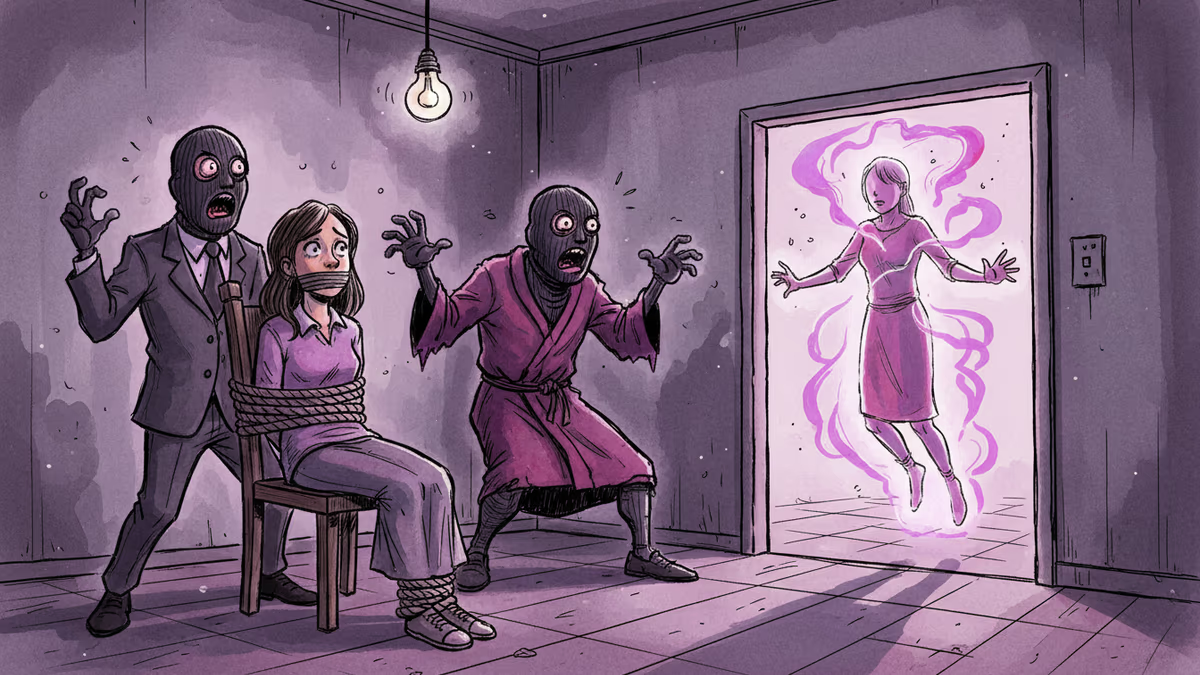
The WONDERfools Ep. 1: Dead on Arrival—Then Alive Again
Park Eun-bin and Cha Eun-woo's new K-drama The WONDERfools launches with a Y2K superhero premise. Does the first episode deliver on its wild concept?
What do you do when your elaborate money-making scheme kills you before it even begins?
That's the question at the heart of The WONDERfools, the new K-drama that premiered May 15, 2026, starring Park Eun-bin and Cha Eun-woo. Set in the final months of 1999—when the world was bracing for Y2K and doomsday preachers roamed the streets—the show opens with a premise that's equal parts dark comedy and superhero origin story. Equal parts, that is, in theory. Episode 1 leans heavier on the dark than the comedy.
The Plan, the Death, and the Comeback
EUN CHAE-NI (Park Eun-bin) is 27, unemployed, and running out of time—literally. She has congestive heart failure, and her doctor has essentially told her to get her affairs in order. While Y2K survivalists hand out flyers about the apocalypse, Chae-ni has her own countdown ticking. Her one wish: to travel. The price tag: 50 million won.
Her grandmother won't fund the trip. Her best friend KANG RO-BIN (Im Sung-jae)—a perpetual pushover who just drained his savings on apartment repairs—doesn't have it either. So Chae-ni hatches a plan: a fake kidnapping. She recruits Ro-bin and the neighborhood's loudest complainer, SOHN KYEONG-HOON (Choi Dae-hoon), promising each 5 million won to play her captors while she extorts ransom from her family.
The plan collapses before it starts. Tied to a chair in an abandoned space, Chae-ni's heart gives out. She dies before anyone can call for help.
Panicking, Kyeong-hoon and Ro-bin decide to dump the body at the local illegal waste site—the one Kyeong-hoon ironically spends his days filing complaints about. That night, LEE WOON-JEONG (Cha Eun-woo), a new civil servant quietly investigating a string of disappearances, happens to be at the same dump. In the chaos that follows, Chae-ni's body rolls into a pool of toxic black sludge. When police arrive minutes later, Chae-ni is standing there, very much alive.
The episode's final reveal: Woon-jeong isn't just a diligent bureaucrat. During an earlier run-in with Chae-ni at a grocery store—where their shopping carts collided and knives went flying—he used telekinesis to redirect the sharp objects away from her head. Nobody noticed. He's been hiding it.

Why 1999, and Why It Actually Works
The Y2K setting isn't just nostalgia bait. It's structural.
In a world without smartphones, CCTV networks, or social media, a person with superpowers has a fighting chance of staying hidden. The information blackout of pre-internet rural Korea means Woon-jeong's secret investigation into Dr. HA WON-DO—a disgraced scientist who conducted illegal human experiments at an orphanage decades ago—can plausibly go undetected. The toxic sludge that seems to be transforming homeless men into something inhuman connects back to Dr. Ha's work, and the hooded figures levitating through the night suggest the conspiracy is very much ongoing.
The era also gives Chae-ni's desperation a specific texture. The 1997 Asian financial crisis had gutted South Korea's job market by 1999, and a 27-year-old woman with a spotty resume and a terminal illness wouldn't just be unlucky—she'd be invisible to the system entirely. Her nihilism isn't a character quirk; it's a rational response to a society that had already written her off.
K-drama has rarely tackled the superhero genre head-on. Powers tend to appear as romantic devices—the immortal in Goblin, the webtoon character in W, the memory-eraser in My Lovely Liar. The WONDERfools appears to be positioning superpowers as the actual engine of its plot, not the garnish. Whether that ambition holds is the central question hanging over the remaining episodes.
What Episode 1 Gets Right—and What It's Still Building
Park Eun-bin is one of the few actors working in K-drama today who can make a character simultaneously exasperating and deeply sympathetic. Her Chae-ni is reckless, self-destructive, and stubborn—but the small moments reveal a woman who refuses to guilt-trip her grandmother about her illness even when it would get her exactly what she wants. That restraint, buried under layers of chaos, is what makes the character worth following.
Cha Eun-woo's Woon-jeong is a more deliberate construction. Quiet, precise, apparently stable—but his apartment tells a different story: furniture removed or taped down, documents spread across the floor, a man clearly operating on the edge of something. The role asks for a kind of controlled unraveling that's different from anything in his previous work, and episode 1 only gives us the surface.
The show's stated genre is comedy, and that's where the first episode creates friction. The humor is sparse for a show marketed as a comedic romp. The color palette is muted, almost melancholic. The 1999 setting is gestured at—old phones, Y2K pamphlets—but not fully inhabited visually. The four main characters are introduced efficiently, but they're still operating as archetypes: the reckless leader, the bumbling sidekicks, the mysterious outsider. The hints of complexity are there. The space to develop them hasn't opened yet.
That's not necessarily a problem. Many strong ensemble comedies spend their first episode building the architecture before the jokes can land. The question is whether The WONDERfools is deliberately pacing itself or still finding its rhythm.
This content is AI-generated based on source articles. While we strive for accuracy, errors may occur. We recommend verifying with the original source.
Related Articles
MBC's action-comedy Fifties Professionals introduces Kwon Yul as an unpredictable new antagonist. Here's why this drama's premise matters beyond the casting news.
tvN's Spooky in Love teaser drops with Park Eun Bin as a ghost-seeing hotel heiress. Behind the occult romance lies a calculated industry strategy worth unpacking.
JTBC's Reborn Rookie pairs veteran actor Son Hyun Joo with idol-turned-actor Lee Jun Young in a body-swap drama. A look at the genre's industrial logic and what it signals about Korean TV's audience strategy.
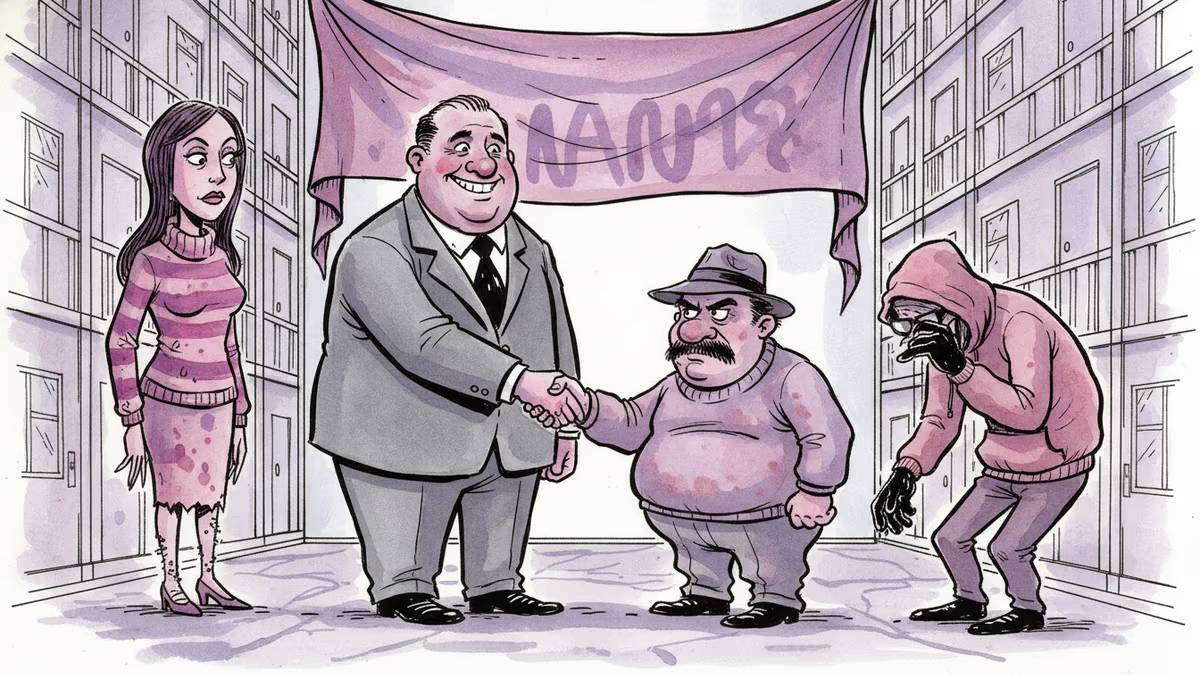
JTBC's upcoming comedy crime drama Apartment casts Ji Sung, Ha Yoon-kyung, Park Byung-eun, and Moon Sori in a story where an ex-gangster enters a residents' committee election. What does the project reveal about JTBC's 2026 strategy?
MBC's action-comedy Fifties Professionals introduces Kwon Yul as an unpredictable new antagonist. Here's why this drama's premise matters beyond the casting news.
tvN's Spooky in Love teaser drops with Park Eun Bin as a ghost-seeing hotel heiress. Behind the occult romance lies a calculated industry strategy worth unpacking.
JTBC's Reborn Rookie pairs veteran actor Son Hyun Joo with idol-turned-actor Lee Jun Young in a body-swap drama. A look at the genre's industrial logic and what it signals about Korean TV's audience strategy.
JTBC's upcoming comedy crime drama Apartment casts Ji Sung, Ha Yoon-kyung, Park Byung-eun, and Moon Sori in a story where an ex-gangster enters a residents' committee election. What does the project reveal about JTBC's 2026 strategy?
Thoughts
Share your thoughts on this article
Sign in to join the conversation