

Finale Fever: What 'Perfect Crown's' Ratings Surge Really Tells Us
MBC's 'Perfect Crown' and 'My Royal Nemesis' both hit all-time ratings highs on the same day. Behind the numbers lies a story about how linear TV survives in the streaming era.
The best way to get people to watch your show? Make them wait for the ending.
MBC's romance drama Perfect Crown hit its all-time viewership high on May 16, the day before its series finale aired. According to Nielsen Korea, it was the most-watched program of any genre on Korean television that Friday. In a twist that network schedulers rarely get to enjoy, MBC's other ongoing romance, My Royal Nemesis, broke its own viewership record on the exact same night. Two shows, one broadcaster, one evening—both peaking simultaneously.
The Streaming Era's Unlikely Counterargument
To understand why this matters, it helps to know what these two dramas were up against. The spring 2026 K-drama landscape has been dominated by high-budget prestige productions on Netflix and Tving, platforms that deploy simultaneous global releases and recommendation algorithms as their primary weapons. In that environment, a linear broadcast romance drama fighting for Friday night eyeballs looks, on paper, like a losing proposition.
And yet. Perfect Crown topped the entire Friday lineup. That's not just a win for MBC—it's a data point in an ongoing argument about what linear television still does that streaming doesn't.
Streaming platforms are engineered for binge-watching: drop all episodes at once, let viewers consume on their own schedule, measure success in hours watched rather than concurrent viewers. Linear broadcast dramas work on the opposite logic. Two episodes a week, a cliffhanger every 60 minutes, and a built-in social media cycle where viewers process each episode together in real time before the next one arrives. The anticipation is the product.

Why Two Shows Peak on the Same Night
MBC's scheduling strategy this spring wasn't accidental. Pairing Perfect Crown—a more conventional melodrama—with My Royal Nemesis, which blends romance with fantasy and period elements, was a calculated attempt to hold different viewer segments in the same timeslot rather than splitting them across competing channels. The bet: if the two shows appeal to overlapping but distinct audiences, MBC effectively owns Friday evening.
It worked. But the strategy carries a structural risk that networks rarely discuss publicly: if one show underperforms early in the season, it can drag down the paired title's momentum and create a scheduling hole that's hard to fill mid-run. The fact that both shows are exiting strong suggests MBC threaded that needle cleanly this cycle—though replicating it next season is far from guaranteed.
The 'Wait-and-Confirm' Viewer
There's a specific Korean viewing behavior that helps explain the finale ratings spike, and it's one that streaming executives have spent years trying to engineer around. A significant portion of Korean drama viewers hold off on committing to a show until they've confirmed it ends well. Spoiler culture and social media have made it easy to check whether a drama's finale is satisfying before investing 16 weeks of weekly viewing. When a show builds a reputation for sticking the landing, late-arriving viewers flood in for the final episodes—pushing ratings to their peak precisely when the story is ending.
This is the inverse of how Netflix thinks about viewership. The platform's all-at-once release model is partly designed to short-circuit this psychology: if everything is available immediately, there's no 'wait and confirm' phase, just a decision to start or not. Linear broadcast dramas can't eliminate the wait—so they've learned to weaponize it instead.
This content is AI-generated based on source articles. While we strive for accuracy, errors may occur. We recommend verifying with the original source.
Related Articles

MBC's action-comedy Fifties Professionals introduces Kwon Yul as an unpredictable new antagonist. Here's why this drama's premise matters beyond the casting news.
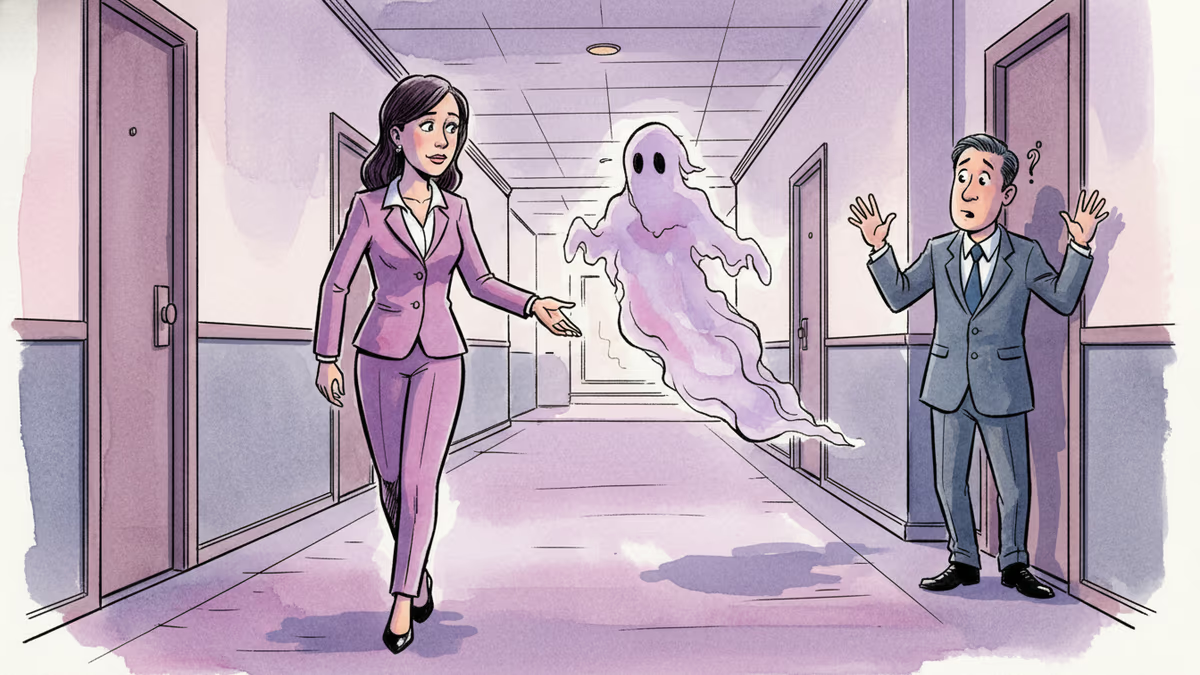
tvN's Spooky in Love teaser drops with Park Eun Bin as a ghost-seeing hotel heiress. Behind the occult romance lies a calculated industry strategy worth unpacking.

JTBC's Reborn Rookie pairs veteran actor Son Hyun Joo with idol-turned-actor Lee Jun Young in a body-swap drama. A look at the genre's industrial logic and what it signals about Korean TV's audience strategy.

JTBC's upcoming comedy crime drama Apartment casts Ji Sung, Ha Yoon-kyung, Park Byung-eun, and Moon Sori in a story where an ex-gangster enters a residents' committee election. What does the project reveal about JTBC's 2026 strategy?
MBC's action-comedy Fifties Professionals introduces Kwon Yul as an unpredictable new antagonist. Here's why this drama's premise matters beyond the casting news.
tvN's Spooky in Love teaser drops with Park Eun Bin as a ghost-seeing hotel heiress. Behind the occult romance lies a calculated industry strategy worth unpacking.
JTBC's Reborn Rookie pairs veteran actor Son Hyun Joo with idol-turned-actor Lee Jun Young in a body-swap drama. A look at the genre's industrial logic and what it signals about Korean TV's audience strategy.
JTBC's upcoming comedy crime drama Apartment casts Ji Sung, Ha Yoon-kyung, Park Byung-eun, and Moon Sori in a story where an ex-gangster enters a residents' committee election. What does the project reveal about JTBC's 2026 strategy?
Thoughts
Share your thoughts on this article
Sign in to join the conversation