
IU's Rifle Scene Reveals What 'Perfect Crown' Is Really About
MBC's Perfect Crown shows IU pointing a rifle at a Grand Duke in an alternate Korea ruled by a constitutional monarchy. What the casting and premise reveal about K-drama's class anxiety.
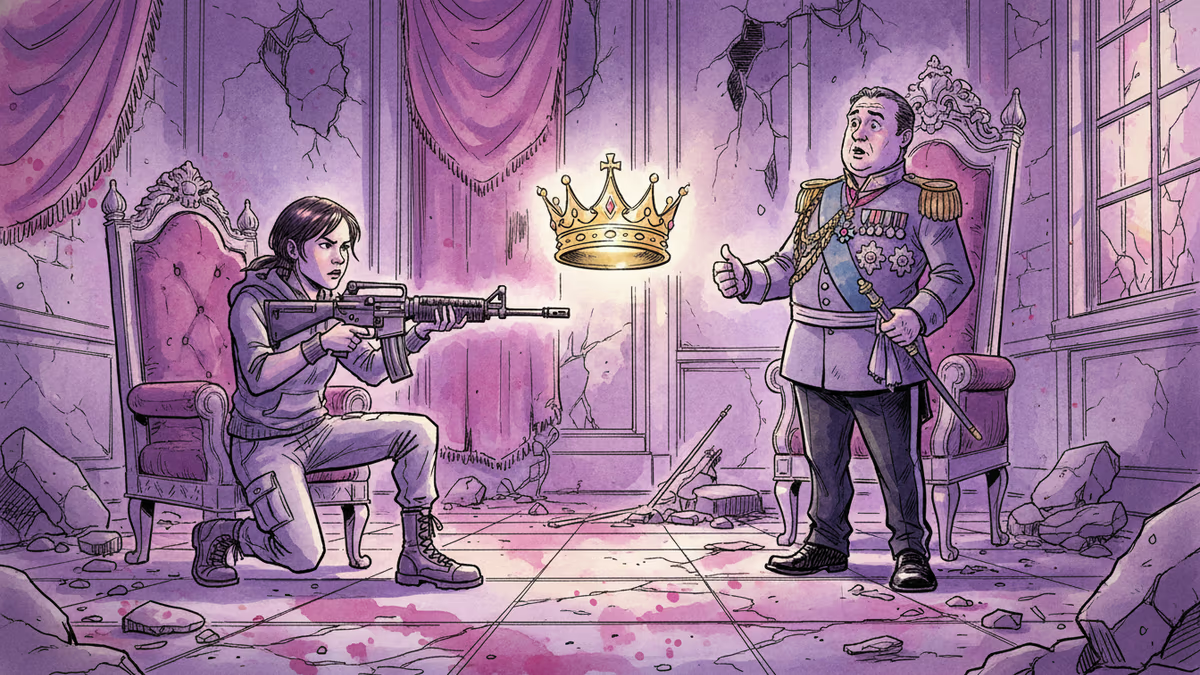
A chaebol heiress pointing a rifle at a Grand Duke. That's the image MBC's Perfect Crown chose to tease its central romance — and it says more about where K-drama is headed than any press release could.
The newly released stills show IU as Seong Hui Ju, a wealthy heir to one of Korea's most powerful conglomerates, training a weapon on the royal male lead played by Noh Sang Hyun. The setting: an alternate present-day Korea that never abolished its monarchy. The twist: in this world, all the money in the world still can't buy you a noble title.
The Constitutional Monarchy Premise — And Why It Keeps Coming Back
K-drama has visited the monarchy fantasy before. The King: Eternal Monarch (2020) built a parallel-universe Korean Empire around Lee Min-ho. King the Land (2023) blended royal aesthetics with chaebol power. Both were criticized for using the monarchy as little more than a costume — a backdrop for romance rather than a genuine interrogation of hierarchy.
Perfect Crown enters the same genre with a structurally sharper premise: what if old-money status and new-money wealth were placed in direct conflict, with wealth losing? That's a meaningful shift. For the past decade, K-drama's class narratives have placed chaebol families at the apex of every social pyramid — objects of aspiration in Heirs (2013), targets of critique in Reborn Rich (2022), but always at the top. Seong Hui Ju is rich and powerless. That inversion is the show's most interesting move.
The timing matters too. Korean audiences have spent the past two years watching real-world institutions destabilize in ways that felt unscripted. Counterfactual premises — what if the system were different? — tend to gain cultural traction when the existing system feels unreliable. The monarchy fantasy isn't nostalgia. It's a mirror held up at an angle.
IU's Choice: Why MBC Over Netflix?

IU's last drama was Hotel Del Luna in 2019 — over six years ago. In the intervening period, she released albums, headlined sold-out concert tours, and appeared in the film Dream (2023). Her return to television was always going to be a signal.
The signal she sent is a complicated one. In 2026, MBC is structurally disadvantaged against Netflix, Disney+, and Tving in terms of global distribution. Netflix's same-quarter releases — including the widely streamed When Life Gives You Tangerines — benefit from algorithmic reach across 190 countries. A broadcast network drama, however well-made, doesn't get that pipeline.
For a performer of IU's caliber, that's a deliberate trade-off. One reading: she prioritized creative control over maximum exposure. Netflix's content deals increasingly involve IP ownership clauses and season commitments that give platforms significant leverage over talent. Choosing MBC may be a way of retaining the kind of authorship over her image that has defined her career. Another reading: the project simply offered the right role at the right time, and the platform was secondary.
Either way, the choice repositions IU outside the OTT-first logic that has dominated Korean drama casting since 2021. Whether that gamble pays off in international viewership numbers will be worth watching.
The Class Inversion at the Heart of the Show
The rifle scene isn't just a tension-building teaser. It's a visual thesis statement. A commoner — even a fabulously wealthy one — threatening a member of the royal family is a specific kind of image to put in a romance drama's promotional material.
K-drama has long been fluent in the language of class fantasy, but the fantasy has usually run in one direction: ordinary person gets access to elite world, falls in love, earns belonging. Perfect Crown runs the fantasy differently. The protagonist already has economic capital. What she lacks is symbolic capital — the kind that can't be purchased. That gap is where the story lives.
This maps onto anxieties that Korean audiences recognize from lived experience: elite university admissions that money alone can't guarantee, social networks that remain closed regardless of wealth, a growing sense that the rules of upward mobility have quietly changed. Dressing those anxieties in a monarchy costume doesn't neutralize them — it amplifies them through a safe fictional distance.
This content is AI-generated based on source articles. While we strive for accuracy, errors may occur. We recommend verifying with the original source.
Related Articles

MBC's action-comedy Fifties Professionals introduces Kwon Yul as an unpredictable new antagonist. Here's why this drama's premise matters beyond the casting news.
tvN's Spooky in Love teaser drops with Park Eun Bin as a ghost-seeing hotel heiress. Behind the occult romance lies a calculated industry strategy worth unpacking.

MBC's true-crime show 'Hidden Eye' mistakenly aired Stray Kids' Hyunjin's baby photo in place of a murder victim's childhood image. Five months later, an apology. What does that timeline reveal?

MBC's Perfect Crown held the No. 1 spot on Korea's buzz rankings even in its final week on air, with Park Ji Hoon topping the actor chart. Here's what the numbers reveal about the K-drama market right now.
MBC's action-comedy Fifties Professionals introduces Kwon Yul as an unpredictable new antagonist. Here's why this drama's premise matters beyond the casting news.
tvN's Spooky in Love teaser drops with Park Eun Bin as a ghost-seeing hotel heiress. Behind the occult romance lies a calculated industry strategy worth unpacking.
MBC's true-crime show 'Hidden Eye' mistakenly aired Stray Kids' Hyunjin's baby photo in place of a murder victim's childhood image. Five months later, an apology. What does that timeline reveal?
MBC's Perfect Crown held the No. 1 spot on Korea's buzz rankings even in its final week on air, with Park Ji Hoon topping the actor chart. Here's what the numbers reveal about the K-drama market right now.
Thoughts
Share your thoughts on this article
Sign in to join the conversation