

Filing for Love" Nearly Doubles to 9.4% — Who's Really Winning This Drama Season?
Week of May 4–10 ratings show Perfect Crown holding at 13.3%, but Filing for Love's near-doubling to 9.4% in six episodes is the real story. What it tells us about how Korean drama success is measured in 2026.
Six episodes in, Filing for Love nearly doubled its ratings in a single week — from the low 5% range to 9.4% on Sunday, May 10. Meanwhile, the show everyone assumed was running away with the season, Perfect Crown, quietly posted its series high of 13.3% and may be heading toward its finale. Spring 2026's drama landscape just got a lot more interesting.
The Numbers, Laid Out
The week of May 4–10 produced some of the clearest movement this season has seen. Here's what the data actually shows:
Perfect Crown (MBC) hit 11.7% on Friday and 13.3% on Saturday — its highest numbers yet, cementing its position as the dominant terrestrial drama of the first half of 2026. But with episode 10 in the books, the finale window is approaching, and the question of what fills that vacuum matters.
Recipe for Love (KBS) posted 14.3% on Sunday with its 30th episode. A weekend family drama sustaining 14% past its 30th hour is a reminder that Korea's older, TV-first viewing demographic hasn't gone anywhere, regardless of how much industry conversation centers on OTT.
Yumi's Cells 3 (tvN) wrapped its finale at 2.5% — a series high, but still a modest number by any conventional measure. The more interesting story is structural: this is a three-season adaptation of a webtoon IP that first aired in 2021, making it roughly a five-year franchise run. Low ratings, loyal niche — it's a long-tail content model that looks more like streaming logic than broadcast logic.
My Royal Nemesis (SBS) opened to 4.1% and 5.4% in its first two episodes. Solid, not spectacular. It's now in direct weekend competition with Filing for Love, which makes the next two to three weeks a genuine test for both.
The Scarecrow (ENA) climbed to 6.3% and 7.4% across episodes 5 and 6. For ENA — a channel that barely registered before Extraordinary Attorney Woo put it on the map in 2022 — consistently clearing 7% is meaningful territory.

Why Filing for Love's Jump Deserves Closer Attention
A 3.5 percentage point single-day spike from Saturday to Sunday isn't typical for cable dramas. What's driving it?
The most straightforward explanation is competitive positioning. Perfect Crown is winding down. When the weekend's dominant show exits, its audience doesn't disappear — it migrates. Filing for Love is the most logically adjacent destination: same weekend slot, similar romantic tone, already building momentum.
But there's a platform layer worth unpacking. tvN has been deepening its simultaneous release architecture with Tving, CJ ENM's streaming arm, since 2025. That means the broadcast rating is increasingly a partial signal — it captures live and same-day viewing but misses a growing share of catch-up and streaming consumption. If Filing for Love has been quietly accumulating Tving views ahead of its broadcast spike, the 9.4% may be confirming what streaming data already suggested.
There's also a seasonal pattern. Late spring — particularly May — has historically been a mild tailwind for light romantic dramas in Korea. Whether this show is riding that current or generating its own momentum will become clearer once Perfect Crown is off the board and there's no longer a ratings ceiling above it.
The Measurement Problem Nobody Wants to Solve
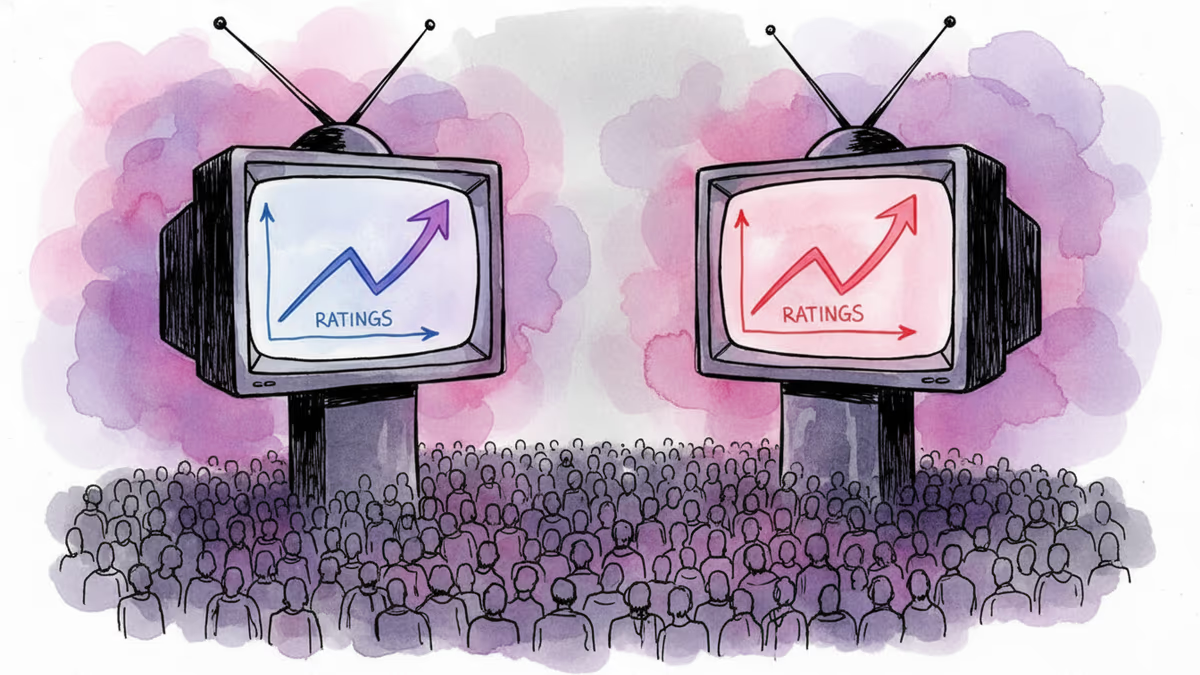
Look at this week's leaderboard and you'll notice something structurally odd. Recipe for Love at 14.3% and Filing for Love at 9.4% are ranked by the same metric, but they represent almost entirely different viewer behaviors.
The KBS weekend drama number captures a specific, well-understood thing: older viewers, television sets, real-time viewing. The tvN number captures something murkier — a blend of live broadcast, same-day replay, and whatever fraction of Tving streaming gets folded into the official count. The industry hasn't standardized a unified viewership metric that accounts for this, and the gap between what ratings measure and what actual content consumption looks like keeps widening.
This isn't just an academic problem. It shapes which shows get renewed, which formats attract investment, and how international buyers — particularly Netflix and Disney+, who are always watching the Korean market for acquisition targets — assess a show's commercial value. A drama that rates 6% on broadcast but drives significant OTT traffic may be worth more than a 10% broadcast hit with minimal streaming legs. The current reporting infrastructure doesn't make that distinction visible.
Next week brings two new entries — Azure Spring (MBN) and The Legend of Kitchen Soldier — both short-form miniseries formats that will likely be judged more by streaming metrics than broadcast ratings from the start. Their opening numbers will be another data point in the ongoing negotiation over what "success" means in Korean drama in 2026.
This content is AI-generated based on source articles. While we strive for accuracy, errors may occur. We recommend verifying with the original source.
Related Articles

tvN's Spooky in Love teaser drops with Park Eun Bin as a ghost-seeing hotel heiress. Behind the occult romance lies a calculated industry strategy worth unpacking.

tvN's Spooky in Love casts Park Eun Bin as a ghost-seeing hotel heiress in a remake of the 2011 film Spellbound. Here's what the casting and genre choice reveal about K-drama's evolving formula.

tvN's occult romance remake "Spooky in Love" stars Park Eun Bin as a ghost-seeing hotel heiress. What does this 2011 film adaptation tell us about K-drama's genre strategy in 2026?
tvN's 'The Legend of Kitchen Soldier' and ENA's 'The Scarecrow' both broke their own viewership records on May 19. What does a simultaneous peak tell us about where Korean TV is heading?
tvN's Spooky in Love teaser drops with Park Eun Bin as a ghost-seeing hotel heiress. Behind the occult romance lies a calculated industry strategy worth unpacking.
tvN's Spooky in Love casts Park Eun Bin as a ghost-seeing hotel heiress in a remake of the 2011 film Spellbound. Here's what the casting and genre choice reveal about K-drama's evolving formula.
tvN's occult romance remake "Spooky in Love" stars Park Eun Bin as a ghost-seeing hotel heiress. What does this 2011 film adaptation tell us about K-drama's genre strategy in 2026?
tvN's 'The Legend of Kitchen Soldier' and ENA's 'The Scarecrow' both broke their own viewership records on May 19. What does a simultaneous peak tell us about where Korean TV is heading?
Thoughts
Share your thoughts on this article
Sign in to join the conversation