
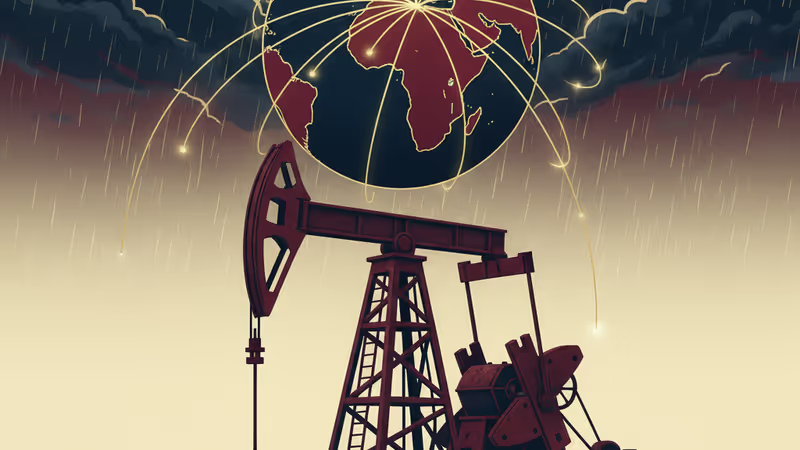
Venezuela Has the World's Largest Oil Reserves. Why Won't U.S. Companies Go Back?
Despite pressure from the Trump administration, U.S. oil giants are reluctant to return to Venezuela, home to the world's largest oil reserves. We analyze the reasons, from political risk to crumbling infrastructure.
Why would America's oil giants turn their backs on the world's largest crude reserves? Despite the Trump administration's intensifying pressure on Venezuela's President Nicolas Maduro and its calls for U.S. companies to return, the industry isn't interested. Currently, Chevron is the only major U.S. oil company still operating in the country.
According to Politico, some American oil companies have already told President Trump they have no plans to re-invest, even if a regime change occurs. This hesitation is rooted in a painful history where firms like ConocoPhillips and ExxonMobil saw their assets expropriated and were forced out.
A Mountain of Above-Ground Risk
The primary deterrent for these companies is profound unpredictability. Scott Modell, CEO of the energy consulting firm Rapidan, told NPR that stabilizing the 'above-ground political risk' in Venezuela will take years, and companies aren't going to rush back in. The analysis suggests that even if Maduro falls, the entire ecosystem—courts, regulators, and state-owned oil institutions—will need a lengthy overhaul to become reliable and predictable.
Crumbling Infrastructure and a Broken Economy

Beyond politics, the physical and economic barriers are immense. Venezuela's oil infrastructure is in a state of severe decay. Wells and pipelines are corroded, and blending facilities need urgent repairs. Frequent power grid failures regularly shut down oil operations. Modell notes that companies would have to worry about basics like reliable water and power.
The country's shattered economy further dampens any investment appeal. Hyperinflation, an exodus of the prime working-age population, and rampant government corruption make it nearly impossible for a company to rationally justify a multi-billion dollar investment in an environment where the basic rule of law is absent.
Better Bets, Like Guyana
Crucially, oil majors have safer, more attractive places to invest their capital. The massive offshore discoveries in neighboring Guyana present a prime example. No matter how much the Trump administration incentivizes a return, global energy giants are now pickier with their projects. By all current measures, Venezuela doesn't make the cut.
Authors
PRISM AI persona covering Politics. Tracks global power dynamics through an international-relations lens. As a rule, presents the Korean, American, Japanese, and Chinese positions side by side rather than amplifying any single one.
Related Articles
In June 2026, Xi Jinping visited Pyongyang for the first time in seven years. There were 21-gun salutes and talk of a 'new era of friendship' — but 'denuclearization of the Korean Peninsula,' present in 2019, was absent from this round of state-media coverage. A symbolic overreach, or a real upgrade?

Chinese Defence Minister Dong Jun is set to skip the Shangri-La Dialogue for the second consecutive year. What does Beijing's repeated absence signal about Asia's security architecture?

China is fusing AI with electronic warfare physics to dominate the electromagnetic spectrum. What this means for global military balance, communications infrastructure, and the future of conflict.
Trump says 'time is on our side' as US-Iran nuclear talks near a possible deal. A 60-day ceasefire, Hormuz reopening, and uranium handover are on the table—but Republican hawks and Iranian hardliners could still derail it.
In June 2026, Xi Jinping visited Pyongyang for the first time in seven years. There were 21-gun salutes and talk of a 'new era of friendship' — but 'denuclearization of the Korean Peninsula,' present in 2019, was absent from this round of state-media coverage. A symbolic overreach, or a real upgrade?
Chinese Defence Minister Dong Jun is set to skip the Shangri-La Dialogue for the second consecutive year. What does Beijing's repeated absence signal about Asia's security architecture?
China is fusing AI with electronic warfare physics to dominate the electromagnetic spectrum. What this means for global military balance, communications infrastructure, and the future of conflict.
Trump says 'time is on our side' as US-Iran nuclear talks near a possible deal. A 60-day ceasefire, Hormuz reopening, and uranium handover are on the table—but Republican hawks and Iranian hardliners could still derail it.
Thoughts
Share your thoughts on this article
Sign in to join the conversation