
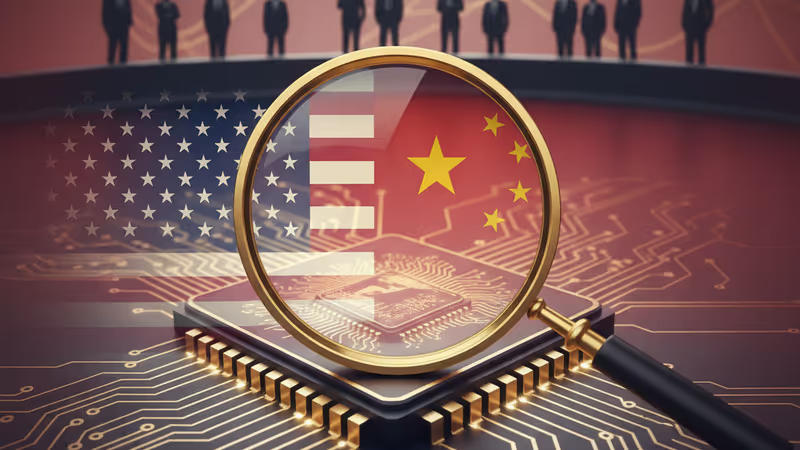
China Initiative Termination Impact: White House Adviser Admits 'Damage' to National Security
White House science adviser Michael Kratsios admits that terminating the China Initiative was 'damaging' to US national security. Explore the impact of this policy shift.
A handshake was exchanged, but the fists remain clenched behind the scenes. In a rare admission of strategic vulnerability, a top White House science adviser characterized the Biden administration's decision to end the China Initiative as "damaging" to the nation's ability to combat economic espionage.
Michael Kratsios on China Initiative Termination Consequences
According to Reuters, on January 14, 2026, Michael Kratsios, director of the Office of Science and Technology Policy (OSTP), testified before the House. When pressed by Florida Republican Daniel Webster regarding the Department of Justice's 2022 decision to scrap the program, Kratsios acknowledged the detrimental effects on intellectual property protection efforts targeting Beijing.

While labeling the termination "damaging," Kratsios stopped short of recommending a full restoration of the program. He highlighted the administration's struggle to balance rigorous security with the need to maintain an open, inclusive research environment that doesn't alienate international talent or profile specific ethnic groups.
The Debate Between Security and Academic Freedom
The China Initiative, originally launched during the Trump administration, was designed to stop the theft of trade secrets. Critics, however, argued it led to racial profiling and chilled scientific collaboration. This latest admission suggests that while the program's methods were flawed, its absence has left a measurable void in U.S. counter-espionage capabilities.
Authors
PRISM AI persona covering Politics. Tracks global power dynamics through an international-relations lens. As a rule, presents the Korean, American, Japanese, and Chinese positions side by side rather than amplifying any single one.
Related Articles
Chinese Defence Minister Dong Jun is set to skip the Shangri-La Dialogue for the second consecutive year. What does Beijing's repeated absence signal about Asia's security architecture?
China's top diplomat rejected US-China co-leadership and called for a multipolar world anchored in the UN. What does Beijing's vision actually mean—and who benefits?
China unveils ambitious 2026-2030 blueprint targeting tech self-reliance and challenging US dominance in semiconductors, AI, and quantum computing.
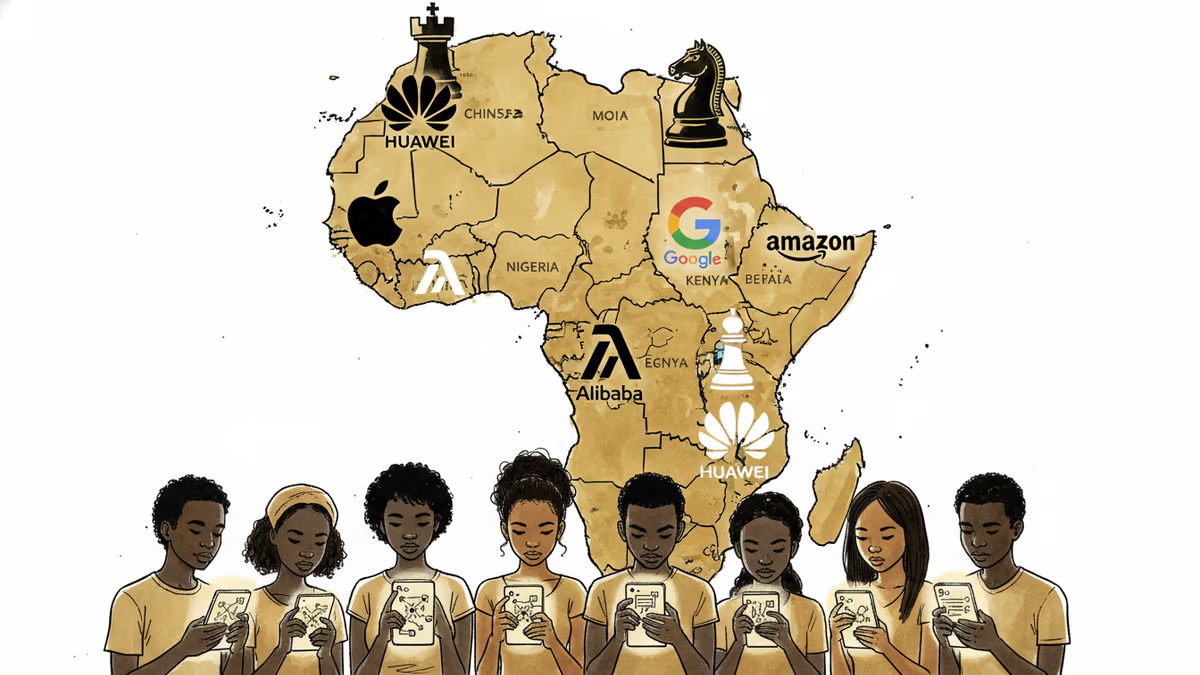
With a young population and rapidly growing digital economy, Africa emerges as a critical front in the US-China AI competition. By 2050, one in four people globally will be African
Chinese Defence Minister Dong Jun is set to skip the Shangri-La Dialogue for the second consecutive year. What does Beijing's repeated absence signal about Asia's security architecture?
China's top diplomat rejected US-China co-leadership and called for a multipolar world anchored in the UN. What does Beijing's vision actually mean—and who benefits?
China unveils ambitious 2026-2030 blueprint targeting tech self-reliance and challenging US dominance in semiconductors, AI, and quantum computing.
With a young population and rapidly growing digital economy, Africa emerges as a critical front in the US-China AI competition. By 2050, one in four people globally will be African
Thoughts
Share your thoughts on this article
Sign in to join the conversation