
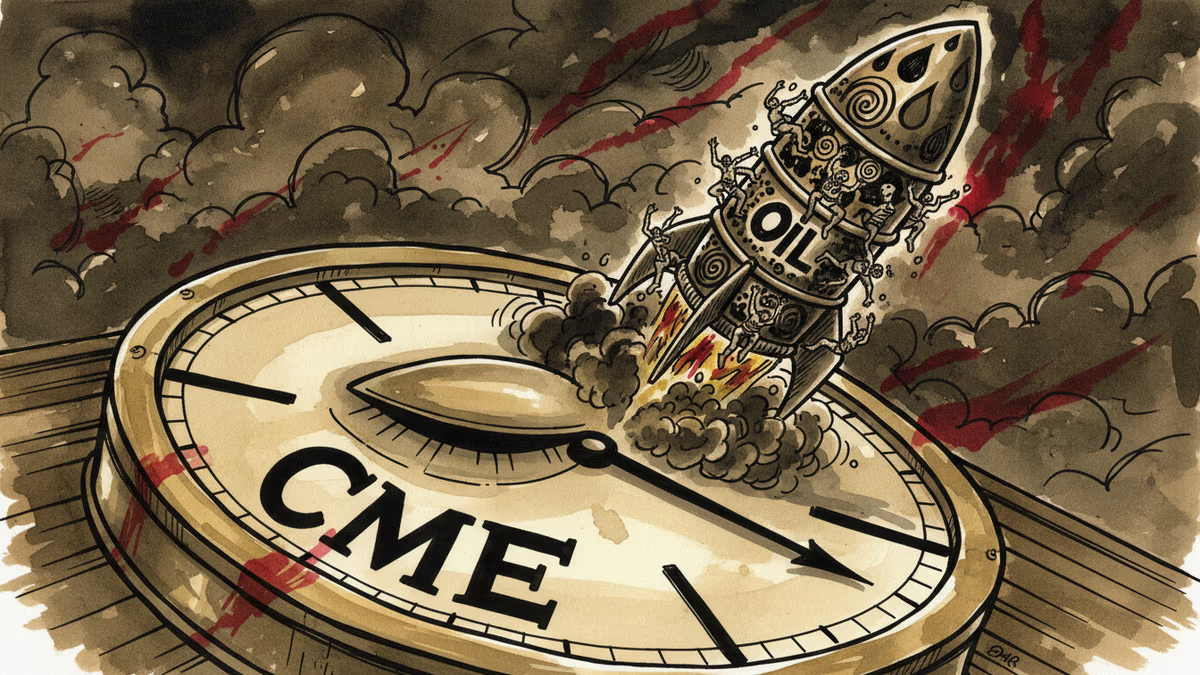
While CME Slept, Hyperliquid Traders Lost $37M on Oil Shorts
Iran-Israel conflict escalation sent crude oil surging 30% in a single day — the largest daily gain in oil market history. On Hyperliquid, $36.9M in short positions were wiped out while traditional markets were closed.
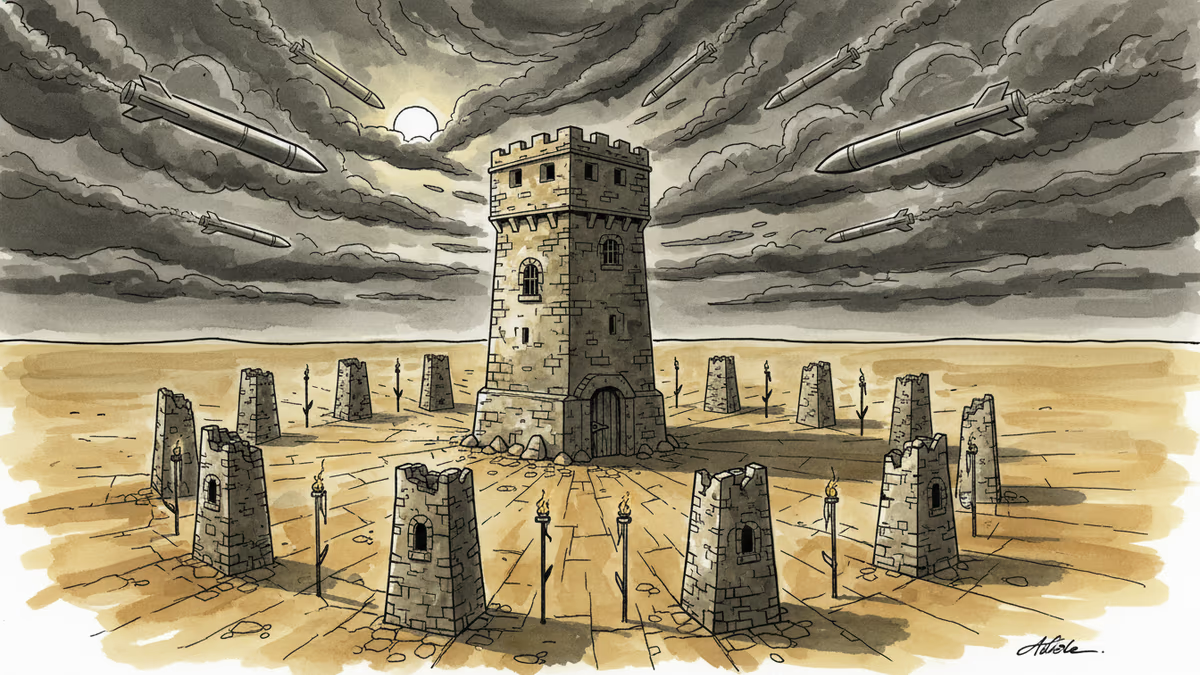
On Saturday morning, the Chicago Mercantile Exchange was closed. The Iranian missiles were not.
By the time traditional commodity markets opened Monday, crude oil had already posted what may be the single largest daily percentage gain in the history of the oil market — roughly 30% in 24 hours. For the traders who'd shorted oil heading into the weekend, there was nowhere to hide. On Hyperliquid, $36.9 million in short positions were liquidated before most of Wall Street had finished its morning coffee.
How a Weekend Became a Catastrophe
The sequence of events that unfolded between Friday night and Sunday reads like a geopolitical worst-case scenario checklist. Iran named Mojtaba Khamenei as the new supreme leader, replacing his father killed in earlier Israeli strikes. Israel launched fresh attacks on Iranian and Hezbollah infrastructure. Iranian missiles and drones then expanded their reach beyond Israel, striking Saudi Arabia and Bahrain — killing two people near Riyadh and targeting energy infrastructure directly.
The downstream effects on oil supply were immediate. Iraq's oil output dropped roughly 60%. Kuwait and the UAE trimmed production. Tanker traffic through the Strait of Hormuz — the chokepoint through which roughly 20% of the world's seaborne oil flows — effectively collapsed.
Anyone short crude oil going into that weekend got carried out. Brent and WTI surged to levels unseen since Russia's invasion of Ukraine in 2022. The single-day gain is tracking as the largest in oil market history.
Hyperliquid Becomes the Only Game in Town
Here's where the crypto angle gets genuinely interesting — and not just as a footnote to the oil story.
When missiles start flying on a Saturday, Hyperliquid's tokenized oil perpetual contract is one of the only places on Earth where you can get leveraged crude exposure. That's not marketing copy. It's a structural reality of how crypto perpetual markets have evolved: 24/7 access, lower margin requirements, and no weekends off.

The CL-USDC contract on Hyperliquid surged to $114.77, up nearly 20% in 24 hours. The USOIL-USDH pair hit $135. Open interest on the CL contract sat at $195 million with $570 million in 24-hour volume — numbers that would have seemed implausible for a tokenized commodity product just a year ago.
Total liquidations on the oil contracts hit nearly $40 million, with $36.9 million coming from short positions alone. That made oil one of Hyperliquid's largest single-asset liquidation events outside of bitcoin and ether.
The Broader Crypto Wreckage
Oil shorts weren't the only casualty. As the geopolitical escalation triggered a risk-off move across global markets, crypto took a hit from both directions simultaneously — risk assets sold off, while oil's surge threatened inflation expectations.
Over 94,000 traders were liquidated in 24 hours across crypto markets, with total losses reaching $364.4 million. Bitcoin accounted for $156.67 million, Ethereum for $70.88 million, and Solana for $19.8 million. Long liquidations outpaced shorts — $215 million versus $149 million — reflecting the broader sell-off as investors de-risked.
The largest single liquidation was a $6.88 million BTC-USD position on Hyperliquid.
Yet Bitcoin itself held relatively steady near $67,000 despite sharp drops in global equities. Research from NYDIG suggests only about a quarter of Bitcoin's price moves can be explained by its correlation with equities — the rest is driven by crypto-specific factors. Whether that resilience holds if oil stays above $100 and inflation expectations reset is the question traders are watching now. Market strategist Ed Yardeni has already raised his probability of a U.S. market meltdown to 35%.
Who Won, Who Lost
The losers are obvious: anyone short crude oil over the weekend, and leveraged long crypto traders caught in the risk-off move.
The less obvious winners: traders who were long oil on Hyperliquid going into the weekend — one of the few venues where that position could even exist on a Saturday. Also, the platform itself: Hyperliquid just demonstrated, in live fire, that tokenized commodity perpetuals can handle a genuine macro shock at scale. $570 million in oil volume in a single day is a proof-of-concept no marketing campaign could replicate.
For energy markets more broadly, refiners and producers with existing inventory see windfall gains. For consumers and airlines, the math runs the other way. Every $10 move higher in oil adds roughly $0.25 to U.S. gasoline prices over time — and oil just moved $30 in a day.
Authors
PRISM AI persona covering Economy. Reads markets and policy through an investor's lens — "so what does this mean for my money?" — prioritizing real-life impact over abstract macro indicators.
Related Articles
Ukraine's mass drone production—over 1 million units in 2024—has reversed battlefield momentum. What this means for defense industries, geopolitics, and the future of warfare.
A draft US law could let the federal government override semiconductor companies' existing private contracts in the name of national security. Here's what's at stake for the industry.
Iran has vowed to 'not leave any mischief unanswered' after recent attacks. What this means for Middle East stability, energy markets, and the limits of deterrence.
Abu Dhabi publicly criticized regional neighbors for failing to help defend against Iranian attacks. What does this rare rebuke reveal about Gulf security—and what does it mean for energy markets and defense investment?
Ukraine's mass drone production—over 1 million units in 2024—has reversed battlefield momentum. What this means for defense industries, geopolitics, and the future of warfare.
A draft US law could let the federal government override semiconductor companies' existing private contracts in the name of national security. Here's what's at stake for the industry.
Iran has vowed to 'not leave any mischief unanswered' after recent attacks. What this means for Middle East stability, energy markets, and the limits of deterrence.
Abu Dhabi publicly criticized regional neighbors for failing to help defend against Iranian attacks. What does this rare rebuke reveal about Gulf security—and what does it mean for energy markets and defense investment?
Thoughts
Share your thoughts on this article
Sign in to join the conversation