
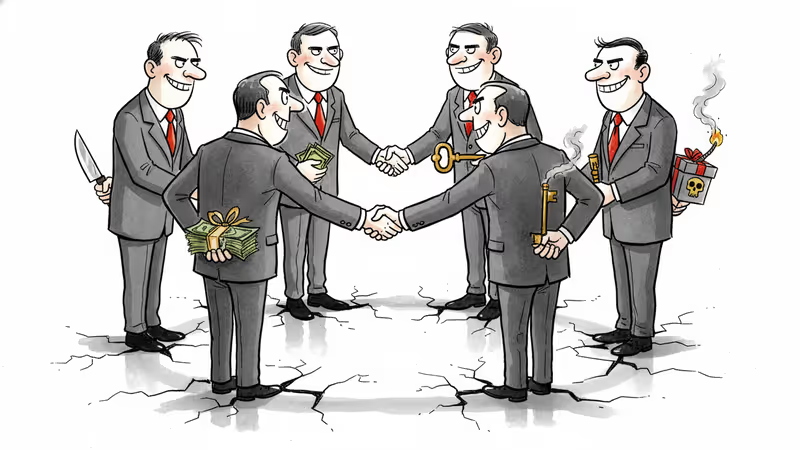
PRISM Weekly Digest: Jan Week 4, 2026 | The Recalibration of Trust
Behind Davos AI investment debates, Jensen Huang's China New Year diplomacy, end of 50-year panda diplomacy, three cracks in digital trust. This week's question: Who and what can we trust?
PRISM Weekly Digest
Fourth Week of January 2026 | The Recalibration of Trust
If one word runs through this week's news, it's "trust."
At Davos, Big Tech CEOs demanded "$1 trillion in AI investment" but couldn't say when it would pay off. Jensen Huang handed out oranges in Shanghai, hinting "this year will be different," while US chip restrictions remain in place. Pandas are leaving Japan after 50 years. Microsoft handed encryption keys to the FBI—the opposite of what Apple did.
The trust equations between corporations and governments, nations and nations, companies and users are being rewritten. This week's news asks one question: "Who—and what—can we trust?"
Davos's Real Message: Can We Trust the AI Investment Thesis?
AI dominated Davos. But beneath the surface optimism, there were cracks.
NVIDIA's Jensen Huang claimed "$1 trillion in AI datacenter investment is needed over the next four years." Given his company sells AI chips, the conflict of interest is obvious. Meanwhile, Anthropic's Dario Amodei countered that "current models are already useful enough."
The interesting one is Microsoft's Satya Nadella. He said "time to ROI on AI investments is shrinking" but offered no specifics. For a CEO who announced $80 billion in AI spending, the inability to quantify returns reveals the current state of AI investment.
A Bag of Oranges as Diplomatic Signal: Jensen Huang in Shanghai
Days after championing AI investment at Davos, Jensen Huang appeared in Shanghai, handing oranges and red envelopes to Chinese employees.
Just a holiday greeting? No. He hinted "H200 GPU imports may be approved this year." A signal that the Trump administration might ease some of Biden's chip export restrictions.
Here's the connection. For Huang, who called for "$1 trillion in investment" at Davos, China is an essential market. About 25% of NVIDIA's revenue comes from China. Block that market, and a significant portion of that "$1 trillion" loses meaning.
End of 50-Year Diplomacy: What the Pandas Leave Behind
Tokyo's Ueno Zoo pandas Ri Ri and Shin Shin return to China in February. This ends over 50 years of "panda diplomacy" since 1972.
Pandas were China's most successful soft power tool. One cute pair projected "China isn't threatening" for decades. But as US-China tensions deepen, that formula is breaking.
It's not just Japan. The UK, Australia, and US are also returning pandas. The geopolitical tensions once masked by "cuteness" can no longer be hidden.
Whose Side Is Your Data On? Three Cracks in Digital Trust
Three seemingly unrelated stories this week share one thread.
1. Microsoft Gives FBI Encryption Keys

Microsoft provided user encryption keys to the FBI. The opposite of Apple's 2016 stance: "Absolutely not."
Microsoft says it "followed legal process." Apple said "user privacy is non-negotiable." Why the difference? Business models. Apple sells hardware; Microsoft sells cloud (Azure). With major government contracts, Microsoft can't afford to fight the FBI.
2. ICE Uses Ad Data for Surveillance
ICE announced it will use online advertising data for investigations. Your Google searches, Instagram ad views—all potentially in government hands without a warrant.
"I'm not an undocumented immigrant, so why care?" The problem is this data can apply to anyone. Today immigrants, tomorrow protesters, the day after—you.
3. Russia Hacks Polish Power Grid
Russian hacker group Sandworm attacked Poland's power grid. No actual blackout. That's scarier. The goal wasn't "cutting power" but "showing they could."
Impact on Your Wallet: Three Korean Economic Signals
Tax Break Ends = Housing Inventory Lock?
President Lee Jae-myung confirmed multi-property capital gains tax breaks end May 9. The government's logic: "normalize the housing market."
But markets may react differently. Once breaks end, multi-property owners have no reason to sell. Sell and face a tax bomb; hold and collect rent. Result? Inventory lock → rental shortage → rising rents.
Of course, the opposite could happen—a rush to sell before the deadline. The key: policy intent and market reaction don't always align.
What 1% Growth Means
54% of economists forecast another year of 1% growth. What does this mean?
Simply put: the pie barely grows. When it doesn't grow, competition intensifies. Jobs, promotions, investment returns—everything becomes zero-sum.
The 74 Million Passenger Paradox
Incheon Airport hit a record 74.07 million passengers. Sounds positive, but dig deeper.
More Koreans traveling abroad reflects weak won + domestic consumption slump. Japan trips aren't "cheap"—there's just less to spend on at home. Foreign tourists are up thanks to K-culture, but Korean departures are growing faster.
Three Dramas Hit Simultaneous Peak Ratings: What It Means
On Saturday, for the first time in K-drama history, KBS, MBC, and SBS dramas simultaneously set their own peak ratings.
- KBS 'Golden Time' 18.2%
- MBC 'Undercover Hong' 12.7%
- SBS 'Positively Yours' 9.8%
Possible in the Netflix era? The hint: all three are about "family." You watch OTT alone, but family dramas still gather people around the living room TV.
Four Stories You Shouldn't Miss
| Story | Why It Matters |
|---|---|
| Myanmar Military Election Ends | An election the world won't recognize, but Myanmar's reality. The gap between democracy's form and substance |
| UK PM's First China Visit in 8 Years | Post-Brexit Britain plays the China card. Values vs interests—what will the UK choose? |
| Australia's Under-16 Social Media Ban | Effectiveness is questionable, but starting the conversation is the achievement. Korea needs this discussion too |
| Alex Honnold's Taipei 101 Free Solo | 508m without ropes. Redefining human limits, witnessed globally via Netflix livestream |
Questions This Week Leaves Us
Reading this week's news, I kept returning to these questions:
- When the person saying "invest $1 trillion in AI" profits from chip sales—how much should we trust them?
- When trust between nations crumbles, which side should corporations take? Or can they take both?
- If your data can reach the government without a warrant, will you still use that service?
- In an era of 1% growth, how should individuals survive?
I won't give you answers. But I encourage you to carry these questions as you read next week's news. News isn't just "what happened." It's asking "why it happened, and what it means for me."
"Books build depth, PRISM captures speed."
PRISM Weekly Digest publishes every Saturday.
Authors

Combining the sharp eye of a financial auditor with the warm sensibility of a picture book editor, writing stories that read the currents of the AI era. Currently Editor-in-Chief at Liabooks.
Related Articles

Trump announced substantial progress on a US-Iran peace deal and Hormuz reopened after six weeks. Bitcoin jumped from $74,000 to $76,700 in four hours. Xi seated Putin, Iran, and India at the same desk in one week. SpaceX opened its books for the first time in 23 years with the largest IPO in U.S. history; Nvidia conceded China to Huawei. BTS held the Billboard 200 top 10 for an eighth straight week.
Trump and Xi met in Beijing for the first time in nine years. Microsoft poured $100B into OpenAI and became the supporting actor; Cerebras received $70B on day one. Hormuz entered week six. Cisco cut 4,000. ILLIT hit Billboard No. 1, CORTIS debuted at No. 3, and BTS is confirmed for the World Cup Final halftime stage.

A closed Hormuz arrives at the kitchen table, Musk vs. Altman puts a trillion dollars on trial, the Big Four bet $650 billion on AI, and Trump sends 25% tariff invoices to long-time allies. K-pop's seventeen-year slave-contract era closes with a standard-contract reform.
Tim Cook's 25-year goodbye, $40 billion poured into Anthropic, shots near the White House dinner, and TXT's first Grand Slam — a week of power handed over and crises distributed.
Trump announced substantial progress on a US-Iran peace deal and Hormuz reopened after six weeks. Bitcoin jumped from $74,000 to $76,700 in four hours. Xi seated Putin, Iran, and India at the same desk in one week. SpaceX opened its books for the first time in 23 years with the largest IPO in U.S. history; Nvidia conceded China to Huawei. BTS held the Billboard 200 top 10 for an eighth straight week.
Trump and Xi met in Beijing for the first time in nine years. Microsoft poured $100B into OpenAI and became the supporting actor; Cerebras received $70B on day one. Hormuz entered week six. Cisco cut 4,000. ILLIT hit Billboard No. 1, CORTIS debuted at No. 3, and BTS is confirmed for the World Cup Final halftime stage.
A closed Hormuz arrives at the kitchen table, Musk vs. Altman puts a trillion dollars on trial, the Big Four bet $650 billion on AI, and Trump sends 25% tariff invoices to long-time allies. K-pop's seventeen-year slave-contract era closes with a standard-contract reform.
Tim Cook's 25-year goodbye, $40 billion poured into Anthropic, shots near the White House dinner, and TXT's first Grand Slam — a week of power handed over and crises distributed.
Thoughts
Share your thoughts on this article
Sign in to join the conversation