
Waymo's Wrong Turn: Why a Viral Video Signals a Deeper Crisis for the AV Industry
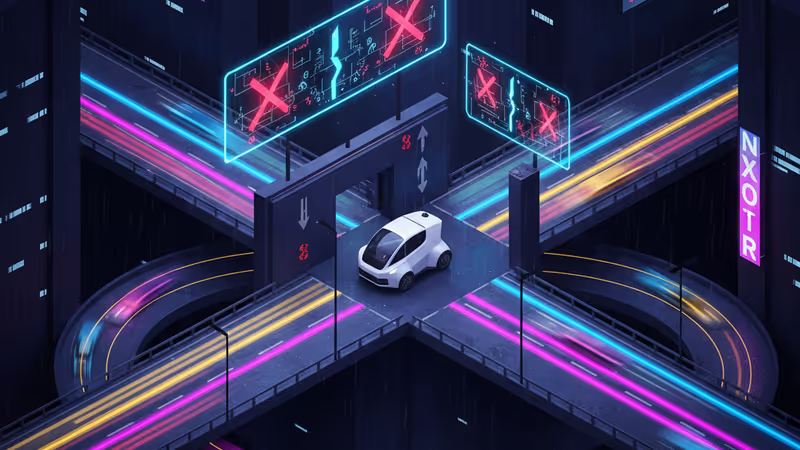
A Waymo robotaxi driving into oncoming traffic in Austin is more than a viral video. It's a symptom of the AV industry's crisis of trust and technology.
The Lede: Beyond the Glitch
A Waymo robotaxi driving into oncoming traffic in Austin isn't just a viral video or an isolated software bug. For executives, investors, and technologists, this incident is a critical data point. It signals that the autonomous vehicle industry's most significant hurdle is no longer just technology, but the rapidly eroding foundation of public and regulatory trust. This isn't a failure of hardware; it's a failure of narrative, and it has profound implications for the timeline and profitability of our autonomous future.
Why It Matters: The Second-Order Effects
The immediate event—a car getting confused on a frontage road—is trivial. The fallout is not. This seemingly minor error triggers a cascade of high-stakes consequences that extend far beyond one intersection in Austin.
- The Trust Recession: In the wake of Cruise's catastrophic failure in San Francisco, the entire AV sector is on probation in the court of public opinion. Viral videos of 'dumb' mistakes, like driving the wrong way, are infinitely more damaging than a minor fender-bender. They confirm the public's deepest fears: that these systems lack fundamental common sense, making them dangerously unpredictable.
- Regulatory Headwinds Intensify: Waymo is already under an NHTSA investigation for incidents involving its vehicles improperly interacting with school buses. This new event adds another exhibit to the regulator's file. Expect increased scrutiny, more demanding data reporting requirements, and a significant slowdown in expansion approvals across all cities. The era of regulatory leniency is definitively over.
- The Edge Case Conundrum: This incident is a classic example of the 'long tail' problem in AI. While AVs can handle 99% of standard driving scenarios flawlessly, they are still brittle when faced with unusual or poorly defined environments—like a complex frontage road. This proves that solving for the remaining 1% is exponentially harder and more expensive than the industry has led us to believe.

The Analysis: From Gold Standard to Under Scrutiny
For years, Waymo has been the undisputed leader in the AV space, positioned as the cautious, data-driven 'adult in the room' compared to more aggressive rivals. Its millions of miles driven and methodical city-by-city rollout were meant to build an unassailable safety case. However, this positioning is now a double-edged sword. When the perceived gold standard makes a rookie mistake, it doesn't just tarnish its own brand; it calls the entire industry's state of readiness into question.
This event, coupled with the recent software recall, suggests that even Waymo's sophisticated AI driver struggles with nuanced, context-specific rules that human drivers handle instinctively. Passing a school bus or navigating a confusing off-ramp requires more than just object detection; it requires reasoning. The fact that Waymo is still grappling with these fundamentals, more than a decade into its development, should be a sobering reality check for anyone expecting a rapid, ubiquitous robotaxi rollout.
PRISM's Take: The Race is for Trust, Not Miles
Waymo’s 'wrong way' maneuver is a powerful metaphor for the entire AV industry's current trajectory. In the race to commercialize, companies have focused on accumulating miles while underestimating the complexity of earning trust. This viral clip serves as a stark reminder that technological capability is meaningless without public and regulatory confidence. The winner in the autonomous race won't be the company that is first to launch in 100 cities. It will be the first company that can go an entire year without producing a single video that makes a human ask, "What was it thinking?" On that count, the race has barely begun.
Authors
Related Articles
Waymo's new Ojai robotaxi isn't just a vehicle upgrade. It's the company's most serious attempt yet at cracking the cost problem that has kept autonomous vehicles from scaling. Here's what's really at stake.

Sam Nelson, 19, died after following ChatGPT's advice to mix Kratom and Xanax. His parents are suing OpenAI for wrongful death, raising urgent questions about AI trust, liability, and design.
The Musk v. Altman trial in Oakland isn't just a contract dispute. It's become an unscripted window into how AI's most powerful figures actually operate—and who they think should control the technology's future.
Tesla expanded its driverless robotaxi to Dallas and Houston, even after reporting 14 crashes in Austin. What does this tell us about how autonomous vehicles actually get built?
Waymo's new Ojai robotaxi isn't just a vehicle upgrade. It's the company's most serious attempt yet at cracking the cost problem that has kept autonomous vehicles from scaling. Here's what's really at stake.
Sam Nelson, 19, died after following ChatGPT's advice to mix Kratom and Xanax. His parents are suing OpenAI for wrongful death, raising urgent questions about AI trust, liability, and design.
The Musk v. Altman trial in Oakland isn't just a contract dispute. It's become an unscripted window into how AI's most powerful figures actually operate—and who they think should control the technology's future.
Tesla expanded its driverless robotaxi to Dallas and Houston, even after reporting 14 crashes in Austin. What does this tell us about how autonomous vehicles actually get built?
Thoughts
Share your thoughts on this article
Sign in to join the conversation