
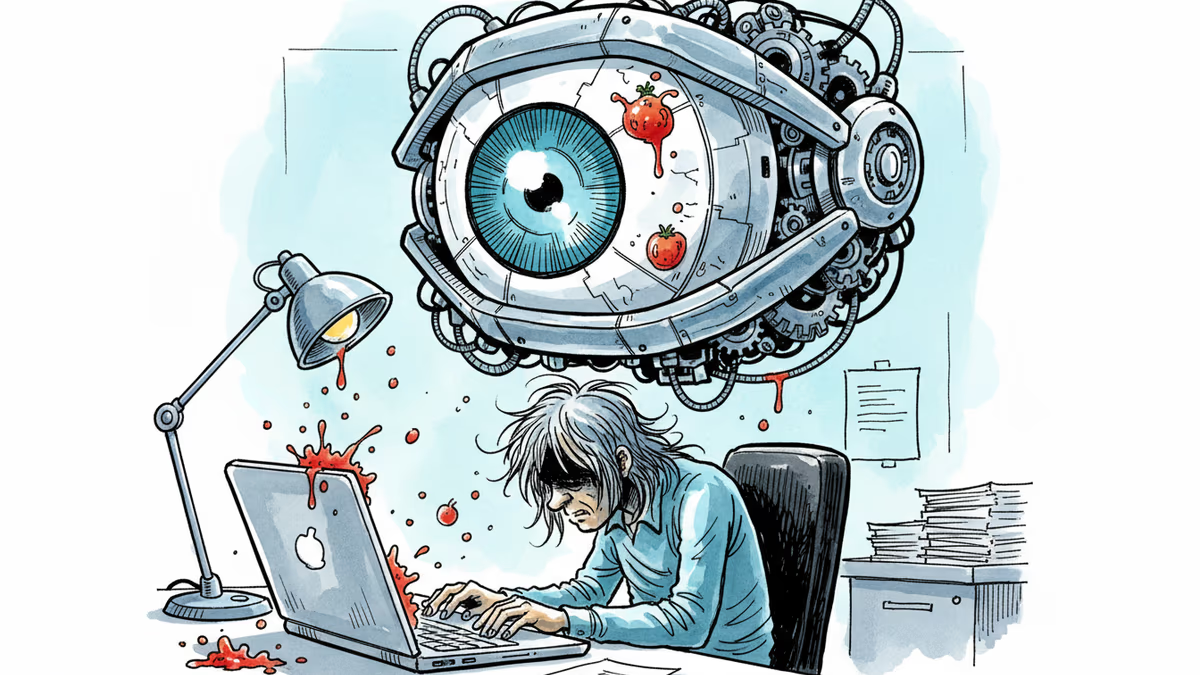
AI Watches Your Screen to Stop Procrastination—But at What Cost?
New macOS app Fomi uses AI to analyze screenshots and block distractions contextually. Privacy advocates question whether productivity gains justify constant surveillance.
Your computer is watching you work. Every click, every tab switch, every moment of digital wandering—it's all being analyzed by an AI that decides whether you're being productive or just procrastinating. Welcome to Fomi, a $8-per-month macOS app that promises to solve the oldest problem in remote work: staying focused when Netflix is just one tab away.
Unlike traditional website blockers that treat Reddit like digital kryptonite, Fomi claims to understand context. It can tell the difference between researching a work project on YouTube versus falling down a three-hour rabbit hole of cat videos. The secret? It takes screenshots of everything you do and sends them to OpenAI's GPT for real-time analysis.
The Smart Distraction Detective
Traditional productivity apps work like digital sledgehammers—they block entire websites regardless of why you're visiting them. Need to find technical documentation on Reddit? Too bad. Research competitor strategies on Instagram? Blocked. This binary approach has frustrated knowledge workers for years, creating a constant cycle of turning blockers on and off.
Zach Yang, Fomi's creator, built the app after watching a friend struggle with MBA studies. "He needed YouTube for study videos, so web/app blockers didn't work, and once he was watching, recommendations would often pull him away," Yang explains. The solution seemed obvious: teach AI to distinguish between productive browsing and mindless scrolling.
The app works by asking users to describe their work and current tasks. As they navigate their computer, a green dot appears near the MacBook's notch. Switch to something questionable, and it turns yellow. Cross into clear distraction territory, and a red tomato splats across the screen with a personalized warning message.
Early testing suggests the contextual approach works surprisingly well. The same website that triggers warnings for leisure browsing gets a pass when you're researching work-related content. The AI can even distinguish between productive and unproductive YouTube videos on the same channel.

The Privacy Trade-Off
Here's where things get complicated. To achieve this contextual awareness, Fomi uploads approximately half a gigabyte of screenshots during a typical workday. Every window, every document, every private message potentially gets sent to OpenAI's servers for analysis.
Yang's team has implemented privacy safeguards—local computer vision detects and redacts personal information like names, phone numbers, and passwords before upload. Screenshots are processed once and stored only in RAM, never on Fomi's servers. The app even goes through Apple's App Store review process as an additional privacy assurance.
But privacy advocates aren't convinced these measures go far enough. The sheer volume of visual data being transmitted raises questions about what happens if that information is intercepted, misused, or accessed by bad actors. For employees handling confidential information, the risk calculation becomes even more complex.
The Productivity Paradox
The emergence of AI-powered productivity tools like Fomi reflects a broader tension in modern work culture. We've created digital environments so distracting that we need artificial intelligence to help us stay human. The average knowledge worker checks email every six minutes and switches between apps over 1,100 times per day, according to recent productivity studies.
Some users report genuine behavior change after using contextual blocking tools. The immediate feedback loop—being called out for specific distractions rather than generic warnings—appears more effective than traditional approaches. Others worry about the psychological impact of constant digital surveillance, even when self-imposed.
Corporate adoption adds another layer of complexity. Should employers provide tools like Fomi to help remote workers stay focused? Or does workplace-sponsored screen monitoring cross ethical boundaries, regardless of productivity benefits?
Authors
Related Articles
Google Home introduces Live Search feature enabling real-time camera analysis. Smart home convenience meets privacy concerns as AI monitors daily life 24/7
Anonymous developers transform Jeffrey Epstein's email data into Wikipedia-style profiles, documenting connections and potential crimes of associates. A new frontier in citizen journalism or digital vigilantism?
CES 2026's hottest gadgets promise to revolutionize note-taking. But are AI recorders worth the hype and subscription fees? A deep dive into six devices reshaping how we capture conversations.
Anthropic launches Claude Opus 4.6 with improved first-try accuracy for complex tasks, targeting enterprise workflows and agentic coding applications.
Google Home introduces Live Search feature enabling real-time camera analysis. Smart home convenience meets privacy concerns as AI monitors daily life 24/7
Anonymous developers transform Jeffrey Epstein's email data into Wikipedia-style profiles, documenting connections and potential crimes of associates. A new frontier in citizen journalism or digital vigilantism?
CES 2026's hottest gadgets promise to revolutionize note-taking. But are AI recorders worth the hype and subscription fees? A deep dive into six devices reshaping how we capture conversations.
Anthropic launches Claude Opus 4.6 with improved first-try accuracy for complex tasks, targeting enterprise workflows and agentic coding applications.
Thoughts
Share your thoughts on this article
Sign in to join the conversation