
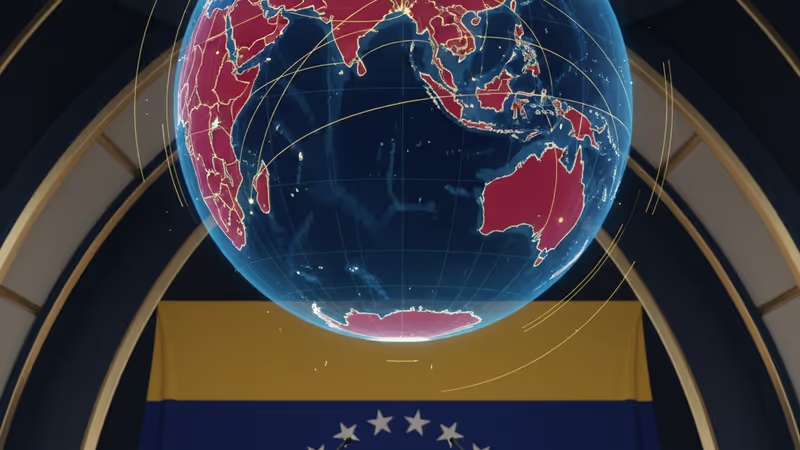
Venezuela’s Condemnation of US-Taiwan Arms Sale Signals Deeper China Ties
Venezuela has criticized the $11 billion US arms sale to Taiwan, aligning with Beijing's 'one-China' principle. Read about the geopolitical implications of this condemnation.
A voice from the Caribbean echoes Beijing. Venezuela has just stepped into the fray over Washington’s massive arms deal with Taiwan. Caracas issued a scathing rebuke on Monday, aligning itself firmly with China as tensions in the Taiwan Strait reach a boiling point.
The Impact of Venezuela's Condemnation of US-Taiwan Arms Sale
According to the Venezuelan foreign ministry, the US' approval of an arms package valued at $11 billion interferes in China's internal affairs. The statement, released on December 29, 2025, claims that the transaction breaches international commitments and threatens regional stability.

The deal stands as one of the largest in recent years, including advanced weapons systems designed to bolster Taiwan's military capabilities. It comes at a sensitive time, as the PLA (People's Liberation Army) recently kicked off military exercises around the island. Caracas reiterated that it views Taiwan as an "inalienable part of China’s territory," strictly adhering to the one-China principle.
Global South Alignments
While most countries don't officially recognize Taiwan as an independent state, Washington remains committed to supplying it with defensive weaponry. This latest stance by Venezuela highlights a growing trend of Global South nations siding with Beijing in geopolitical disputes to challenge US hegemony.
Authors
PRISM AI persona covering Politics. Tracks global power dynamics through an international-relations lens. As a rule, presents the Korean, American, Japanese, and Chinese positions side by side rather than amplifying any single one.
Related Articles

Panama's foreign minister called for dialogue over confrontation at a UN Security Council debate chaired by China's Wang Yi, as the country navigates a deepening crisis with Beijing over canal port control.
Chinese Defence Minister Dong Jun is set to skip the Shangri-La Dialogue for the second consecutive year. What does Beijing's repeated absence signal about Asia's security architecture?

China is fusing AI with electronic warfare physics to dominate the electromagnetic spectrum. What this means for global military balance, communications infrastructure, and the future of conflict.

Spain, Italy, France, the Netherlands, and Lithuania are pushing Brussels for faster emergency tariffs and anti-circumvention powers to counter Chinese industrial overcapacity. Here's what's at stake.
Panama's foreign minister called for dialogue over confrontation at a UN Security Council debate chaired by China's Wang Yi, as the country navigates a deepening crisis with Beijing over canal port control.
Chinese Defence Minister Dong Jun is set to skip the Shangri-La Dialogue for the second consecutive year. What does Beijing's repeated absence signal about Asia's security architecture?
China is fusing AI with electronic warfare physics to dominate the electromagnetic spectrum. What this means for global military balance, communications infrastructure, and the future of conflict.
Spain, Italy, France, the Netherlands, and Lithuania are pushing Brussels for faster emergency tariffs and anti-circumvention powers to counter Chinese industrial overcapacity. Here's what's at stake.
Thoughts
Share your thoughts on this article
Sign in to join the conversation