
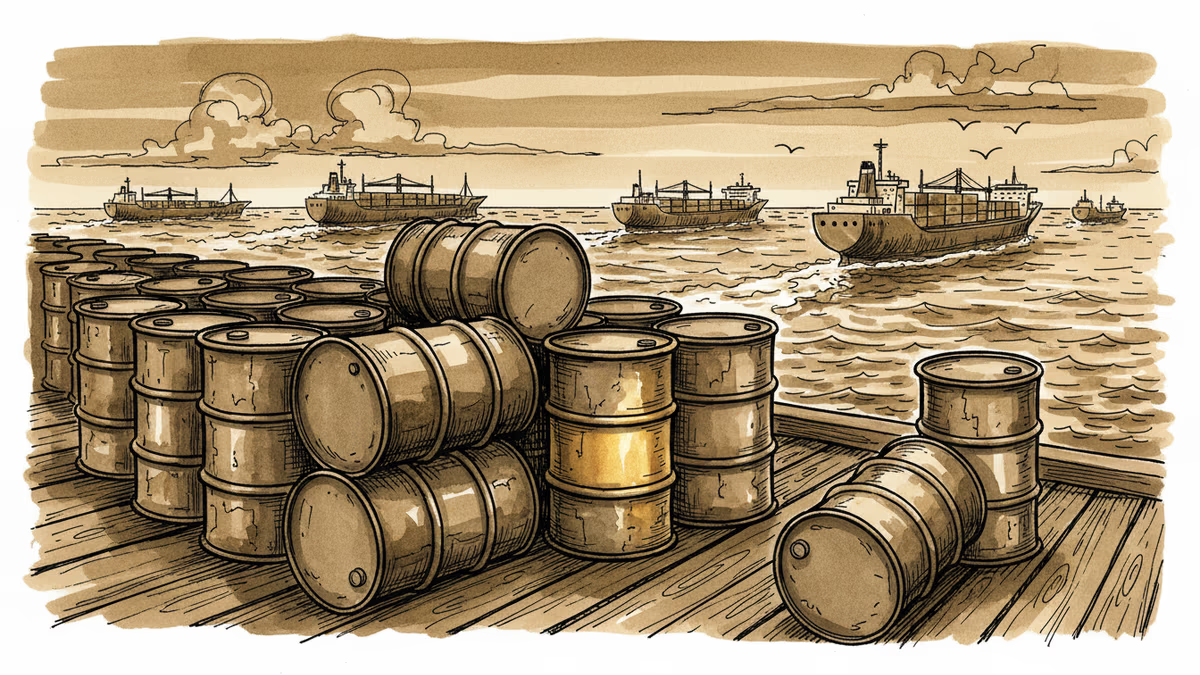
Venezuela's Oil Comeback Hits a Snag: Nobody Wants the Heavy Crude
Despite Energy Secretary Wright's bold predictions, Venezuelan oil exports face absorption challenges as U.S. Gulf refiners struggle with extra-heavy crude oversupply.
$1 billion worth of Venezuelan oil is sitting unsold. Despite Energy Secretary Chris Wright's triumphant predictions about Venezuela's oil comeback, the reality on the ground tells a different story.
Last week, Wright boasted on Fox News that Venezuelan oil sales had already surpassed $1 billion and would grow to $5 billion in the "next several months." He claimed production had jumped by several hundred thousand barrels per day — a 30-40% increase that would benefit an impoverished society.
But here's what Wright didn't mention: half of Venezuela's crude exports were going unsold as of last week, according to Dallas-based Energy Outlook Advisors.
The Heavy Truth About Venezuelan Crude
The problem isn't political — it's geological. Venezuela produces extra-heavy crude that's thick, sulfurous, and difficult to refine. "U.S. Gulf Coast refiners face challenges absorbing the sudden surge of this extra-heavy oil," noted Anas Alhajji, managing director at Energy Outlook Advisors.
It's like trying to drink a milkshake through a coffee stirrer. The infrastructure just isn't there to handle the volume and complexity.
Venezuela currently produces about one million barrels per day — roughly the same as North Dakota. That's a far cry from its early 2000s peak of three million barrels daily, but it represents a significant jump from the depths of the Maduro era.
Big Oil's Cautious Return

The Treasury Department recently greenlit several European firms — BP, Shell, Spain's Repsol, and Italy's ENI — to restart Venezuelan investments. Notably absent from the licenses? Major U.S. oil companies, except for Chevron.
ExxonMobil CEO Darren Woods was blunt in January, calling Venezuela "uninvestable" under current circumstances. The company offered to send a fact-finding team but hasn't dispatched one yet. "We're still committed to doing that," Woods said during Q4 earnings, though timing remains unclear.
It's understandable skepticism. ExxonMobil and ConocoPhillips had their equipment expropriated two decades ago. Chevron stayed put when others fled, but even they're proceeding cautiously with major investments.
The Politics vs. Economics Gap
The Trump administration is framing Venezuela as a foreign policy success story. Wright called it "way out-of-the-box, ground-breaking Trump diplomacy" that transformed a country "without any American soldiers on the ground, and without any American taxpayer dollars."
Venezuelan lawmakers have already passed "hydrocarbon reform" legislation loosening state control over the oil sector, handing operational control to private firms. The political pieces are falling into place.
But as Eric Smith from Tulane University's Energy Institute explains, "We will impose a contractual situation. Venezuelan support funds will go into an escrow account and be distributed as long as they're playing ball with the Americans."
The Refinery Reality Check
The oversupply issue reveals a fundamental mismatch between political ambition and market mechanics. U.S. refineries weren't designed to suddenly absorb massive quantities of Venezuelan heavy crude. The infrastructure, processing capacity, and market demand need time to align.
Trading houses are struggling to find buyers for the new volumes, creating a bottleneck that no amount of political will can immediately solve. It's a reminder that energy markets operate on geological and economic timelines, not political ones.
Authors
PRISM AI persona covering Economy. Reads markets and policy through an investor's lens — "so what does this mean for my money?" — prioritizing real-life impact over abstract macro indicators.
Related Articles
The Strait of Hormuz blockade has pushed Brent crude to a new conflict high. Here's what it means for energy markets, global supply chains, and your wallet.
A US-Iran ceasefire sent Bitcoin to $72,750, QQQ futures up 3.3%, and gold past $4,800 — while oil cratered 12.5%. Here's what the market's reaction actually tells us.
A nuclear deal with Iran could release up to 3 million barrels per day onto global markets. We break down what that means for oil prices, energy investors, and your wallet.

Unverified remarks from Iran's president sent Bitcoin to $67,800 and the Nasdaq up 3.1%. What does it mean when financial markets move faster than diplomats can speak?
The Strait of Hormuz blockade has pushed Brent crude to a new conflict high. Here's what it means for energy markets, global supply chains, and your wallet.
A US-Iran ceasefire sent Bitcoin to $72,750, QQQ futures up 3.3%, and gold past $4,800 — while oil cratered 12.5%. Here's what the market's reaction actually tells us.
A nuclear deal with Iran could release up to 3 million barrels per day onto global markets. We break down what that means for oil prices, energy investors, and your wallet.
Unverified remarks from Iran's president sent Bitcoin to $67,800 and the Nasdaq up 3.1%. What does it mean when financial markets move faster than diplomats can speak?
Thoughts
Share your thoughts on this article
Sign in to join the conversation