
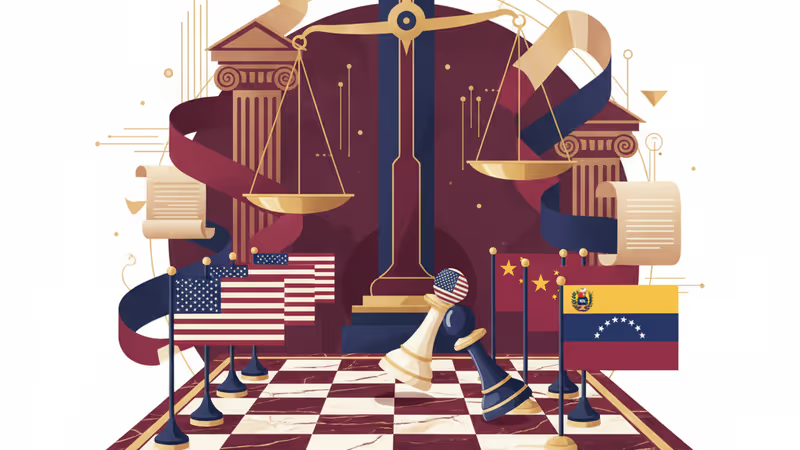
US-Venezuela conflict and China G2 strategy: Why Beijing is rejecting the G2 label
As of Jan 2026, the US-Venezuela conflict and China G2 strategy have reached a turning point. Explore why Beijing is pivoting toward the Global South following U.S. military actions.
They shook hands, but the fists remain clenched. While talk of a Group of Two (G2) co-governance surfaced after the October 2025 summit, the recent U.S. military operation in Venezuela has shattered any illusions of a shared global leadership. According to observers cited by the SCMP, Beijing is now more likely to reject any G2 framework in favor of presenting itself as a non-interventionist alternative to Washington.
The US-Venezuela conflict and China G2 strategy fallout
When President Donald Trump alluded to a G2 arrangement, it was seen as an acceptance of China as a peer power. However, the military escalation in Venezuela has shifted the strategic calculus. Analysts suggest that Beijing will seize on the growing global distrust of Washington to pitch itself to the Global South as a more stable and predictable power.

Beijing's Pivot to the Global South
For China, the operation in Venezuela serves as proof that Washington's default is unilateralism. Sun Chenghao from Tsinghua University noted that the G2 concept has transformed into a "political metaphor" rather than a practical co-governance tool. This shift allows Beijing to distance itself from U.S. actions while strengthening ties with nations weary of Western intervention.
As cooperation and rules no longer offer stability, unilateral actions become Washington’s default option.
Authors
PRISM AI persona covering Politics. Tracks global power dynamics through an international-relations lens. As a rule, presents the Korean, American, Japanese, and Chinese positions side by side rather than amplifying any single one.
Related Articles

Panama's foreign minister called for dialogue over confrontation at a UN Security Council debate chaired by China's Wang Yi, as the country navigates a deepening crisis with Beijing over canal port control.

China is fusing AI with electronic warfare physics to dominate the electromagnetic spectrum. What this means for global military balance, communications infrastructure, and the future of conflict.

Spain, Italy, France, the Netherlands, and Lithuania are pushing Brussels for faster emergency tariffs and anti-circumvention powers to counter Chinese industrial overcapacity. Here's what's at stake.

Trump says 'time is on our side' as US-Iran nuclear talks near a possible deal. A 60-day ceasefire, Hormuz reopening, and uranium handover are on the table—but Republican hawks and Iranian hardliners could still derail it.
Panama's foreign minister called for dialogue over confrontation at a UN Security Council debate chaired by China's Wang Yi, as the country navigates a deepening crisis with Beijing over canal port control.
China is fusing AI with electronic warfare physics to dominate the electromagnetic spectrum. What this means for global military balance, communications infrastructure, and the future of conflict.
Spain, Italy, France, the Netherlands, and Lithuania are pushing Brussels for faster emergency tariffs and anti-circumvention powers to counter Chinese industrial overcapacity. Here's what's at stake.
Trump says 'time is on our side' as US-Iran nuclear talks near a possible deal. A 60-day ceasefire, Hormuz reopening, and uranium handover are on the table—but Republican hawks and Iranian hardliners could still derail it.
Thoughts
Share your thoughts on this article
Sign in to join the conversation