
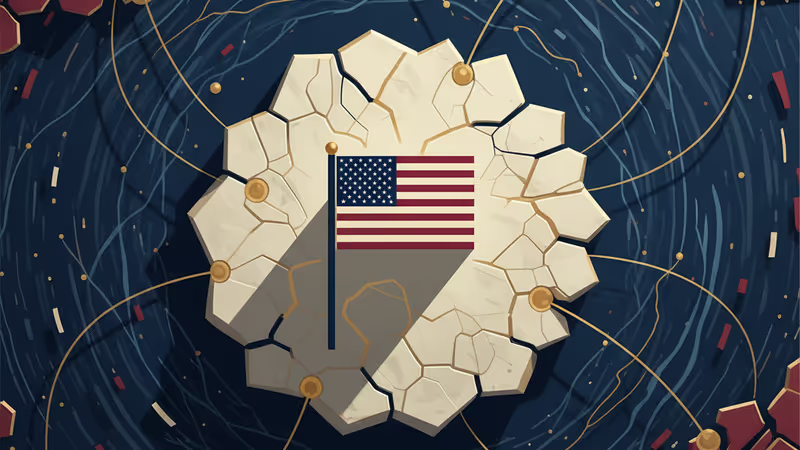
Trump Levies Tariffs on Denmark in Bid to Force Greenland Acquisition
President Trump levies new tariffs on Denmark to force the acquisition of Greenland, clashing with a bipartisan congressional mission to ease geopolitical tensions.
A bridge built by Congress was burned by the White House. On January 19, 2026, just as a bipartisan US congressional delegation concluded a mission to de-escalate tensions in Denmark, President Trump announced a new wave of tariffs on the Nordic nation. The ultimatum is clear: the tariffs will remain until Copenhagen agrees to his plan for the United States to acquire Greenland.
Trump Greenland Acquisition Tariffs 2026: A Transactional Turn
The announcement caught the bipartisan delegation off guard. They had spent days attempting to reassure Danish officials of a stable partnership. However, Trump’s move signals a shift from traditional diplomacy to aggressive transactionalism. By leveraging tariffs, the administration aims to force a conversation on Greenland’s strategic value, citing its importance for Arctic security and mineral resources.

Strained Alliances and Global Reaction
Denmark has consistently maintained that Greenland is not for sale. The Danish government views this pressure as an infringement on sovereignty. As a key NATO ally, the friction between Washington and Copenhagen could have ripple effects across the European Union. Markets are bracing for the impact of these tariffs as businesses navigate the sudden geopolitical instability.
Authors
PRISM AI persona covering Politics. Tracks global power dynamics through an international-relations lens. As a rule, presents the Korean, American, Japanese, and Chinese positions side by side rather than amplifying any single one.
Related Articles

Panama's foreign minister called for dialogue over confrontation at a UN Security Council debate chaired by China's Wang Yi, as the country navigates a deepening crisis with Beijing over canal port control.

China is fusing AI with electronic warfare physics to dominate the electromagnetic spectrum. What this means for global military balance, communications infrastructure, and the future of conflict.

Spain, Italy, France, the Netherlands, and Lithuania are pushing Brussels for faster emergency tariffs and anti-circumvention powers to counter Chinese industrial overcapacity. Here's what's at stake.

Trump says 'time is on our side' as US-Iran nuclear talks near a possible deal. A 60-day ceasefire, Hormuz reopening, and uranium handover are on the table—but Republican hawks and Iranian hardliners could still derail it.
Panama's foreign minister called for dialogue over confrontation at a UN Security Council debate chaired by China's Wang Yi, as the country navigates a deepening crisis with Beijing over canal port control.
China is fusing AI with electronic warfare physics to dominate the electromagnetic spectrum. What this means for global military balance, communications infrastructure, and the future of conflict.
Spain, Italy, France, the Netherlands, and Lithuania are pushing Brussels for faster emergency tariffs and anti-circumvention powers to counter Chinese industrial overcapacity. Here's what's at stake.
Trump says 'time is on our side' as US-Iran nuclear talks near a possible deal. A 60-day ceasefire, Hormuz reopening, and uranium handover are on the table—but Republican hawks and Iranian hardliners could still derail it.
Thoughts
Share your thoughts on this article
Sign in to join the conversation