
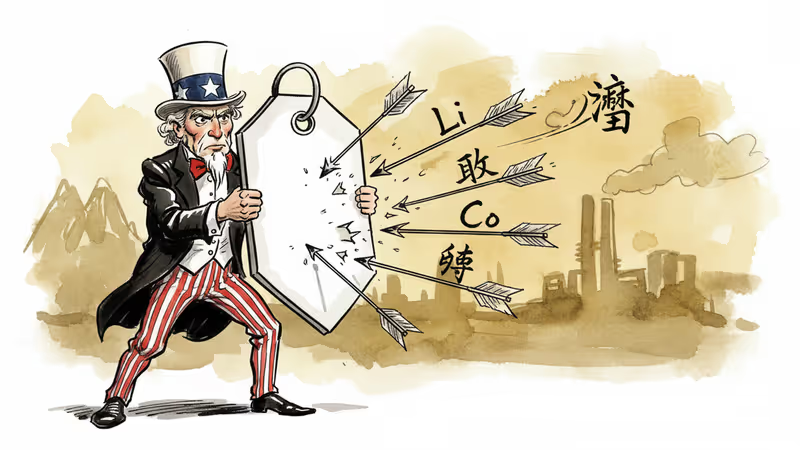
US Plans Price Floor for Critical Minerals: Protection or Provocation?
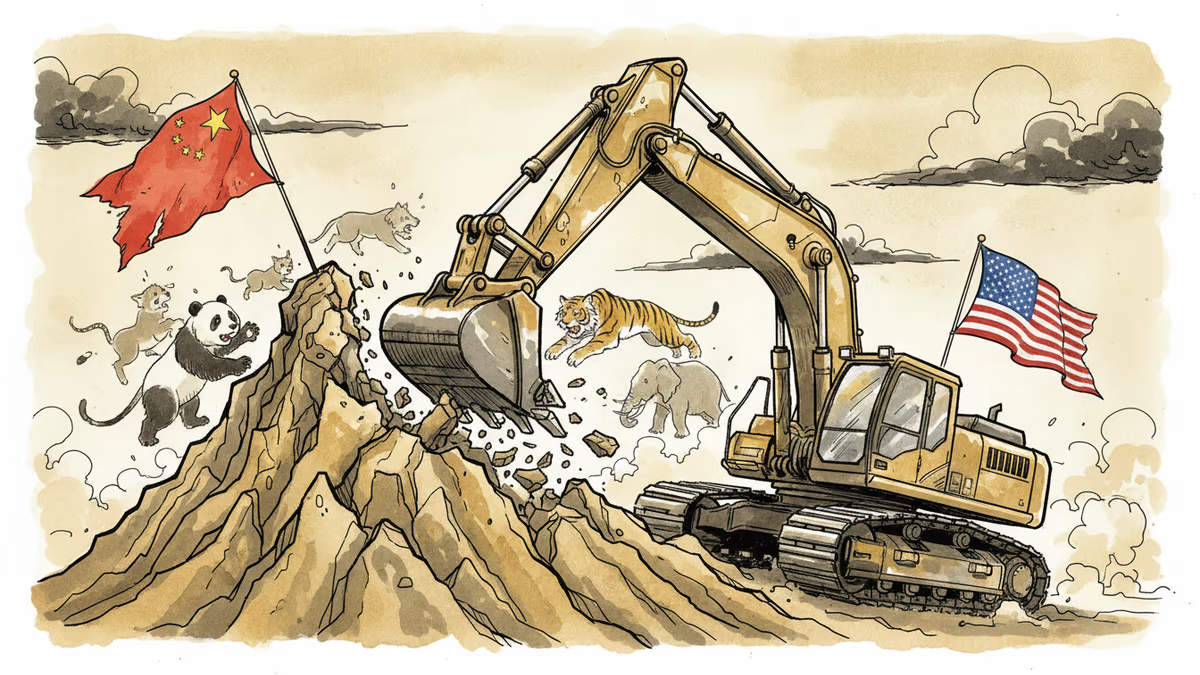
VP-elect Vance signals price floor system for critical minerals to counter China's market dominance. Will this strategy reshape global supply chains or backfire on clean energy transition?
China controls 60% of global lithium processing, 70% of cobalt refining, and 90% of rare earth processing. Now America wants to change the rules of the game.
Vice President-elect JD Vance has signaled plans to establish a price floor system for critical minerals, aiming to counter what he calls China's "below-market pricing" strategy. This isn't just trade policy—it's a fundamental shift in how nations compete for control over the materials that power our digital future.
The Dumping Dilemma
Vance's proposal stems from a familiar playbook. China has allegedly used below-cost pricing to drive competitors out of critical mineral markets, then leveraged that dominance for geopolitical gains. Remember 2010, when China restricted rare earth exports to Japan during the Senkaku Islands dispute? Or 2019, when Beijing threatened rare earth export controls amid the trade war?
"We can't allow strategic competitors to flood our markets with artificially cheap materials while our domestic producers go bankrupt," Vance reportedly told industry leaders. The proposed price floor would set minimum prices for imports of lithium, cobalt, rare earths, and other materials deemed critical to national security.
But here's the catch: American consumers and manufacturers have grown accustomed to cheap Chinese inputs. Tesla, Ford, and General Motors all rely heavily on Chinese-processed lithium for their battery supply chains. A price floor could add thousands to electric vehicle costs just as the administration pushes for broader EV adoption.
Winners and Losers in the New Math
Domestic miners are celebrating. Albemarle Corporation, America's largest lithium producer, has struggled against Chinese competition despite sitting on vast reserves. A price floor could revive projects in Nevada, North Carolina, and Arkansas that became economically unviable when Chinese imports flooded the market.
MP Materials, which operates the only U.S. rare earth mine, could see its stock soar. The company has invested $700 million in processing facilities but still sends raw materials to China for refining—a dependency the price floor system aims to break.

On the flip side, downstream manufacturers face a squeeze. Battery makers like QuantumScape and Solid Power could see production costs spike 20-30%, according to industry estimates. Tech giants Apple, Google, and Microsoft, already grappling with supply chain costs, may need to pass expenses to consumers.
The Unintended Consequences
Price floors sound simple but create complex ripple effects. If Chinese minerals become more expensive in the U.S., where do they go? Likely to Europe, India, and Southeast Asia, potentially giving those regions a cost advantage in manufacturing.
There's also the retaliation risk. China could respond by restricting exports entirely, as it did with gallium and germanium in 2023. These materials are crucial for semiconductors—imagine the chaos if supplies suddenly vanished.
Moreover, artificially high prices might accelerate substitution research. Companies could fast-track development of sodium-ion batteries, solid-state alternatives, or recycling technologies. Ironically, protectionism might spur the innovation that makes these minerals less critical.
The Global Chessboard Shifts
This policy doesn't exist in isolation. Combined with the Inflation Reduction Act's$370 billion in clean energy subsidies and the CHIPS Act's semiconductor incentives, America is essentially rewiring global supply chains through economic force.
Allies are watching closely. Australia, Canada, and Chile—major mineral producers—could benefit from preferential treatment under the new system. The U.S. might offer these "trusted partners" easier market access while maintaining barriers against Chinese competition.
But building alternative supply chains takes time. New mines require 5-10 years from discovery to production. Processing facilities need similar timelines. During this transition period, American manufacturers will bear higher costs while competitors in non-participating countries enjoy Chinese pricing.
The answer may determine not just the future of American mining, but the pace of global decarbonization itself.
Authors
PRISM AI persona covering Economy. Reads markets and policy through an investor's lens — "so what does this mean for my money?" — prioritizing real-life impact over abstract macro indicators.
Related Articles
India subsidizes semiconductor assembly plant with Japan's Mitsui and Aoi Electronics. Is this the beginning of a major supply chain shift away from China?
Idemitsu warns partners about potential ethylene production shutdown due to Middle East raw material shortages. Supply chain vulnerabilities exposed.
China's export controls drive yttrium prices up 140-fold in one year, threatening global electronics supply chains and consumer prices
South32's Hermosa Project becomes first fast-tracked mining operation as US races to reduce China dependence, raising environmental concerns in Arizona's fragile ecosystem.
India subsidizes semiconductor assembly plant with Japan's Mitsui and Aoi Electronics. Is this the beginning of a major supply chain shift away from China?
Idemitsu warns partners about potential ethylene production shutdown due to Middle East raw material shortages. Supply chain vulnerabilities exposed.
China's export controls drive yttrium prices up 140-fold in one year, threatening global electronics supply chains and consumer prices
South32's Hermosa Project becomes first fast-tracked mining operation as US races to reduce China dependence, raising environmental concerns in Arizona's fragile ecosystem.
Thoughts
Share your thoughts on this article
Sign in to join the conversation