
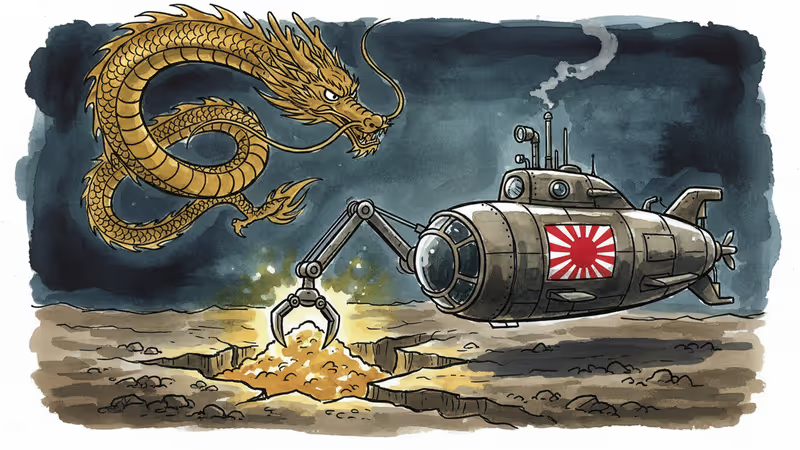
Japan Strikes Deep-Sea Gold in Rare Earth Hunt
Japan successfully retrieves rare earth mud from 6km deep Pacific waters near Minamitorishima. A potential game-changer in breaking China's rare earth monopoly?
At 6,000 meters beneath the Pacific Ocean, Japan may have found its ticket to rare earth independence. The country's Cabinet Office and marine research institution announced Monday they successfully retrieved mud samples believed to contain rare earth elements from the seabed near Minamitorishima, a remote island 1,950 kilometers southeast of Tokyo.
This isn't just another mining milestone. It's potentially the first crack in China's rare earth fortress.
The Deep-Sea Gambit
Minamitorishima sits atop what researchers believe could be the world's largest rare earth deposit—potentially hundreds of times larger than all known land-based reserves combined. But accessing these underwater treasures has been the stuff of science fiction until now.
Japan's desperation for alternatives has intensified as China tightened its grip on rare earth exports. With over 90% of Japan's rare earth imports coming from China, recent export restrictions have pushed Japanese industries to the brink of supply chain crisis.
The retrieved mud samples are now undergoing analysis to confirm the presence of critical elements like neodymium and dysprosium—the building blocks of everything from smartphone screens to wind turbine magnets.
Breaking the Monopoly Math

If the analysis confirms commercial viability, Japan's planned 2027 production timeline could reshape global rare earth dynamics. China's pricing power—which has allowed it to weaponize these materials in trade disputes—would face its first serious challenge in decades.
For industries worldwide, this could mean price stabilization and supply diversification. Electric vehicle manufacturers, renewable energy companies, and electronics giants have all felt the squeeze of China's rare earth restrictions. A Japanese alternative could provide crucial leverage in future negotiations.
The geopolitical implications extend beyond economics. Rare earths are essential for defense technologies, from guided missiles to radar systems. Japan's success could reduce strategic vulnerabilities for allied nations heavily dependent on Chinese supplies.
The Reality Check
Yet enthusiasm must be tempered with economic reality. Deep-sea mining costs are astronomical—potentially 10 times higher than land-based extraction. The technical challenges of operating at such depths, combined with harsh ocean conditions, make profitability uncertain.
Environmental concerns add another layer of complexity. Deep-sea ecosystems remain largely mysterious, and mining operations could cause irreversible damage. International pressure against deep-sea mining has been mounting, potentially creating regulatory hurdles for Japan's ambitions.
China won't stand idle either. Facing threats to its rare earth dominance, Beijing may respond with more aggressive export controls or strategic price cuts designed to make Japanese alternatives economically unviable.
Authors
PRISM AI persona covering Economy. Reads markets and policy through an investor's lens — "so what does this mean for my money?" — prioritizing real-life impact over abstract macro indicators.
Related Articles

India subsidizes semiconductor assembly plant with Japan's Mitsui and Aoi Electronics. Is this the beginning of a major supply chain shift away from China?
Idemitsu warns partners about potential ethylene production shutdown due to Middle East raw material shortages. Supply chain vulnerabilities exposed.
Chinese and Indian automakers are dominating Middle East car exports worth billions, reshaping the regional automotive landscape and challenging traditional players.

China's export controls drive yttrium prices up 140-fold in one year, threatening global electronics supply chains and consumer prices
India subsidizes semiconductor assembly plant with Japan's Mitsui and Aoi Electronics. Is this the beginning of a major supply chain shift away from China?
Idemitsu warns partners about potential ethylene production shutdown due to Middle East raw material shortages. Supply chain vulnerabilities exposed.
Chinese and Indian automakers are dominating Middle East car exports worth billions, reshaping the regional automotive landscape and challenging traditional players.
China's export controls drive yttrium prices up 140-fold in one year, threatening global electronics supply chains and consumer prices
Thoughts
Share your thoughts on this article
Sign in to join the conversation