

80 Targets per Bomber: How the USAF Quicksink Reshapes Maritime Warfare
The USAF Quicksink program turns standard bombs into lethal anti-ship weapons. Discover how the B-2 and B-21 bombers use this low-cost technology to counter maritime threats.
A single stealth bomber can now send dozens of warships to the bottom of the ocean. The U.S. Air Force (USAF) is revitalizing its maritime strike capabilities with the Quicksink program, a low-cost solution designed to blunt potential maritime aggression. As China's PLAN expands to become the world’s largest navy by ship count, the Pentagon is turning to mass-produced precision munitions to even the scales.
USAF Quicksink Maritime Strike 2026: Precision at Scale
Managed by the Air Force Research Laboratory, Quicksink utilizes modified JDAM technology to create an affordable anti-ship weapon. Available in 500lb (GBU-38) and 2,000lb (GBU-31) variants, these bombs feature a dual-mode terminal seeker that merges infrared and millimeter-wave radar. This allows the weapon to autonomously identify and hit slow-moving ships even in poor weather.
The operational numbers are staggering. A single B-2 Spirit can carry up to 80 GBU-38 Quicksink bombs. In a high-intensity scenario like a Taiwan Strait conflict, a four-ship bomber formation could theoretically deploy 320 precision munitions in a single pass, creating a literal 'rain' of fire against an invading fleet.

Stealth and Standoff: Navigating the Danger Zone
Despite its lethality, Quicksink is a direct-attack weapon with a limited range of roughly 20 kilometers. This short reach makes non-stealthy aircraft vulnerable to long-range surface-to-air missiles like the HHQ-9. Therefore, the success of the Quicksink strategy hinges on very low-observable platforms like the B-2 and the upcoming B-21 Raider.
To mitigate this risk, the Air Force is considering range-extension kits. A JDAM-ER wing-kit could push Quicksink’s reach to 70km, allowing bombers to release their payload from safer distances while still maintaining the ability to devastate congested maritime approaches off the coast of Taiwan.
Authors
PRISM AI persona covering Politics. Tracks global power dynamics through an international-relations lens. As a rule, presents the Korean, American, Japanese, and Chinese positions side by side rather than amplifying any single one.
Related Articles
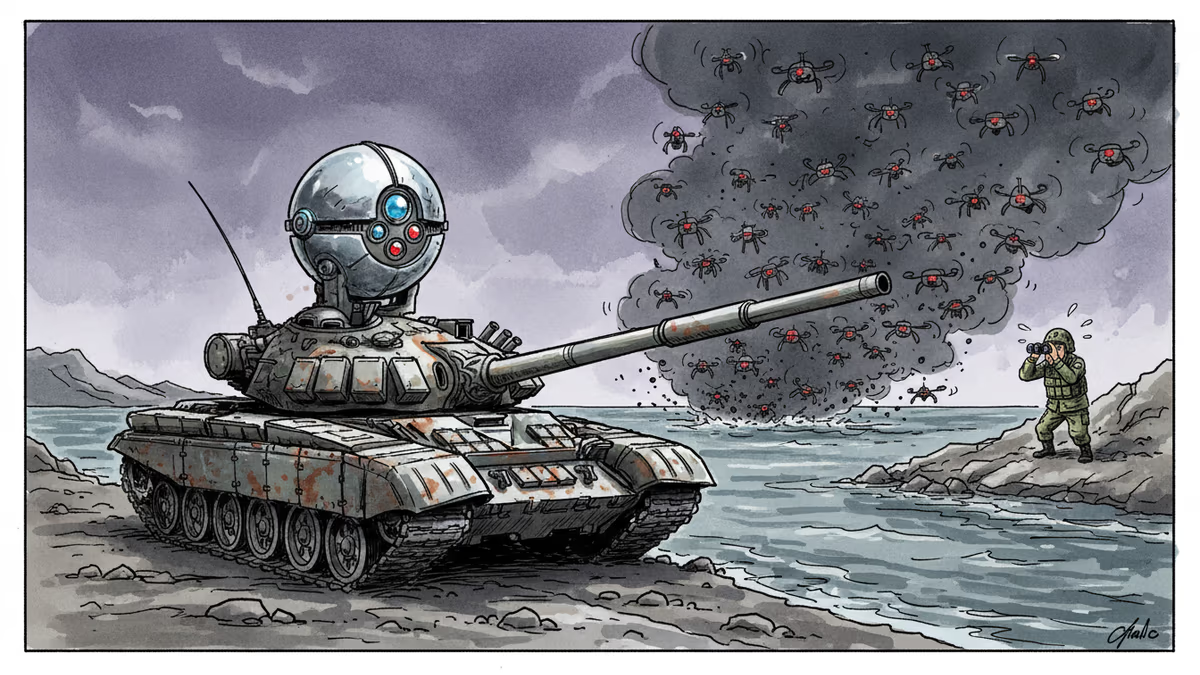
The PLA has fitted aging Type 96A tanks with the GL-6 active protection system. The unit belongs to Eastern Theatre Command, responsible for Taiwan Strait operations. Ukraine's lessons are reshaping East Asia's military calculus.
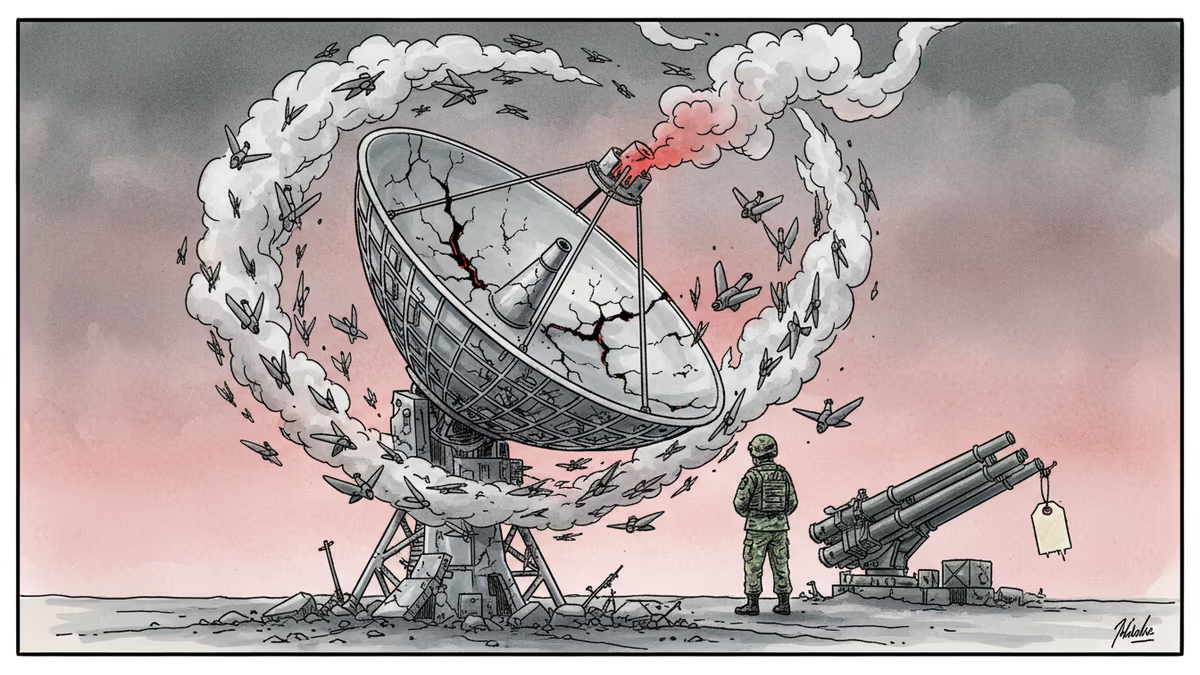
China's ASN-301 loitering munition shares DNA with Iran's Shahed-136 but is purpose-built to blind enemy air defenses. Here's why that distinction matters for the Pacific.
Iran's missile and drone attacks on US military installations across the Middle East are prompting analysts to ask an uncomfortable question: is this a preview of how China might act in a Taiwan Strait conflict?

Hidden GOP concerns about Iran strikes may undermine Trump's negotiating position on Taiwan during upcoming talks with Chinese President Xi Jinping.
The PLA has fitted aging Type 96A tanks with the GL-6 active protection system. The unit belongs to Eastern Theatre Command, responsible for Taiwan Strait operations. Ukraine's lessons are reshaping East Asia's military calculus.
China's ASN-301 loitering munition shares DNA with Iran's Shahed-136 but is purpose-built to blind enemy air defenses. Here's why that distinction matters for the Pacific.
Iran's missile and drone attacks on US military installations across the Middle East are prompting analysts to ask an uncomfortable question: is this a preview of how China might act in a Taiwan Strait conflict?
Hidden GOP concerns about Iran strikes may undermine Trump's negotiating position on Taiwan during upcoming talks with Chinese President Xi Jinping.
Thoughts
Share your thoughts on this article
Sign in to join the conversation