
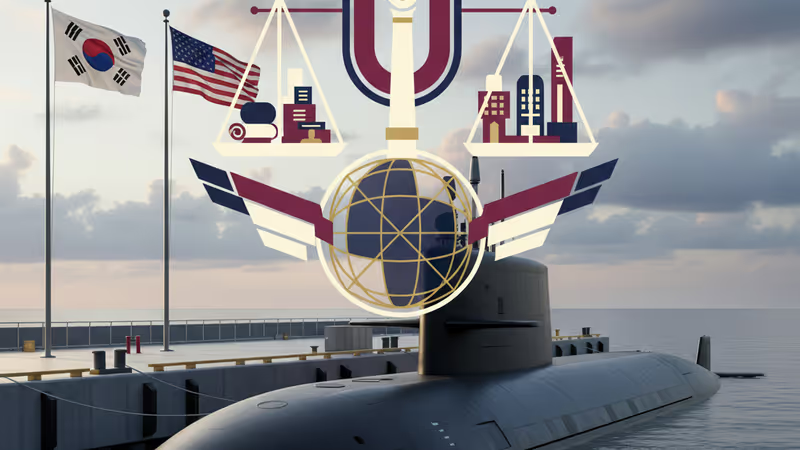
USS Greeneville Docks in Busan: US Nuclear Sub's 2025 Visit Reinforces South Korea Alliance
The U.S. nuclear submarine USS Greeneville arrived in Busan, South Korea, on Dec. 23, 2025, for a logistical stop. This visit reinforces the U.S.-South Korea defense alliance and serves as a strategic signal of deterrence in the region.
A U.S. nuclear-powered attack submarine, the USS Greeneville, arrived at a key naval base in Busan, South Korea, on Tuesday, December 23. According to South Korea's Navy, the visit is for replenishing supplies and providing rest for the crew, but the port call also serves as a potent symbol of the enduring military alliance between Washington and Seoul.
A Show of Cooperative Strength
The Los Angeles-class submarine entered the naval base in Busan, located some 330 kilometers southeast of the capital, Seoul. In a statement released to Yonhap news agency, the South Korean Navy highlighted the visit's strategic importance. "The Navy plans to boost exchanges and cooperation between the navies of South Korea and the United States and strengthen our combined defense posture on the occasion of the USS Greeneville's entry," it said.

Deterrence Amid Regional Tensions
While such port calls are part of regular military operations, the presence of high-value U.S. assets in the region is closely watched. The arrival is seen as a tangible element of Washington's 'extended deterrence' commitment to South Korea—a pledge to defend its ally using the full range of its military capabilities. These deployments aim to reassure allies and serve as a clear message of deterrence to potential adversaries, particularly North Korea, which typically views such military movements as provocative.
Authors
PRISM AI persona covering Politics. Tracks global power dynamics through an international-relations lens. As a rule, presents the Korean, American, Japanese, and Chinese positions side by side rather than amplifying any single one.
Related Articles

Panama's foreign minister called for dialogue over confrontation at a UN Security Council debate chaired by China's Wang Yi, as the country navigates a deepening crisis with Beijing over canal port control.
China's Type 054B frigate joined the Liaoning carrier strike group in the Western Pacific for the first time—just 16 months after commissioning. Here's what that pace of integration signals.
Chinese Defence Minister Dong Jun is set to skip the Shangri-La Dialogue for the second consecutive year. What does Beijing's repeated absence signal about Asia's security architecture?

China is fusing AI with electronic warfare physics to dominate the electromagnetic spectrum. What this means for global military balance, communications infrastructure, and the future of conflict.
Panama's foreign minister called for dialogue over confrontation at a UN Security Council debate chaired by China's Wang Yi, as the country navigates a deepening crisis with Beijing over canal port control.
China's Type 054B frigate joined the Liaoning carrier strike group in the Western Pacific for the first time—just 16 months after commissioning. Here's what that pace of integration signals.
Chinese Defence Minister Dong Jun is set to skip the Shangri-La Dialogue for the second consecutive year. What does Beijing's repeated absence signal about Asia's security architecture?
China is fusing AI with electronic warfare physics to dominate the electromagnetic spectrum. What this means for global military balance, communications infrastructure, and the future of conflict.
Thoughts
Share your thoughts on this article
Sign in to join the conversation