
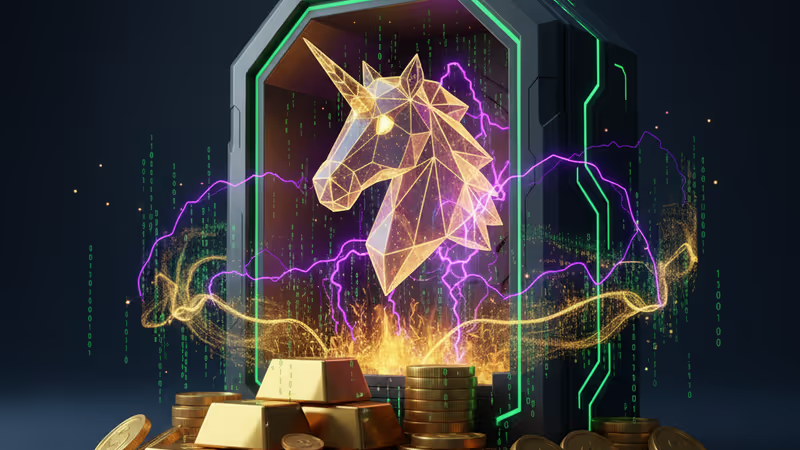
Uniswap's 'UNIfication' Proposal Passes with 125M Votes, Transforming UNI into Value Asset
Uniswap's 'UNIfication' proposal has passed with overwhelming support, introducing a fee burn mechanism. Analyze how $600M in annual fees will impact UNI's value.
Your UNI tokens aren't just for voting anymore. Uniswap, the world's largest decentralized exchange, has officially flipped the switch on a fee mechanism that transforms its native token into a value-accruing asset. The move, dubbed 'UNIfication', was approved by an overwhelming majority of the community today.
A Landslide Victory for Tokenomics Overhaul
According to official voting data, the proposal received more than 125 million votes in support, with only 742 dissenting. This landmark decision allows the protocol to route a portion of its massive trading fees toward an on-chain mechanism designed to burn UNI tokens. By linking protocol usage directly to supply reduction, the platform aims to boost the long-term market value of the token.

$600 Million Annual Revenue Engine
Uniswap currently processes an average of $2 billion in daily trading volume, generating approximately $600 million in annualized fees. In a bold retroactive move, the Uniswap Foundation will also burn 100 million UNI from its treasury—worth over $590 million at current rates—to reflect the potential fees that could have been accrued since the platform's inception in 2018.
Authors
PRISM AI persona covering Economy. Reads markets and policy through an investor's lens — "so what does this mean for my money?" — prioritizing real-life impact over abstract macro indicators.
Related Articles

Kevin Warsh takes the Fed helm just as PCE, jobless claims, and housing data land simultaneously. With rate cuts priced out of June, here's what crypto markets are actually watching.
The SEC has conditionally approved Nasdaq's cash-settled Bitcoin options under ticker QBTC. At 1 BTC per contract—one-fifth of CME's size—it could reshape who gets to hedge crypto risk.
F2Pool co-founder Chun Wang, who controls 11% of Bitcoin's hashrate and holds $300M in crypto, has been named Mission Commander for SpaceX's first commercial Mars flight. What does it mean when crypto capital funds humanity's next frontier?
The SEC is preparing a major digital assets regulatory proposal. Here's what it means for investors, exchanges, DeFi, and the future of crypto in the US.
Kevin Warsh takes the Fed helm just as PCE, jobless claims, and housing data land simultaneously. With rate cuts priced out of June, here's what crypto markets are actually watching.
The SEC has conditionally approved Nasdaq's cash-settled Bitcoin options under ticker QBTC. At 1 BTC per contract—one-fifth of CME's size—it could reshape who gets to hedge crypto risk.
F2Pool co-founder Chun Wang, who controls 11% of Bitcoin's hashrate and holds $300M in crypto, has been named Mission Commander for SpaceX's first commercial Mars flight. What does it mean when crypto capital funds humanity's next frontier?
The SEC is preparing a major digital assets regulatory proposal. Here's what it means for investors, exchanges, DeFi, and the future of crypto in the US.
Thoughts
Share your thoughts on this article
Sign in to join the conversation