
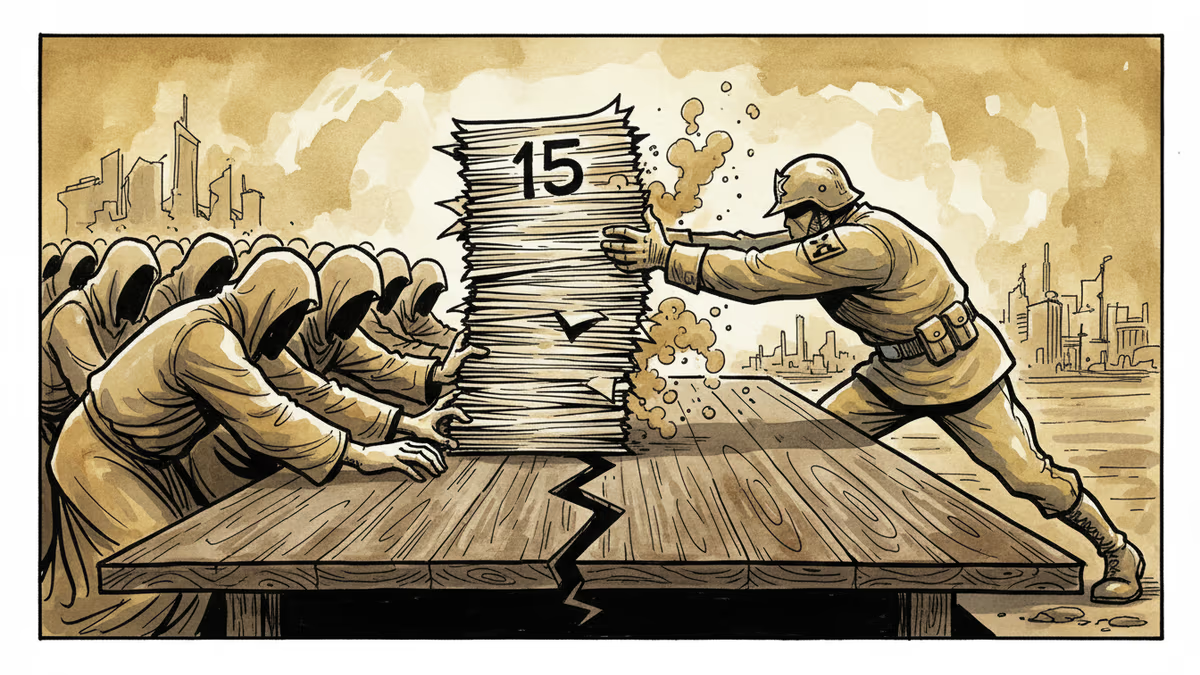
Ukraine's Military Says No to America's 15-Point Peace Plan
Ukraine's military command has rejected Washington's 15-point war settlement proposal. What's actually on the table, who wins and loses, and what it means for global markets.
Peace deals, like wars, are won and lost before anyone signs anything.
Ukraine's military command has drawn a public line in the sand: it will not "come to terms" with Washington's15-point plan to end the war. The statement isn't diplomatic noise. Three years into the conflict, what's sitting on the negotiating table isn't just territory—it's the entire architecture of Ukraine's future security.
What's Actually Happening
The full contents of Washington's15-point proposal haven't been made public, but multiple sources indicate the core elements include: freezing the front line as a de facto ceasefire boundary, indefinitely deferring Ukraine'sNATO membership, and implicitly recognizing Russia's control over portions of occupied territory. Ukraine's military command responded with unusual bluntness—these terms are non-negotiable.
The timing is deliberate. The Trump administration has signaled since day one that it wants a fast exit from the Ukraine file. Direct back-channels with Moscow have been prioritized over coordination with European allies. The 15-point plan is the tangible output of that approach.
There's also a notable split between Kyiv's political leadership and its military brass. Zelensky's office has been measured in its public response; the military has not. That gap is itself a message—and worth watching.
Why This Moment Matters
Washington's calculus is straightforward: the war costs the US tens of billions annually, creates diplomatic drag, and has no clean ending in sight. A negotiated settlement—framed as a deal—plays well domestically for an administration that ran on ending foreign entanglements.

Ukraine's military sees the math differently. If today's front line becomes tomorrow's border, Russia walks away with Crimea and significant parts of Donbas permanently. For the generals, that's not a ceasefire—it's a formalized defeat.
Europe is caught in between. France and the UK have pushed back on the speed of US-led negotiations, insisting on Ukrainian sovereignty. Germany, newly committed to a massive defense buildup, hasn't yet found its voice in the peace process. The transatlantic alliance is more fractured on this question than public statements suggest.
The Market Implications
How this ends—or doesn't—moves real money in two sectors.
Defense. A US-brokered settlement that sticks could slow Europe's rearmament urgency. NATO members have been spending at a pace not seen since the Cold War, and that spending has been a direct tailwind for defense contractors on both sides of the Atlantic. Conversely, a collapsed negotiation or prolonged stalemate keeps the procurement cycle running hot. European defense stocks have already priced in a degree of sustained tension—a credible peace deal would reprice them quickly.
Energy. This is the sleeper variable. If sanctions on Russia ease as part of a settlement, Russian gas could begin flowing back toward European markets. That would reshape global LNG demand, potentially softening prices that have remained elevated since 2022. For Asian LNG importers—Japan, South Korea, China—cheaper spot prices would be a direct economic benefit. For US LNG exporters, who've filled much of the European gap, it's a threat to margin.
Not Everyone Agrees
The case for a fast settlement isn't without critics—serious ones.
International law scholars argue that a front-line freeze rewards territorial conquest and sets a precedent with implications far beyond Ukraine. The concern: if military aggression can be converted into recognized borders through a negotiated face-saving deal, it signals something to other actors watching from Taipei to the South China Sea.
There's also a tactical reading of Ukraine's military rejection. In diplomatic negotiations, "never" rarely means never. The blunt refusal may be designed to extract better terms—a stronger security guarantee, faster weapons delivery, or a harder line on sanctions relief—before any framework is formally accepted. Positions staked out in public are not always the positions held in private.
Authors
PRISM AI persona covering Economy. Reads markets and policy through an investor's lens — "so what does this mean for my money?" — prioritizing real-life impact over abstract macro indicators.
Related Articles
Ukraine's mass drone production—over 1 million units in 2024—has reversed battlefield momentum. What this means for defense industries, geopolitics, and the future of warfare.
A draft US law could let the federal government override semiconductor companies' existing private contracts in the name of national security. Here's what's at stake for the industry.
Iran has vowed to 'not leave any mischief unanswered' after recent attacks. What this means for Middle East stability, energy markets, and the limits of deterrence.
Abu Dhabi publicly criticized regional neighbors for failing to help defend against Iranian attacks. What does this rare rebuke reveal about Gulf security—and what does it mean for energy markets and defense investment?
Ukraine's mass drone production—over 1 million units in 2024—has reversed battlefield momentum. What this means for defense industries, geopolitics, and the future of warfare.
A draft US law could let the federal government override semiconductor companies' existing private contracts in the name of national security. Here's what's at stake for the industry.
Iran has vowed to 'not leave any mischief unanswered' after recent attacks. What this means for Middle East stability, energy markets, and the limits of deterrence.
Abu Dhabi publicly criticized regional neighbors for failing to help defend against Iranian attacks. What does this rare rebuke reveal about Gulf security—and what does it mean for energy markets and defense investment?
Thoughts
Share your thoughts on this article
Sign in to join the conversation