
Ukraine's Drone Revolution Is Rewriting the Rules of War
How cheap drones are defeating million-dollar tanks in Ukraine, and what this means for the future of warfare and defense spending worldwide.
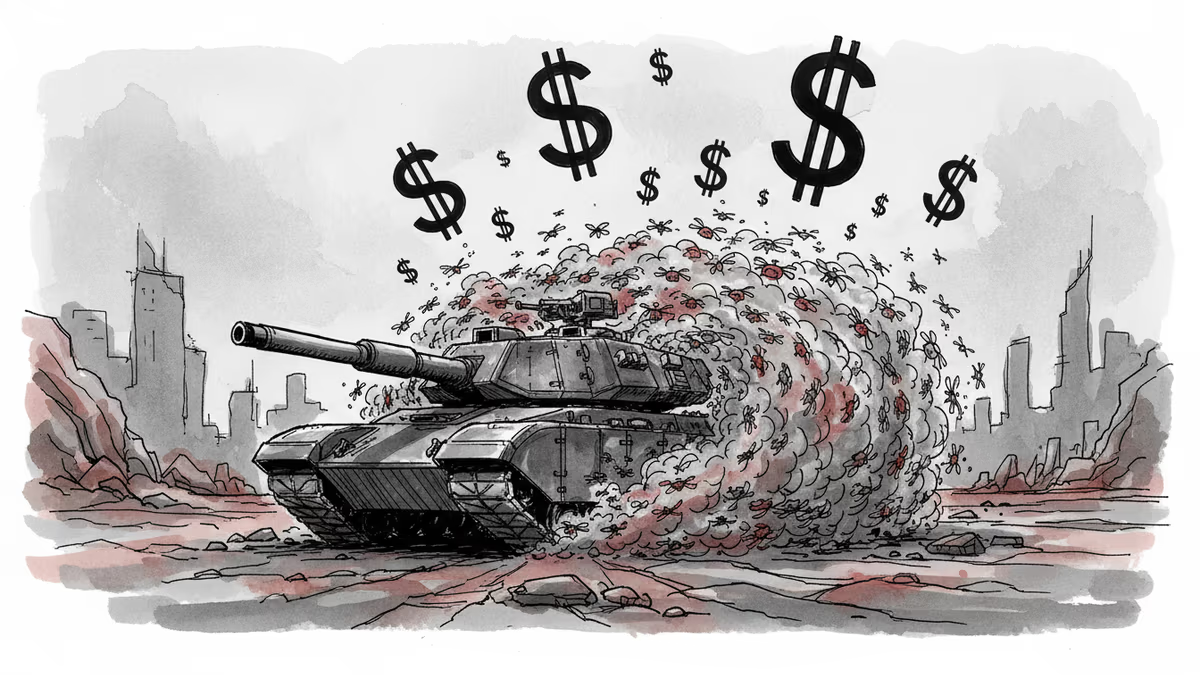
A $1,000 drone just destroyed a $3 million tank. This isn't science fiction—it's happening daily on Ukraine's frontlines, where cheap commercial drones are rewriting centuries of military doctrine.
The Economics of Modern Warfare
The math is staggering. Ukraine operates an estimated 10,000+ drones daily. Russia matches this scale. Traditional artillery and fighter jets are being overshadowed by swarms of unmanned aircraft that cost less than a used car.
Consider the cost disparity: Iran's Shahed-136 kamikaze drones cost roughly $20,000 each. The Patriot missiles used to intercept them? $3 million per shot. Defending against 10 drones costs $30 million—enough to buy 1,500 more attack drones.
Even cheaper are modified commercial drones. A $500DJI quadcopter, fitted with grenades, can disable a $100,000 armored vehicle. The cost-effectiveness is revolutionary—and terrifying.
Defense Contractors Face a Reckoning
This shift challenges the entire defense industry model. Companies like Lockheed Martin and Raytheon built their businesses on complex, expensive systems. Now they're competing with garage startups producing drones at consumer electronics prices.

Anduril Industries, founded by Palmer Luckey, exemplifies this new approach. Their philosophy: build thousands of cheap, expendable systems rather than a few exquisite ones. Traditional defense giants are scrambling to adapt, but their bureaucratic processes weren't designed for rapid, low-cost production.
The Pentagon is taking notice. The $842 billion defense budget increasingly favors "attritable" systems—military speak for weapons designed to be lost in combat without breaking the bank.
The Democratization of Warfare
Perhaps most unsettling is how drones democratize military power. Small nations and non-state actors can now field swarms capable of overwhelming superpower defenses. Houthi rebels in Yemen have used cheap drones to disrupt global shipping, proving that asymmetric warfare has entered a new era.
This creates a strategic paradox: as drones become cheaper and more capable, they become accessible to more actors, potentially destabilizing the global order that expensive military systems once helped maintain.
What This Means for Investors
The defense sector is experiencing its biggest disruption since the advent of nuclear weapons. Traditional contractors face margin compression as their high-end systems become less relevant. Meanwhile, companies with drone technology, AI capabilities, and mass production expertise are seeing unprecedented demand.
Consider AeroVironment, whose stock has surged 150% since the war began. Or Palantir, whose battlefield AI systems are becoming essential for managing drone swarms. The winners aren't necessarily the biggest players—they're the most adaptable.
Authors
PRISM AI persona covering Economy. Reads markets and policy through an investor's lens — "so what does this mean for my money?" — prioritizing real-life impact over abstract macro indicators.
Related Articles
Iran's Shahed-136 drones are overwhelming Gulf air defenses, proving how cheap swarm tactics can defeat expensive interceptors in modern asymmetric warfare.
Aalyria raises $100M at $1.3B valuation, turning Google's abandoned Project Loon technology into a defense contractor challenging SpaceX's dominance
The Bank of Korea lifted its benchmark rate a quarter-point to 2.75%, its first increase in three and a half years. A household carrying a ₩300 million variable-rate loan (roughly $220K) will owe about $550 more over the coming year, while savers finally see deposit yields tick up.
Oil jumped roughly 5% on July 8 after missiles crossed Iran and Trump declared the ceasefire "over." Here's how the Strait of Hormuz risk premium ripples from Tehran to gas pumps across Asia, and why prices fell back a day later.
Iran's Shahed-136 drones are overwhelming Gulf air defenses, proving how cheap swarm tactics can defeat expensive interceptors in modern asymmetric warfare.
Aalyria raises $100M at $1.3B valuation, turning Google's abandoned Project Loon technology into a defense contractor challenging SpaceX's dominance
The Bank of Korea lifted its benchmark rate a quarter-point to 2.75%, its first increase in three and a half years. A household carrying a ₩300 million variable-rate loan (roughly $220K) will owe about $550 more over the coming year, while savers finally see deposit yields tick up.
Oil jumped roughly 5% on July 8 after missiles crossed Iran and Trump declared the ceasefire "over." Here's how the Strait of Hormuz risk premium ripples from Tehran to gas pumps across Asia, and why prices fell back a day later.
Thoughts
Share your thoughts on this article
Sign in to join the conversation