
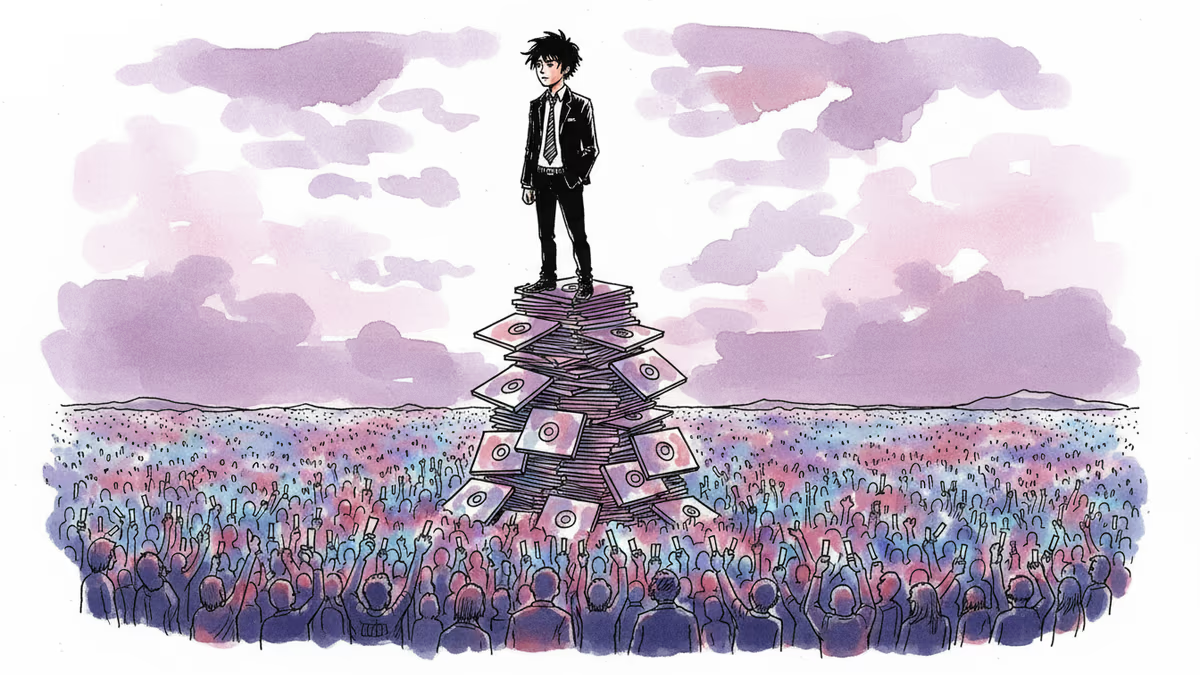
TWS Hit 1M Sales in 4 Days. Here's Why That Number Needs Context.
TWS's 'NO TRAGEDY' crossed 1 million copies in four days, nearly doubling their previous first-week record. But what does a million-seller actually mean in 2026's K-pop economy?
One million albums in four days — from a group that didn't exist two years ago.
TWS (short for Tomorrow With us Seventeen — yes, the HYBE lineage is baked into the name) dropped their new mini-album 《NO TRAGEDY》 on April 27, and by day four, Hanteo Chart had logged over 1 million physical copies sold. It's the group's first million-seller ever. More striking: the first-week tally nearly doubled their previous personal record. That's not incremental growth — the trajectory itself has shifted.
What a Million Copies Means in 2026
To understand why this number matters — and why it needs unpacking — you have to understand how the K-pop physical album market actually works in 2026.
The million-seller benchmark, once reserved for the very top tier of the industry (BTS, SEVENTEEN), has migrated steadily down-market over the past five years. Stray Kids, ATEEZ, ENHYPEN, and a growing roster of fourth-generation acts have all crossed the threshold, making it less a ceiling and more a qualifying standard for mid-tier acts with serious fanbases. TWS clearing it isn't a surprise — it's a confirmation that the group has graduated from the "promising newcomer" bracket into something more durable.
The competitive landscape around this release matters too. The first half of 2026 has been dense with fourth-gen boy group comebacks — NCT DREAM, ZEROBASEONE, and others have all been vying for the same fan wallets and streaming real estate. TWS has carved out a specific lane: bright, youthful, almost aggressively optimistic in its aesthetic. 《NO TRAGEDY》 and its title track 〈You, You〉 stay firmly in that register. The fact that they nearly doubled sales without pivoting to a darker or more "mature" concept is notable. It suggests the lane itself is widening, not just the car.
The Architecture Behind the Number

Here's the part that doesn't make it into the press releases.
Korean physical album sales figures are not equivalent to "number of people who bought this album." The industry has spent roughly a decade engineering a structure that incentivizes — and in some cases requires — fans to purchase multiple copies of the same release. Random photocard inserts, fan sign event entry lotteries (where each album purchase is one entry), and multiple packaging versions all drive what the industry calls "multi-buying."
HYBE, SM, JYP, and YG have all refined this model to varying degrees. Pledis Entertainment, the HYBE sub-label behind TWS, operates within this same ecosystem. So when a headline says "1 million copies sold," the more precise read is: "1 million units moved, distributed across a fanbase that likely numbers considerably fewer than 1 million people."
This isn't a scandal — it's a business model, and fans participate in it knowingly. But it does complicate the narrative of what "scale" means for a K-pop act. The more interesting metric, and the harder one to track, is streaming performance. Does 〈You, You〉 chart on Melon, Spotify, or Apple Music among listeners who have no stake in the photocard lottery? That gap between physical buyers and casual streamers is where the real question of TWS's mainstream crossover potential lives.
The HYBE Infrastructure Question
TWS's trajectory is also a data point in a larger story about HYBE's multi-label strategy. After the turbulence of 2024–2025 — the ADOR/NewJeans dispute, management restructuring, and questions about whether HYBE's conglomerate model was cannibalizing its own artists — the company needed proof that its pipeline still worked. TWS doubling their sales record is, among other things, a quiet argument that the label infrastructure functions.
But there's a tension worth watching. HYBE's model depends on each sub-label maintaining a distinct identity while sharing backend resources. As TWS scales up, the pressure to compete directly with stablemates like TOMORROW X TOGETHER or ENHYPEN will increase. Whether Pledis can keep TWS's identity legible as the commercial stakes rise is an open operational question.
This content is AI-generated based on source articles. While we strive for accuracy, errors may occur. We recommend verifying with the original source.
Related Articles

BABYMONSTER announces digital single 'SUGAR HONEY ICE TEA' for June 8. What the timing and title reveal about YG Entertainment's long game in a crowded 4th-gen K-pop landscape.
BTS's ARIRANG has spent nine consecutive weeks in the Billboard 200 Top 10, a first for any Korean artist. What the longevity reveals about K-pop's next phase in the US market.
BTS's 'ARIRANG' holds at No. 8 on the Billboard 200 for an eighth consecutive week. Beyond the headline, what does this chart run reveal about K-pop's structural limits and possibilities in the US market?
ILLIT's new mini album debuted at No. 1 on Billboard's World Albums chart and cracked the Billboard 200 top 50. Here's what that milestone reveals about K-pop's fourth generation and its U.S. market strategy.
BABYMONSTER announces digital single 'SUGAR HONEY ICE TEA' for June 8. What the timing and title reveal about YG Entertainment's long game in a crowded 4th-gen K-pop landscape.
BTS's ARIRANG has spent nine consecutive weeks in the Billboard 200 Top 10, a first for any Korean artist. What the longevity reveals about K-pop's next phase in the US market.
BTS's 'ARIRANG' holds at No. 8 on the Billboard 200 for an eighth consecutive week. Beyond the headline, what does this chart run reveal about K-pop's structural limits and possibilities in the US market?
ILLIT's new mini album debuted at No. 1 on Billboard's World Albums chart and cracked the Billboard 200 top 50. Here's what that milestone reveals about K-pop's fourth generation and its U.S. market strategy.
Thoughts
Share your thoughts on this article
Sign in to join the conversation