
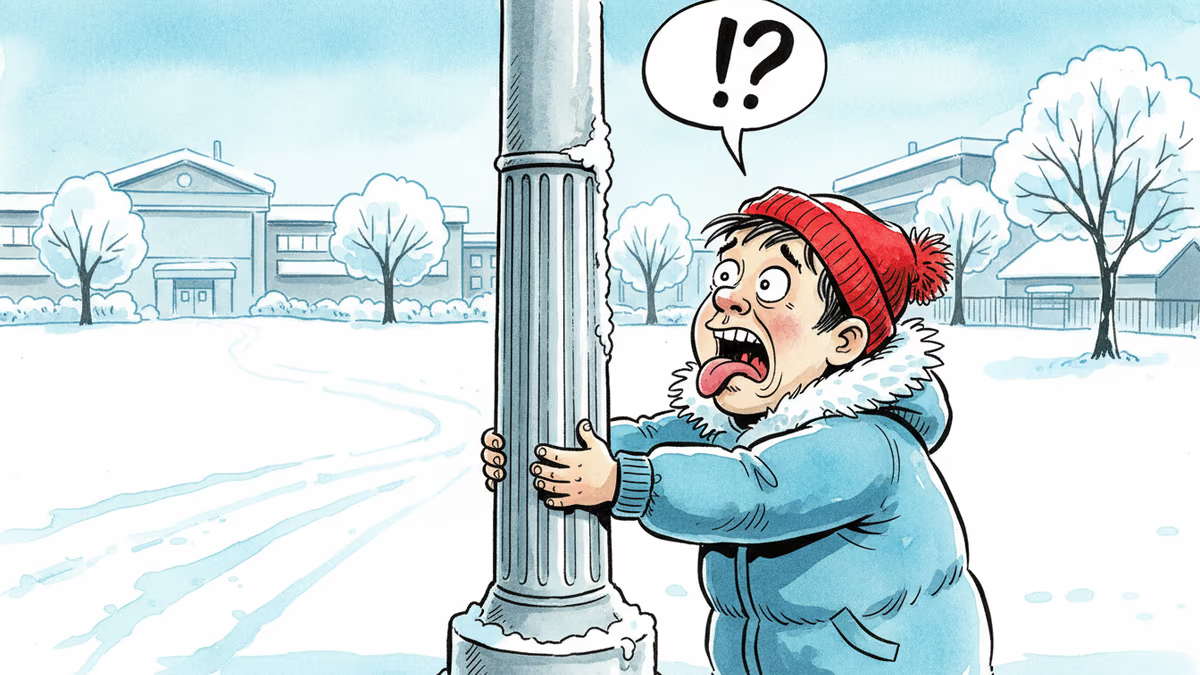
Why Does Your Tongue Stick to Metal in Winter?
A Norwegian grad student turned a childhood mishap into two published papers. The science of 'tundra tongue' is simpler than you think — but the right way to get unstuck might surprise you.
Somewhere in Norway, a kid licked a lamppost. Decades later, that moment became two peer-reviewed papers.
It's one of those universal winter experiences — the inexplicable urge to press your tongue against a cold metal surface, followed immediately by the realization that was a terrible idea. Pop culture immortalized it in the 1983 film A Christmas Story. Medicine gave it a name in 1996: tundra tongue. But until recently, nobody had seriously asked: how dangerous is it, really? And what's the right way to get unstuck?
From Schoolyard to Science Journal
Anders Hagen Jarmund, a graduate student at the Norwegian University of Science and Technology (NTNU), decided those questions deserved real answers. Growing up in Hattfjelldal — a small, reliably frigid town in northern Norway — he'd experienced tundra tongue firsthand. So had his friends. The memory stuck with him longer than the lamppost did.
For his master's thesis, Jarmund recruited colleagues and turned the childhood curiosity into a formal research project. The result: two separate papers, one published in the International Journal of Pediatric Otorhinolaryngology and another in Head & Face Medicine. It's a reminder that some of the most relatable science starts with the simplest question: wait, why does that happen?
The Physics Is Ruthlessly Simple
Metal conducts heat far more efficiently than wood or plastic. When warm, moist tongue tissue contacts a freezing metal surface, the moisture freezes almost instantly — creating a bond that's essentially a thin layer of ice acting as glue. The colder the metal and the wetter the tongue, the stronger the grip.

This is why Norway didn't leave the problem to parental warnings alone. In 1998, the country passed legislation banning bare metal in playground equipment. That a law was needed at all tells you something about how widespread the experience was.
The Part Everyone Gets Wrong
The research doesn't just explain why it happens — it addresses what to do next, which turns out to matter a great deal. The instinct is to yank free. That's the wrong move. Pulling away by force tears the surface tissue of the tongue, causing bleeding and real injury.
The recommended approach is slow and unglamorous: pour warm water between the tongue and the metal to melt the ice bond gradually. No drama, no force. Just physics working in reverse.
Why This Research Matters Beyond the Punchline
It's easy to dismiss tundra tongue as novelty science — the kind of thing that earns a chuckle at a dinner party. But there's a more serious undercurrent here. Jarmund's research highlights a category of everyday hazards that are extremely common, widely experienced, and almost entirely unstudied. Children encounter this risk every winter. Parents and teachers rarely know the safest response. And until recently, no one had formally investigated it.
That gap — between how often something happens and how well we understand it — is worth paying attention to. It shows up in plenty of other areas too: minor injuries, everyday accidents, the small physical risks of childhood that get filed under 'kids will be kids' rather than 'let's figure this out properly.'
Authors
Related Articles

German researchers propose a fourth theory to explain ice's slipperiness, challenging centuries of scientific debate about pressure, friction, and surface melting.

Five stories from late September, traced to where the paper trail stops: Korea's export record, Nvidia's Hugging Face 8-K, a US-China AI channel, the UN on AI, and rising births.

Huawei's CANN is open source under a license barring software for non-Ascend chips. Inside China's second CUDA, and the two links still outside it: pre-training compute and 5nm capacity.
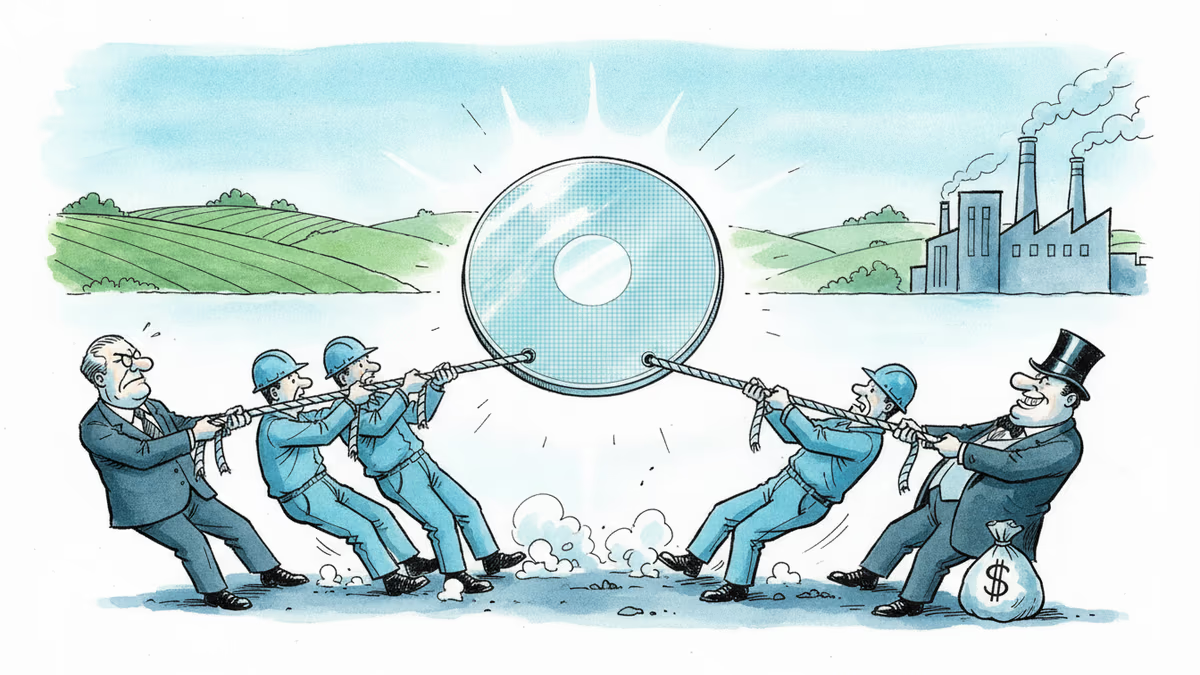
Samsung Electronics' union branch revealed that 84% of survey respondents oppose the government's roughly $290 billion (₩400 trillion) semiconductor megaproject in Gwangju. Government, management, the union and shareholders are all reading the same national project in sharply different ways.
German researchers propose a fourth theory to explain ice's slipperiness, challenging centuries of scientific debate about pressure, friction, and surface melting.
Five stories from late September, traced to where the paper trail stops: Korea's export record, Nvidia's Hugging Face 8-K, a US-China AI channel, the UN on AI, and rising births.
Huawei's CANN is open source under a license barring software for non-Ascend chips. Inside China's second CUDA, and the two links still outside it: pre-training compute and 5nm capacity.
Samsung Electronics' union branch revealed that 84% of survey respondents oppose the government's roughly $290 billion (₩400 trillion) semiconductor megaproject in Gwangju. Government, management, the union and shareholders are all reading the same national project in sharply different ways.
Thoughts
Share your thoughts on this article
Sign in to join the conversation