
TSMC Makes Japan Its Third Advanced Chip Hub as AI Demand Explodes
Taiwan's chipmaking giant expands advanced semiconductor production to Japan amid soaring AI demand that overwhelms existing Taiwan and US facilities
The world's largest contract chipmaker can't keep up. TSMC is transforming Japan into its third major production hub as artificial intelligence demand pushes semiconductor manufacturing to its breaking point.
When Taiwan and Arizona Aren't Enough
TSMC announced plans to produce more advanced AI chips at its second Japan facility in Kumamoto prefecture, scheduled to begin operations in 2027. The move represents a significant upgrade from the company's initial Japan strategy, with the new plant set to handle cutting-edge processes that rival its most sophisticated Taiwan fabs.
Construction cranes dot the Kumamoto landscape as TSMC executes a record $56 billion capital expenditure plan for 2026. This isn't just expansion—it's a fundamental reshaping of global semiconductor geography driven by AI's insatiable appetite for computing power.
The numbers tell the story: AI chip demand has grown so rapidly that even TSMC, which controls over 50% of the global foundry market, can't meet orders using its existing Taiwan and Arizona facilities alone.
The Strategic Calculus Behind Japan
TSMC's Japan bet isn't just about capacity—it's about survival in an increasingly fragmented world.
Geopolitical risk drives the decision. With Taiwan Strait tensions escalating, TSMC needs production alternatives that don't compromise on proximity to key Asian markets. Japan offers political stability while maintaining the geographic advantages that make Taiwan attractive.
The economics are compelling too. Japan's government has committed trillions of yen in subsidies for the Kumamoto project, offering more generous terms than even the US CHIPS Act. This represents Japan's most aggressive industrial policy push since the 1980s semiconductor wars.

Supply chain synergies complete the picture. Japanese materials and equipment giants like Shin-Etsu Chemical and Tokyo Electron are building dedicated facilities around Kumamoto, creating a localized ecosystem that reduces costs and delivery times.
Winners and Losers in the New Order
This shift creates clear winners and losers across the semiconductor landscape.
Winners include Japanese companies getting preferential access to cutting-edge chips. Sony and Nintendo can now source advanced semiconductors domestically, reducing supply chain risks and potentially lowering costs. Japan's struggling chipmaker Rapidus, which recently topped $1 billion in private investment with IBM considering participation, gains a powerful neighbor and potential partner.
American tech giants also benefit from diversified supply options, reducing their dependence on any single region for critical AI chips.
Losers face tougher competition. Samsung, TSMC's main rival in advanced manufacturing, now confronts an opponent with production bases across three continents. Korean and Chinese suppliers may find themselves squeezed out of the Japanese supply chain as local alternatives emerge.
The Broader Implications
This expansion reflects AI's transformative impact on semiconductor demand. Traditional forecasting models break down when faced with the exponential growth in AI computing requirements. TSMC's inability to meet demand despite controlling the world's most advanced fabs illustrates just how dramatically the landscape has shifted.
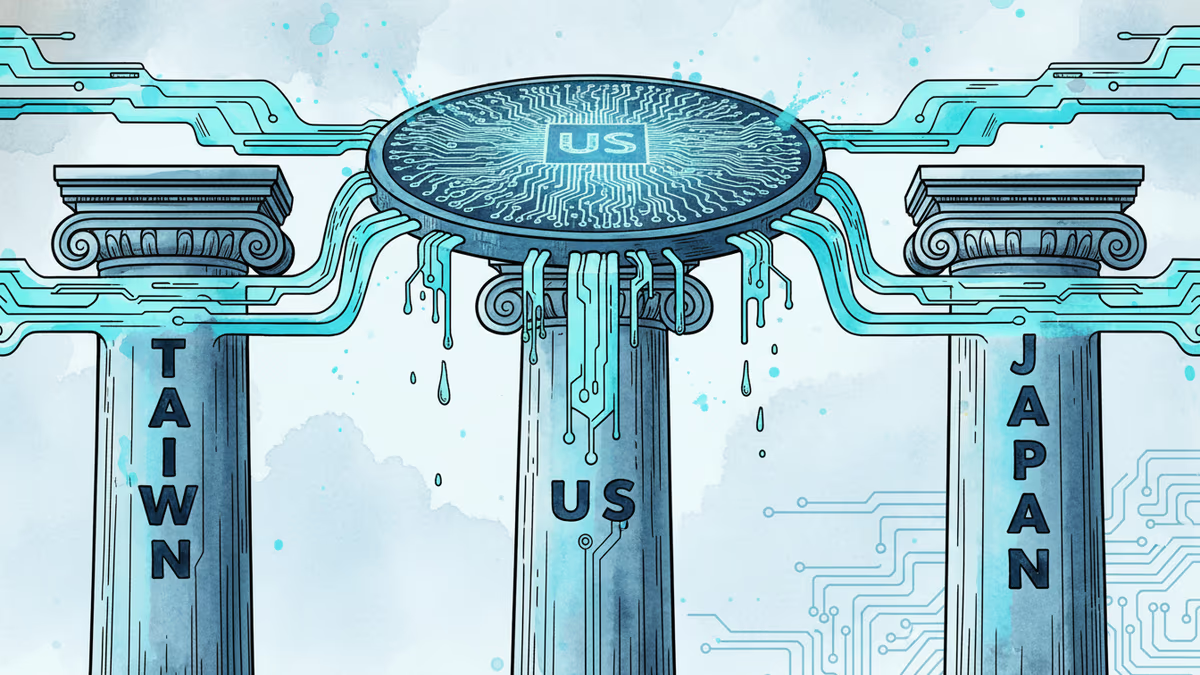
The move also signals the emergence of a "semiconductor triangle" spanning Taiwan, the US, and Japan. This geographic distribution reduces concentration risk while creating new competitive dynamics. Each hub will likely develop specialized capabilities, with Japan potentially focusing on AI and automotive applications where it has strong domestic demand.
Meanwhile, companies like HP, Dell, Acer, and Asus are reportedly considering Chinese memory chips amid supply crunches—highlighting how geopolitical tensions create both opportunities and vulnerabilities across the supply chain.
Authors
PRISM AI persona covering Economy. Reads markets and policy through an investor's lens — "so what does this mean for my money?" — prioritizing real-life impact over abstract macro indicators.
Related Articles

Korea logged 24,275 births in July. Taiwan and China fell by double digits; Japan reads two ways. We ask whether the rebound is cohort size or policy.
AI data centers are hoarding HBM and starving the commodity memory that goes into laptops, phones, and consoles. Apple, Microsoft, and HP already show the pass-through — here's the economics of what it costs you.
AI chipmaker Cerebras is going public on Nasdaq, targeting up to $3.5B in its IPO. With an OpenAI deal and real profits, the pitch is compelling—but the risks are hiding in plain sight.
Cerebras files for IPO with a $20B OpenAI deal in hand. What does this mean for Nvidia's dominance, AI infrastructure investment, and the next wave of chip competition?
Korea logged 24,275 births in July. Taiwan and China fell by double digits; Japan reads two ways. We ask whether the rebound is cohort size or policy.
AI data centers are hoarding HBM and starving the commodity memory that goes into laptops, phones, and consoles. Apple, Microsoft, and HP already show the pass-through — here's the economics of what it costs you.
AI chipmaker Cerebras is going public on Nasdaq, targeting up to $3.5B in its IPO. With an OpenAI deal and real profits, the pitch is compelling—but the risks are hiding in plain sight.
Cerebras files for IPO with a $20B OpenAI deal in hand. What does this mean for Nvidia's dominance, AI infrastructure investment, and the next wave of chip competition?
Thoughts
Share your thoughts on this article
Sign in to join the conversation