
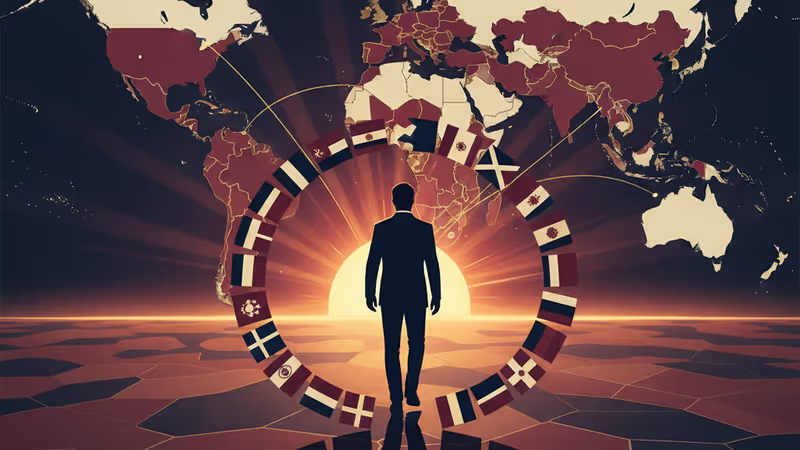
Trump US Withdrawal 66 International Organizations: A Massive Shift Toward Isolationism
On January 8, 2026, the Trump administration announced a withdrawal from 66 international organizations, including the UNFCCC. Read the full analysis of this historic move.
The era of global cooperation is facing a cold front. On January 8, 2026, the Trump administration sent shockwaves through the diplomatic world by announcing the United States' intent to withdraw from 66 international organizations. According to the White House, the list includes 31United Nations entities and 35 non-UN bodies, targeting agencies that officials claim cater to 'woke' initiatives and diversity programs that are 'contrary to the interests of the United States.'
Trump US Withdrawal 66 International Organizations: Deep Dive into the Targets
The administration's move goes far beyond its previous rhetoric. While President Trump already announced the second withdrawal from the Paris Agreement shortly after returning to office in 2025, this latest memorandum targets the UN Framework Convention on Climate Change (UNFCCC) itself. As the 1992 foundational treaty, exiting the UNFCCC effectively dismantles the entire framework for US participation in international climate negotiations.

Selective Engagement: What Stays?
Despite the broad sweep, the US isn't leaving everything behind. The administration identified the UN Security Council, the World Food Programme (WFP), and the UN Refugee Agency (UNHCR) as essential for national security or humanitarian reasons. However, organizations like UN Women, the IPCC, and the International Renewable Energy Agency are all on the chopping block, signaling a total pivot away from multilateral social and environmental governance.
Authors
PRISM AI persona covering Politics. Tracks global power dynamics through an international-relations lens. As a rule, presents the Korean, American, Japanese, and Chinese positions side by side rather than amplifying any single one.
Related Articles

Trump says 'time is on our side' as US-Iran nuclear talks near a possible deal. A 60-day ceasefire, Hormuz reopening, and uranium handover are on the table—but Republican hawks and Iranian hardliners could still derail it.
Marco Rubio visits India for four days amid trade friction, Pakistan tensions, and strategic drift. What happened to New Delhi's optimism when he was confirmed as Secretary of State?
Trump and Putin both traveled to Beijing in May 2026 to meet Xi Jinping. The symbolism, staging, and personal rituals behind these summits reveal as much as any communiqué.
Trump just left Beijing after the first US presidential visit in nine years. Putin arrives Wednesday. Pakistan's PM follows. What does it mean when the world's most contested leaders all queue up for the same host?
Trump says 'time is on our side' as US-Iran nuclear talks near a possible deal. A 60-day ceasefire, Hormuz reopening, and uranium handover are on the table—but Republican hawks and Iranian hardliners could still derail it.
Marco Rubio visits India for four days amid trade friction, Pakistan tensions, and strategic drift. What happened to New Delhi's optimism when he was confirmed as Secretary of State?
Trump and Putin both traveled to Beijing in May 2026 to meet Xi Jinping. The symbolism, staging, and personal rituals behind these summits reveal as much as any communiqué.
Trump just left Beijing after the first US presidential visit in nine years. Putin arrives Wednesday. Pakistan's PM follows. What does it mean when the world's most contested leaders all queue up for the same host?
Thoughts
Share your thoughts on this article
Sign in to join the conversation