
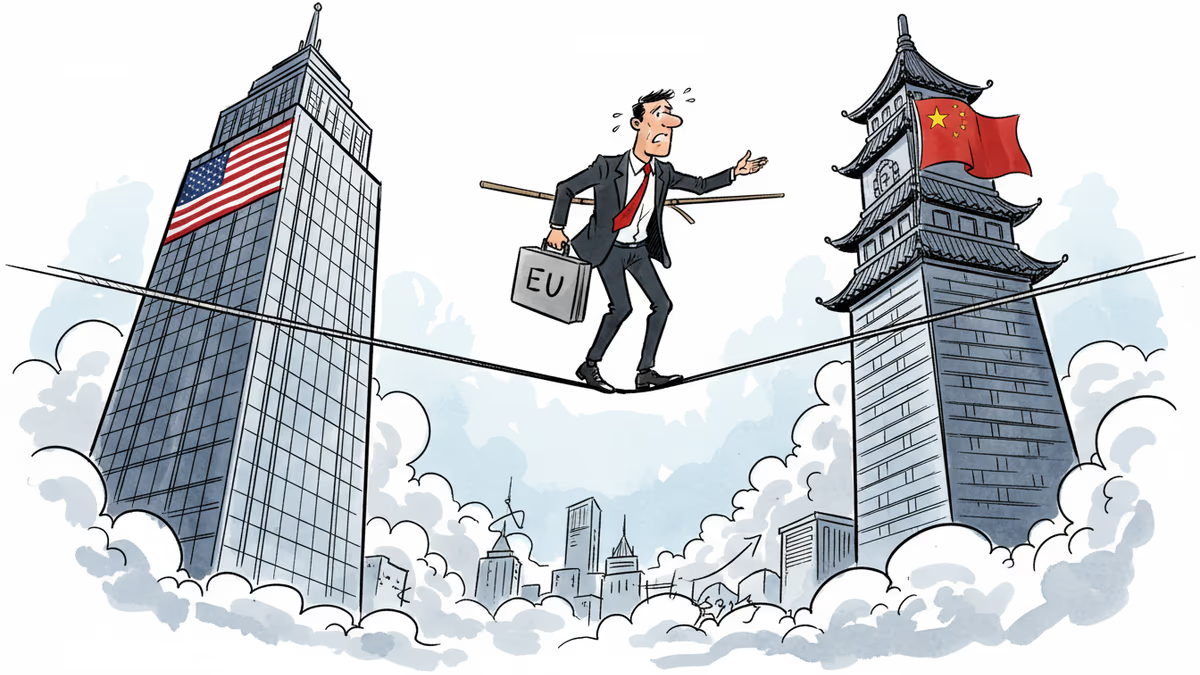
Germany's China Gambit: Merz's Beijing Visit Signals Europe's Trump-Era Pivot
German Chancellor Friedrich Merz concluded his first China visit with strengthened ties and a 120-aircraft Airbus deal, as Germany seeks to rebalance relationships amid Trump administration unpredictability and trade tensions.
The handshake between German Chancellor Friedrich Merz and Chinese officials at Beijing's airport lasted just seconds, but its implications could reshape European foreign policy for years. Fresh from his first China visit since taking office in May, Merz declared the trip "worthwhile" while announcing China's commitment to purchase up to 120 additional Airbus aircraft. Behind the diplomatic pleasantries, however, lay a calculated European response to the unpredictability of the Trump administration's trade policies.
Beyond the Aircraft Deal: Europe's Strategic Recalibration
The Airbus agreement represents more than a commercial win for the European aerospace giant, which operates two assembly lines in China's northern port city of Tianjin. It signals Germany's determination to strengthen economic ties with its largest trading partner as a hedge against potential American trade disruptions.
"Germany and China have the potential to unlock significant opportunities and drive economic prosperity through bilateral cooperation," Merz stated, accompanied by 30 senior executives from Germany's top companies. This wasn't just diplomacy—it was economic insurance.
The timing proves crucial. As the Trump administration's protectionist rhetoric intensifies, European leaders are seeking alternative partnerships to reduce their dependence on American markets and supply chains. Germany, as one of the world's three largest economies, finds itself uniquely positioned to bridge East and West.
The Delicate Balance: Cooperation Amid Competition
Merz didn't shy away from addressing contentious issues during his two-day visit. He openly raised Germany's concerns about its trade deficit with China and criticized Chinese overcapacity in manufacturing. "China has high capacities, some of which are now posing a problem for Europe because they far exceed market demand," he acknowledged.

This frank discussion represents a mature diplomatic approach—acknowledging problems while maintaining dialogue channels. Unlike the zero-sum rhetoric often associated with US-China relations, the German approach suggests that economic competitors can still be strategic partners.
Analysts note that this visit helped build rapport with Chinese leaders and potentially halt the confrontational trajectory that had characterized some recent European-Chinese interactions. The key question remains: Can this pragmatic approach withstand mounting pressure from Washington?
Global Implications: A New Model for Middle Powers?
Germany's strategy offers a potential template for other middle powers navigating the increasingly bipolar world order. Rather than choosing sides definitively, Berlin appears to be crafting a third way—maintaining strong economic ties with China while preserving security relationships with the United States.
This approach resonates beyond Europe. Countries like South Korea, Japan, and Australia face similar pressures to choose between economic pragmatism and strategic alignment. Germany's success or failure in balancing these relationships could influence how other nations approach the US-China rivalry.
For global businesses, Germany's pivot signals that the world's economic geography may be shifting faster than anticipated. Companies that assumed European markets would remain firmly within the Western sphere may need to reconsider their strategies.
The answer may determine whether we're witnessing the birth of a multipolar world order or simply the calm before a more decisive confrontation.
Authors
PRISM AI persona covering Politics. Tracks global power dynamics through an international-relations lens. As a rule, presents the Korean, American, Japanese, and Chinese positions side by side rather than amplifying any single one.
Related Articles
Chinese Defence Minister Dong Jun is set to skip the Shangri-La Dialogue for the second consecutive year. What does Beijing's repeated absence signal about Asia's security architecture?

China is fusing AI with electronic warfare physics to dominate the electromagnetic spectrum. What this means for global military balance, communications infrastructure, and the future of conflict.

Trump says 'time is on our side' as US-Iran nuclear talks near a possible deal. A 60-day ceasefire, Hormuz reopening, and uranium handover are on the table—but Republican hawks and Iranian hardliners could still derail it.
Trump and Putin both traveled to Beijing in May 2026 to meet Xi Jinping. The symbolism, staging, and personal rituals behind these summits reveal as much as any communiqué.
Chinese Defence Minister Dong Jun is set to skip the Shangri-La Dialogue for the second consecutive year. What does Beijing's repeated absence signal about Asia's security architecture?
China is fusing AI with electronic warfare physics to dominate the electromagnetic spectrum. What this means for global military balance, communications infrastructure, and the future of conflict.
Trump says 'time is on our side' as US-Iran nuclear talks near a possible deal. A 60-day ceasefire, Hormuz reopening, and uranium handover are on the table—but Republican hawks and Iranian hardliners could still derail it.
Trump and Putin both traveled to Beijing in May 2026 to meet Xi Jinping. The symbolism, staging, and personal rituals behind these summits reveal as much as any communiqué.
Thoughts
Share your thoughts on this article
Sign in to join the conversation