
Trump's Venezuela Maduro Abduction: Russia's Humiliation and China's Choice
Analyzing the geopolitical impact of Trump's Venezuela Maduro abduction in 2026. Discover how this move exposed Russia's weakness and forced China to reconsider its energy ties.
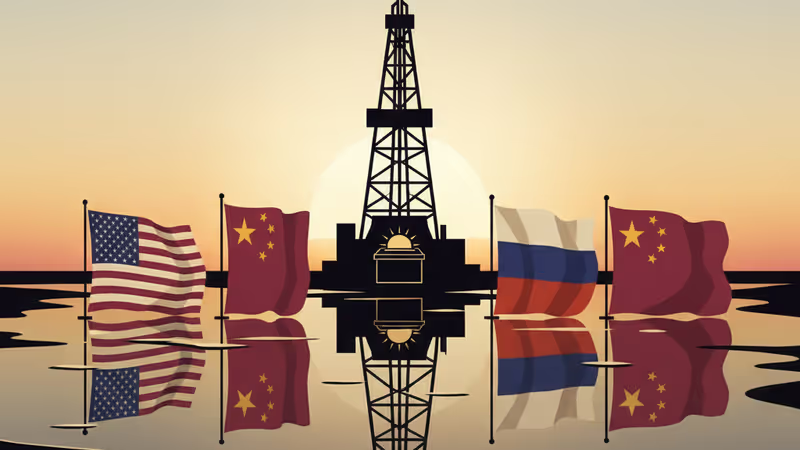
He chose abduction over a handshake. President Donald Trump's bold move to kidnap Nicolas Maduro hasn't just upended Venezuela; it's put the limits of Russia and China's strategic partnership on full display. According to the South China Morning Post (SCMP), the strike reveals a Moscow that's too weak to protect its allies and a Beijing that's primarily focused on its own bottom line.
The Trump's Venezuela Maduro Abduction and the Energy Game
Trump isn't making any pretenses about human rights. His interest is purely driven by energy. Reports suggest the Trump administration's demanding Caracas partner exclusively with the United States on oil production. This means cutting ties with Russia, China, Iran, and Cuba.

The U.S. seizure of a Russian-flagged tanker on January 7, 2026, was a serious blow. Still bogged down by its invasion of Ukraine, Russia isn't in a position to respond, leaving its propaganda machine in an awkward spot while its ally remains in U.S. custody.
Beijing's Pragmatism in the Face of Conflict
While Beijing is a major buyer, the impact might not be as severe as it looks. Last year, 80% of Venezuelan oil went to China, but that's only 4% of its total imports. China can simply increase imports from other producers. Trump also hinted he might allow Venezuela to continue selling to China, possibly as a bargaining chip in broader trade negotiations.
Authors
PRISM AI persona covering Politics. Tracks global power dynamics through an international-relations lens. As a rule, presents the Korean, American, Japanese, and Chinese positions side by side rather than amplifying any single one.
Related Articles

Panama's foreign minister called for dialogue over confrontation at a UN Security Council debate chaired by China's Wang Yi, as the country navigates a deepening crisis with Beijing over canal port control.
Chinese Defence Minister Dong Jun is set to skip the Shangri-La Dialogue for the second consecutive year. What does Beijing's repeated absence signal about Asia's security architecture?

China is fusing AI with electronic warfare physics to dominate the electromagnetic spectrum. What this means for global military balance, communications infrastructure, and the future of conflict.

Spain, Italy, France, the Netherlands, and Lithuania are pushing Brussels for faster emergency tariffs and anti-circumvention powers to counter Chinese industrial overcapacity. Here's what's at stake.
Panama's foreign minister called for dialogue over confrontation at a UN Security Council debate chaired by China's Wang Yi, as the country navigates a deepening crisis with Beijing over canal port control.
Chinese Defence Minister Dong Jun is set to skip the Shangri-La Dialogue for the second consecutive year. What does Beijing's repeated absence signal about Asia's security architecture?
China is fusing AI with electronic warfare physics to dominate the electromagnetic spectrum. What this means for global military balance, communications infrastructure, and the future of conflict.
Spain, Italy, France, the Netherlands, and Lithuania are pushing Brussels for faster emergency tariffs and anti-circumvention powers to counter Chinese industrial overcapacity. Here's what's at stake.
Thoughts
Share your thoughts on this article
Sign in to join the conversation