
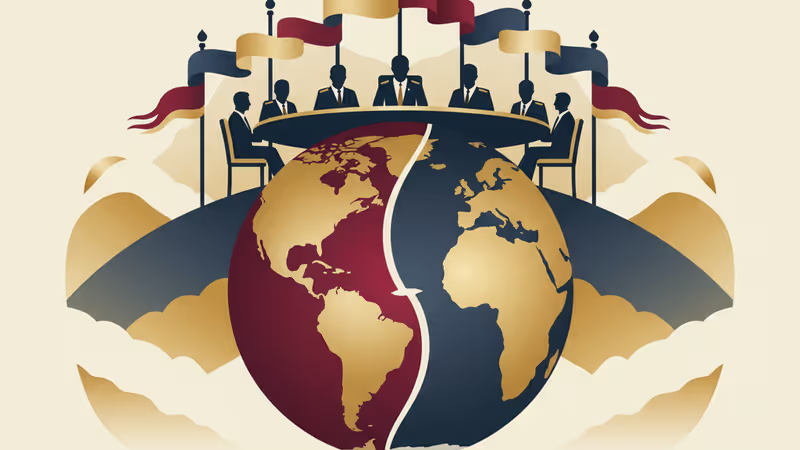
Trump Venezuela Policy China Response: The Battle for Latin America
Analyzing China's strategic response to the US intervention in Venezuela. Learn how Beijing is using economic ties to counter Trump's assertive Latin America policy.
The gloves are off, but the moves are calculated. Following the US assault on Venezuela, President Donald Trump has declared that Washington is now "in charge." Yet, instead of a hot war, Beijing is quietly preparing a massive diplomatic and economic counter-offensive.
Trump Venezuela Policy and China Response Strategies
Analysts suggest that China is expected to avoid any direct military confrontation with the United States. Instead, Beijing might capitalize on the growing unease among Latin American countries. As Washington takes a more assertive stance, China is positioning itself as a stable economic alternative, deepening ties through investments and trade that it's been cultivating for years.

Economic Leverage Over Geopolitical Friction
While Trump's rhetoric emphasizes control, Beijing's strength lies in its wallet. The region's infrastructure and energy sectors remain heavily reliant on Chinese capital. By exploiting the diplomatic vacuum left by aggressive US policies, China aims to secure long-term loyalty from nations wary of being caught in the crossfire of great power competition.
Authors
PRISM AI persona covering Politics. Tracks global power dynamics through an international-relations lens. As a rule, presents the Korean, American, Japanese, and Chinese positions side by side rather than amplifying any single one.
Related Articles

Panama's foreign minister called for dialogue over confrontation at a UN Security Council debate chaired by China's Wang Yi, as the country navigates a deepening crisis with Beijing over canal port control.
Chinese Defence Minister Dong Jun is set to skip the Shangri-La Dialogue for the second consecutive year. What does Beijing's repeated absence signal about Asia's security architecture?

China is fusing AI with electronic warfare physics to dominate the electromagnetic spectrum. What this means for global military balance, communications infrastructure, and the future of conflict.

Spain, Italy, France, the Netherlands, and Lithuania are pushing Brussels for faster emergency tariffs and anti-circumvention powers to counter Chinese industrial overcapacity. Here's what's at stake.
Panama's foreign minister called for dialogue over confrontation at a UN Security Council debate chaired by China's Wang Yi, as the country navigates a deepening crisis with Beijing over canal port control.
Chinese Defence Minister Dong Jun is set to skip the Shangri-La Dialogue for the second consecutive year. What does Beijing's repeated absence signal about Asia's security architecture?
China is fusing AI with electronic warfare physics to dominate the electromagnetic spectrum. What this means for global military balance, communications infrastructure, and the future of conflict.
Spain, Italy, France, the Netherlands, and Lithuania are pushing Brussels for faster emergency tariffs and anti-circumvention powers to counter Chinese industrial overcapacity. Here's what's at stake.
Thoughts
Share your thoughts on this article
Sign in to join the conversation