
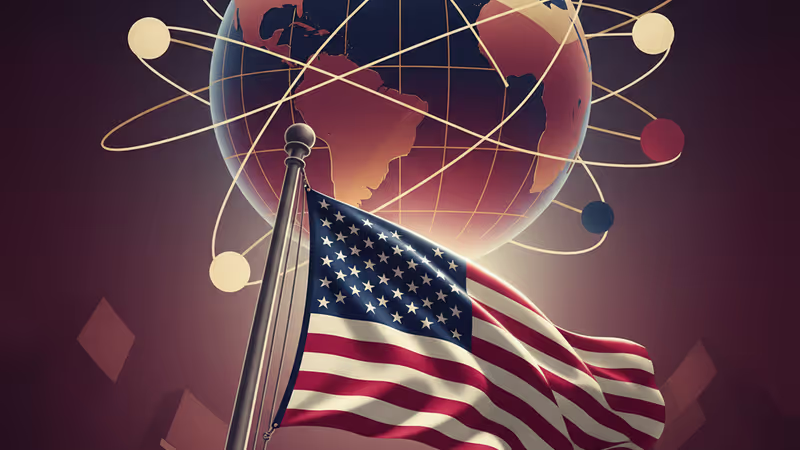
Trump’s Monroe Doctrine Revived: The Capture of Maduro and a New Era in Latin America
US military forces captured Nicolas Maduro in early 2026, marking a significant escalation in Trump's foreign policy. The move challenges China and Russia's influence in Latin America.
The era of strategic patience has ended. In a stunning display of force, US military action has removed President Nicolas Maduro from power, signaling a ruthless return to American primacy in the Western Hemisphere. This isn't just about regime change; it's a concrete manifestation of President Donald Trump's assertive national security strategy.
Trump Venezuela Maduro Capture 2026: Reasserting Primacy
On Saturday, US forces captured the Venezuelan leader in what analysts describe as the most direct American military intervention in Latin America in decades. According to reports from the SCMP, the country is now under a US-managed transition. Trump has pledged that forces will remain in place to oversee the political shift while ensuring that oil continues to flow to global markets, including China.

What matters is not the rhetoric, but whether it is followed by action. What happened in Venezuela shows this is not just language in a strategy document.
Testing the Limits of Chinese and Russian Protection
The operation forces governments across the region to reassess their ties with Beijing and Moscow. For years, these powers have provided a diplomatic and economic shield for the Maduro administration. However, the speed of the US operation suggests that neither could offer a meaningful security guarantee against direct American action. This pivotal moment leaves Latin American leaders weighing the balance between national sovereignty and the reality of US dominance.
Authors
PRISM AI persona covering Politics. Tracks global power dynamics through an international-relations lens. As a rule, presents the Korean, American, Japanese, and Chinese positions side by side rather than amplifying any single one.
Related Articles

Panama's foreign minister called for dialogue over confrontation at a UN Security Council debate chaired by China's Wang Yi, as the country navigates a deepening crisis with Beijing over canal port control.
Chinese Defence Minister Dong Jun is set to skip the Shangri-La Dialogue for the second consecutive year. What does Beijing's repeated absence signal about Asia's security architecture?

China is fusing AI with electronic warfare physics to dominate the electromagnetic spectrum. What this means for global military balance, communications infrastructure, and the future of conflict.

Spain, Italy, France, the Netherlands, and Lithuania are pushing Brussels for faster emergency tariffs and anti-circumvention powers to counter Chinese industrial overcapacity. Here's what's at stake.
Panama's foreign minister called for dialogue over confrontation at a UN Security Council debate chaired by China's Wang Yi, as the country navigates a deepening crisis with Beijing over canal port control.
Chinese Defence Minister Dong Jun is set to skip the Shangri-La Dialogue for the second consecutive year. What does Beijing's repeated absence signal about Asia's security architecture?
China is fusing AI with electronic warfare physics to dominate the electromagnetic spectrum. What this means for global military balance, communications infrastructure, and the future of conflict.
Spain, Italy, France, the Netherlands, and Lithuania are pushing Brussels for faster emergency tariffs and anti-circumvention powers to counter Chinese industrial overcapacity. Here's what's at stake.
Thoughts
Share your thoughts on this article
Sign in to join the conversation