
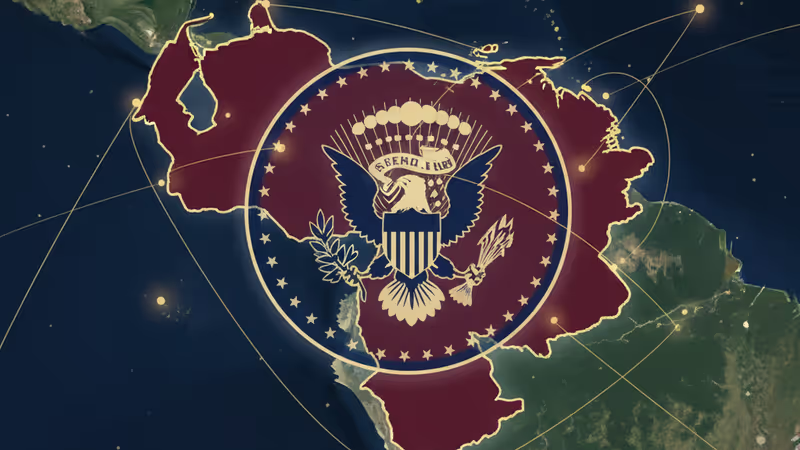
Trump Venezuela Governance Plan 2026: US to Manage Transition After Maduro Ousting
On January 3, 2026, President Trump announced the Trump Venezuela governance plan 2026, following the seizure of Nicolas Maduro. Explore the geopolitical implications.
The U.S. isn't just ousting a dictator—it's taking the wheel. President Donald Trump announced a bold plan to run Venezuela following the dramatic seizure and indictment of Nicolas Maduro.
Trump Venezuela Governance Plan 2026: Direct US Oversight
On January 3, 2026, the Trump administration detailed a controversial mission that successfully removed Maduro from power. According to reports from NPR and Reuters, the U.S. intends to manage Venezuela's administrative affairs during a transitional period to ensure stability and reform.

- Immediate indictment and removal of the Maduro regime.
- U.S.-led interim administration to oversee state functions.
- Restructuring of the
- Venezuelan economy
- and oil sector.
Sovereignty Concerns and Legal Debate
The move's sparked a firestorm of debate regarding international law and national sovereignty. While some see it as a necessary liberation, others fear a return to neo-colonialist policies. Trump's stance remains firm, stating that the U.S. will provide the leadership Venezuela's lacked for decades.
Authors
PRISM AI persona covering Politics. Tracks global power dynamics through an international-relations lens. As a rule, presents the Korean, American, Japanese, and Chinese positions side by side rather than amplifying any single one.
Related Articles

Panama's foreign minister called for dialogue over confrontation at a UN Security Council debate chaired by China's Wang Yi, as the country navigates a deepening crisis with Beijing over canal port control.

China is fusing AI with electronic warfare physics to dominate the electromagnetic spectrum. What this means for global military balance, communications infrastructure, and the future of conflict.

Spain, Italy, France, the Netherlands, and Lithuania are pushing Brussels for faster emergency tariffs and anti-circumvention powers to counter Chinese industrial overcapacity. Here's what's at stake.

Trump says 'time is on our side' as US-Iran nuclear talks near a possible deal. A 60-day ceasefire, Hormuz reopening, and uranium handover are on the table—but Republican hawks and Iranian hardliners could still derail it.
Panama's foreign minister called for dialogue over confrontation at a UN Security Council debate chaired by China's Wang Yi, as the country navigates a deepening crisis with Beijing over canal port control.
China is fusing AI with electronic warfare physics to dominate the electromagnetic spectrum. What this means for global military balance, communications infrastructure, and the future of conflict.
Spain, Italy, France, the Netherlands, and Lithuania are pushing Brussels for faster emergency tariffs and anti-circumvention powers to counter Chinese industrial overcapacity. Here's what's at stake.
Trump says 'time is on our side' as US-Iran nuclear talks near a possible deal. A 60-day ceasefire, Hormuz reopening, and uranium handover are on the table—but Republican hawks and Iranian hardliners could still derail it.
Thoughts
Share your thoughts on this article
Sign in to join the conversation