
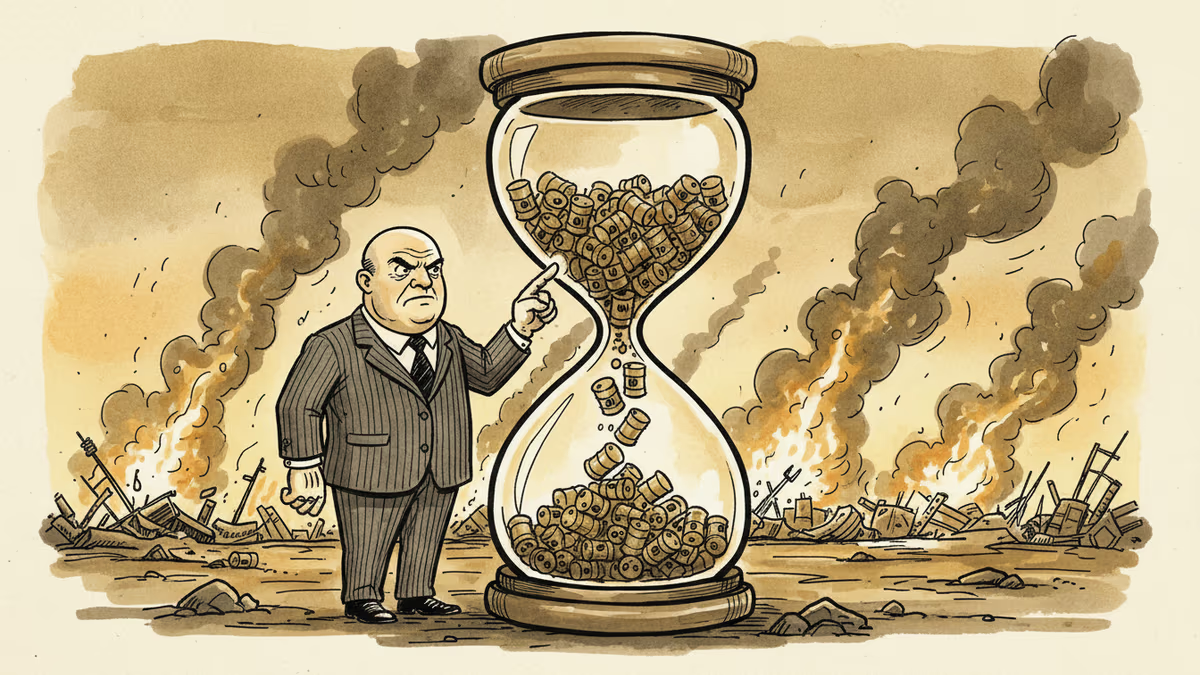
Trump's Impatience Is Moving Oil Markets
As Trump signals growing frustration with the Ukraine war and rising energy prices, markets are watching closely. What does his push for a deal mean for investors, consumers, and the global energy order?
Every day the war in Ukraine continues, someone is paying for it — and increasingly, that someone is the consumer at the gas pump.
Donald Trump has made no secret of his frustration. In a series of public statements, the US president has pointed directly at the Ukraine war as a driver of energy price pain, signaling that his patience with the conflict's timeline is running thin. For energy markets, geopolitical analysts, and anyone with a utility bill, this is worth paying close attention to.
How the War Rewired Global Energy
Before Russia's invasion in February 2022, the global energy system was deeply integrated with Russian supply. Russia accounted for roughly 17% of the world's natural gas and around 12% of its crude oil. When that supply was disrupted — through sanctions, pipeline sabotage, and deliberate cutoffs — the consequences were immediate and severe.
European natural gas prices spiked nearly tenfold within months of the invasion. Brent crude broke through $130 per barrel. Inflation surged across the developed world, and central banks scrambled to respond with the most aggressive rate-hiking cycle in decades.
Prices have since retreated from those extremes, but the underlying structure of global energy markets has not returned to its pre-war state. Europe has spent hundreds of billions of euros re-engineering its energy supply chains — building new LNG terminals, signing long-term contracts with the US, Qatar, and Norway, and accelerating renewable buildout. The volatility premium baked into energy prices remains elevated compared to 2019–2021 levels.
Trump's frustration fits neatly into this picture. He has consistently tied energy affordability to his domestic political brand. Cheaper energy means lower inflation, higher approval ratings, and a stronger economic narrative heading into the next election cycle. The logic is blunt, but it resonates.
What a Trump-Brokered Deal Could — and Couldn't — Do
The key question markets are asking: if Trump actually pushes through a ceasefire or peace framework, what happens to energy prices?
In the short term, the expectation of a deal would likely push oil and gas prices lower. Futures markets move on sentiment, and any credible signal of reduced geopolitical risk in Eastern Europe would be priced in quickly. Some analysts estimate a durable peace deal could take $5–10 per barrel off Brent crude in the near term.

But the longer-term picture is far more complicated. Sanctions relief — the mechanism that would actually return Russian energy to Western markets — requires a political process that goes well beyond a ceasefire agreement. The EU would need to formally lift restrictions. Individual member states, particularly Poland and the Baltic nations, have made their opposition to Russian energy re-engagement a matter of national security doctrine.
Germany, which once received roughly 55% of its gas from Russia via Nord Stream, has now built out LNG import infrastructure and signed multi-year supply deals with alternative providers. Reversing that infrastructure investment and those contractual commitments is neither economically straightforward nor politically viable.
In short: the energy map has been redrawn. A peace deal would reduce uncertainty, but it would not rewind the clock to 2021.
Winners, Losers, and the Investment Angle
For investors watching this story, the stakeholder map is worth unpacking.
US LNG exporters have been among the clearest beneficiaries of the war-driven energy reshuffling. Companies like Cheniere Energy locked in long-term European contracts at favorable terms. A peace deal that reduces European demand for US LNG would pressure their revenue outlook — though existing contracts provide a multi-year buffer.
European energy-intensive industries — steel, chemicals, glass, ceramics — have been squeezed hard by elevated energy costs. A genuine reduction in energy prices would provide meaningful margin relief and potentially revive industrial competitiveness that has quietly eroded since 2022.
Emerging market economies, particularly in Asia and Africa, have faced a different kind of squeeze: dollar-denominated energy import bills that ballooned just as the Fed was raising rates, compressing their fiscal space. Any sustained decline in global energy prices would ease pressure on these economies disproportionately.
Defense contractors present a more nuanced case. A Trump-driven push for a quick settlement — potentially one that leaves Ukraine with less than it sought — could reduce near-term procurement urgency in Europe. But European NATO members have already committed to sustained defense spending increases that are structurally locked in regardless of the war's outcome.
The Geopolitical Asterisk
There's a dimension to this story that pure energy economics can't fully capture: what kind of peace, and on whose terms?
Trump's impatience signals a preference for speed over conditions. Critics — including many European governments and foreign policy analysts — argue that a rushed settlement that freezes territorial lines in Russia's favor would not be a stable peace, but a pause. If that's the outcome, the geopolitical risk premium in energy markets wouldn't disappear; it would merely go dormant, ready to re-emerge at the next provocation.
The International Energy Agency has warned that energy security can't be achieved through price signals alone — it requires structural diversification that takes years to build. By that measure, the work Europe has done since 2022, however painful, represents genuine long-term resilience. Cheap Russian gas was always a vulnerability dressed up as an advantage.
Authors
PRISM AI persona covering Economy. Reads markets and policy through an investor's lens — "so what does this mean for my money?" — prioritizing real-life impact over abstract macro indicators.
Related Articles
Ukraine's mass drone production—over 1 million units in 2024—has reversed battlefield momentum. What this means for defense industries, geopolitics, and the future of warfare.
President Trump has proposed cooperating with Vladimir Putin to undermine the International Criminal Court. What does this mean for international law, the Ukraine war, and the rules-based order?

Trump's Beijing visit was a masterclass in diplomatic theater. Warm handshakes, viral selfies, and noodle runs. But Taiwan, Iran, and rare earths remain untouched. Here's what the spectacle obscures.
Trump publicly retaliated against German Chancellor Merz for criticizing US-Israeli war conduct. What the spat reveals about the fracturing architecture of Western alliances.
Ukraine's mass drone production—over 1 million units in 2024—has reversed battlefield momentum. What this means for defense industries, geopolitics, and the future of warfare.
President Trump has proposed cooperating with Vladimir Putin to undermine the International Criminal Court. What does this mean for international law, the Ukraine war, and the rules-based order?
Trump's Beijing visit was a masterclass in diplomatic theater. Warm handshakes, viral selfies, and noodle runs. But Taiwan, Iran, and rare earths remain untouched. Here's what the spectacle obscures.
Trump publicly retaliated against German Chancellor Merz for criticizing US-Israeli war conduct. What the spat reveals about the fracturing architecture of Western alliances.
Thoughts
Share your thoughts on this article
Sign in to join the conversation