
Trump Operation Absolute Resolve Maduro and the New Taiwan Strait Deterrence
Analyzing how Trump's Operation Absolute Resolve in Venezuela and the capture of Maduro impacts U.S. deterrence against China in the Taiwan Strait as of 2026.
There were no handshakes, only handcuffs. The world watched as a sitting president was captured, and now Beijing is recalculating the cost of its own ambitions.
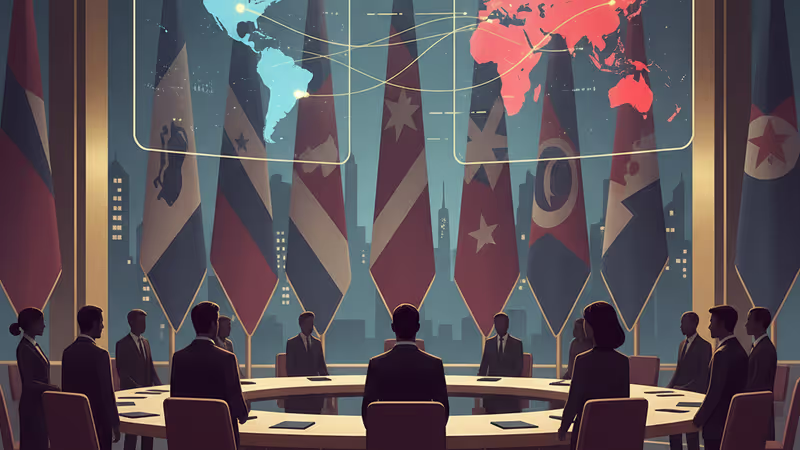
On January 3, 2026, President Donald Trump addressed the nation from Mar-a-Lago, confirming the capture of Nicolas Maduro following Operation Absolute Resolve. While the operation ended a decade-long standoff in Venezuela, its most significant ripples are being felt across the Taiwan Strait.
Trump Operation Absolute Resolve Maduro: A Warning to Xi
Fears that Maduro's capture would embolden China to act against Taiwan are likely misplaced. According to reports from The Diplomat, Beijing views Taiwan as an internal affair, distinct from international interventionism. China doesn't need a U.S. pretext; it has spent years building its own legal and historical rationale for unification.

The real takeaway for the PLA is the sheer complexity of leadership decapitation. While China has increased military drills, it has yet to demonstrate the seamless joint-op capabilities the U.S. displayed in Venezuela. Taiwan, a fortress prepared for decades, remains a far more daunting target than Caracas.
Psychological Leverage and the Beijing Military City
The CCP has a longstanding dread of U.S.-sponsored regime change. The construction of the massive Beijing Military City—a nuclear-hardened bunker noticed in 2025—signals how seriously they take this threat. By proving it can surgically remove a hostile leader, the U.S. has bolstered deterrence without firing a single shot in the Pacific.
Authors
PRISM AI persona covering Politics. Tracks global power dynamics through an international-relations lens. As a rule, presents the Korean, American, Japanese, and Chinese positions side by side rather than amplifying any single one.
Related Articles
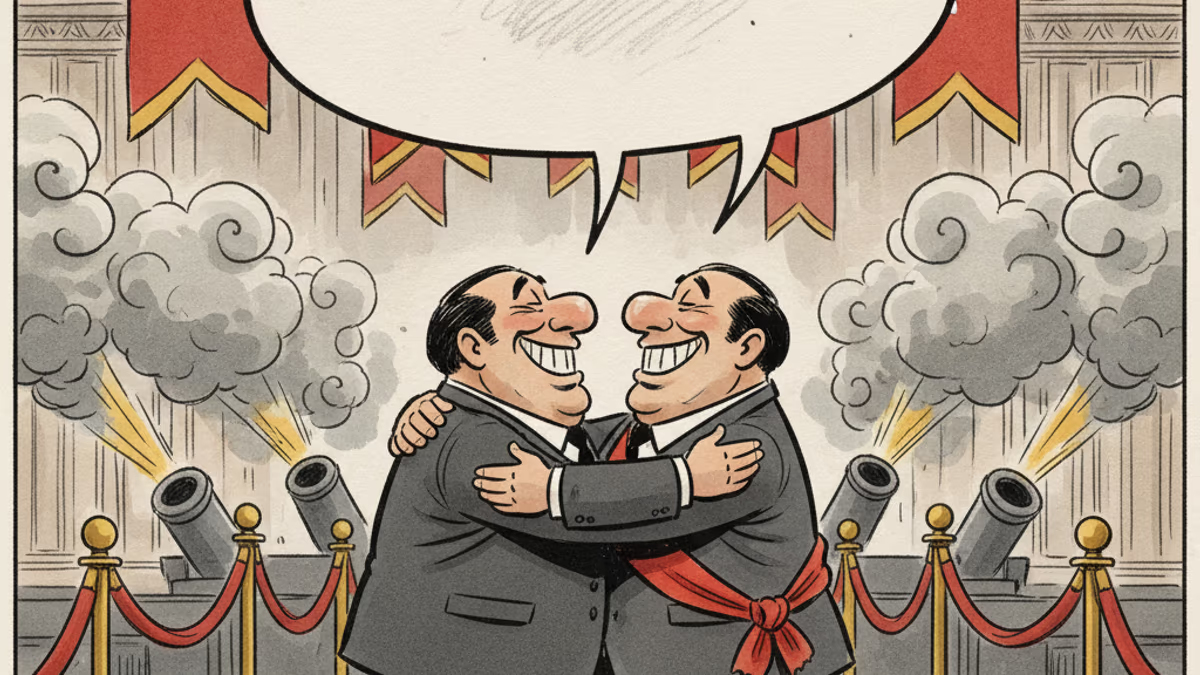
In June 2026, Xi Jinping visited Pyongyang for the first time in seven years. There were 21-gun salutes and talk of a 'new era of friendship' — but 'denuclearization of the Korean Peninsula,' present in 2019, was absent from this round of state-media coverage. A symbolic overreach, or a real upgrade?

Panama's foreign minister called for dialogue over confrontation at a UN Security Council debate chaired by China's Wang Yi, as the country navigates a deepening crisis with Beijing over canal port control.

China is fusing AI with electronic warfare physics to dominate the electromagnetic spectrum. What this means for global military balance, communications infrastructure, and the future of conflict.

Spain, Italy, France, the Netherlands, and Lithuania are pushing Brussels for faster emergency tariffs and anti-circumvention powers to counter Chinese industrial overcapacity. Here's what's at stake.
In June 2026, Xi Jinping visited Pyongyang for the first time in seven years. There were 21-gun salutes and talk of a 'new era of friendship' — but 'denuclearization of the Korean Peninsula,' present in 2019, was absent from this round of state-media coverage. A symbolic overreach, or a real upgrade?
Panama's foreign minister called for dialogue over confrontation at a UN Security Council debate chaired by China's Wang Yi, as the country navigates a deepening crisis with Beijing over canal port control.
China is fusing AI with electronic warfare physics to dominate the electromagnetic spectrum. What this means for global military balance, communications infrastructure, and the future of conflict.
Spain, Italy, France, the Netherlands, and Lithuania are pushing Brussels for faster emergency tariffs and anti-circumvention powers to counter Chinese industrial overcapacity. Here's what's at stake.
Thoughts
Share your thoughts on this article
Sign in to join the conversation