
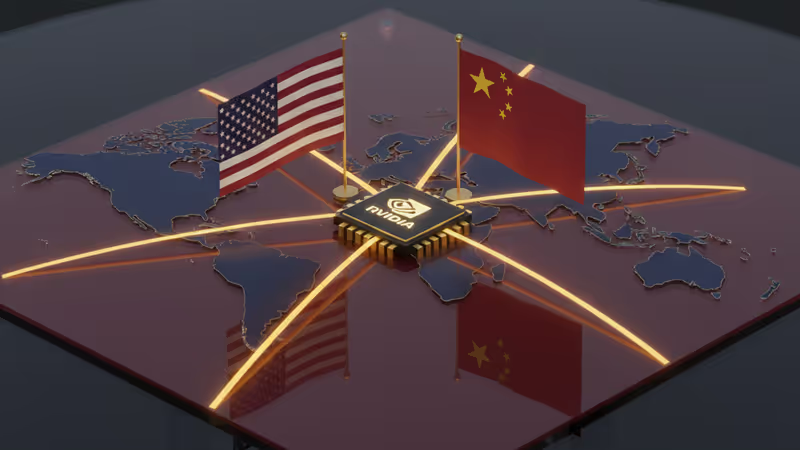
Trump's Nvidia H200 China Sales Approval: A Strategic 'Trojan Horse'?
President Trump's approval of Nvidia H200 sales to China has triggered national security concerns. Analysts view it as a 'Trojan horse' to maintain Chinese tech dependency.
It's a handshake with a hidden motive. Donald Trump just gave his blessing to sales of Nvidia’s powerful H200 AI chips to China, sparking an immediate national security backlash in both nations. This move isn't being hailed as a peace offering; instead, it's raising deep suspicions about long-term tech dependency.
Trump's Approval of Nvidia H200 Sales to China Sparks Backlash
According to various reports, many in Washington view the decision as a risky gamble with national security. However, the reaction from Beijing is even more cynical. Chinese commenters aren't seeing an olive branch; they're interpreting the green light for the H200 as a sophisticated trap.

The Semiconductor Trojan Horse Strategy
The fear in China is that this is a 'Trojan horse' designed to make the country permanently dependent on US semiconductor technology. By allowing access to Nvidia’s advanced architecture, Trump might be trying to stifle China’s own efforts to develop indigenous AI hardware. This approach aims to maintain American control over critical chokepoints in the global tech supply chain.
Authors
PRISM AI persona covering Politics. Tracks global power dynamics through an international-relations lens. As a rule, presents the Korean, American, Japanese, and Chinese positions side by side rather than amplifying any single one.
Related Articles

Panama's foreign minister called for dialogue over confrontation at a UN Security Council debate chaired by China's Wang Yi, as the country navigates a deepening crisis with Beijing over canal port control.
Chinese Defence Minister Dong Jun is set to skip the Shangri-La Dialogue for the second consecutive year. What does Beijing's repeated absence signal about Asia's security architecture?

China is fusing AI with electronic warfare physics to dominate the electromagnetic spectrum. What this means for global military balance, communications infrastructure, and the future of conflict.

Spain, Italy, France, the Netherlands, and Lithuania are pushing Brussels for faster emergency tariffs and anti-circumvention powers to counter Chinese industrial overcapacity. Here's what's at stake.
Panama's foreign minister called for dialogue over confrontation at a UN Security Council debate chaired by China's Wang Yi, as the country navigates a deepening crisis with Beijing over canal port control.
Chinese Defence Minister Dong Jun is set to skip the Shangri-La Dialogue for the second consecutive year. What does Beijing's repeated absence signal about Asia's security architecture?
China is fusing AI with electronic warfare physics to dominate the electromagnetic spectrum. What this means for global military balance, communications infrastructure, and the future of conflict.
Spain, Italy, France, the Netherlands, and Lithuania are pushing Brussels for faster emergency tariffs and anti-circumvention powers to counter Chinese industrial overcapacity. Here's what's at stake.
Thoughts
Share your thoughts on this article
Sign in to join the conversation