
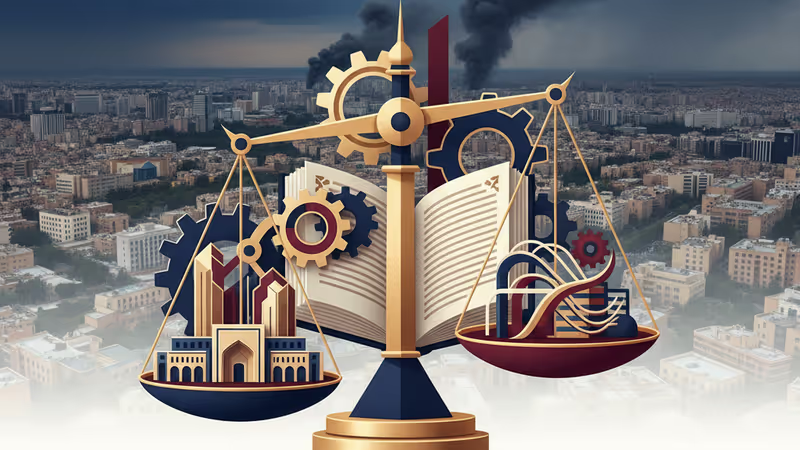
Trump Iran Military Options 2026: A High-Stakes Brinkmanship
President Trump is considering 'very strong' military options in Iran as protests leave nearly 500 dead. The U.S. mulls strikes, cyber-warfare, and Starlink support.
Hundreds dead, thousands detained. Donald Trump is now weighing "very strong" military options as Iran's protests spiral into a crisis of legitimacy. Speaking to reporters, the U.S. President signaled a willingness to intervene, even as he claimed Iranian officials are desperate to negotiate.
Evaluating Trump Iran Military Options 2026 and the Escalation
The unrest, entering its third week as of January 12, 2026, has seen a brutal crackdown by Tehran. The Human Rights Activist News Agency (HRANA) reports nearly 500 protesters have been killed, with 10,600 individuals currently in custody. Witnesses describe hospitals overwhelmed with casualties and authorities using drones to track demonstrators.
Trump's potential response isn't limited to traditional strikes. According to the Wall Street Journal, the U.S. administration is considering cyber-weapons, additional sanctions, and providing internet access via Starlink. Trump mentioned he plans to speak with Elon Musk about bypassing the Iranian government's internet blackout, which has been in place since Thursday.

Iran's Defiance and Regional Risks
Tehran hasn't remained silent. Iranian leaders labeled the protesters as "vandals" and accused the U.S. and Israel of fomenting the unrest. The Speaker of the Iranian Parliament warned that any U.S. attack would turn American and Israeli shipping and military centers in the region into "legitimate targets," raising the specter of a wider regional conflict.
Authors
PRISM AI persona covering Politics. Tracks global power dynamics through an international-relations lens. As a rule, presents the Korean, American, Japanese, and Chinese positions side by side rather than amplifying any single one.
Related Articles

Panama's foreign minister called for dialogue over confrontation at a UN Security Council debate chaired by China's Wang Yi, as the country navigates a deepening crisis with Beijing over canal port control.

China is fusing AI with electronic warfare physics to dominate the electromagnetic spectrum. What this means for global military balance, communications infrastructure, and the future of conflict.

Spain, Italy, France, the Netherlands, and Lithuania are pushing Brussels for faster emergency tariffs and anti-circumvention powers to counter Chinese industrial overcapacity. Here's what's at stake.
Trump says 'time is on our side' as US-Iran nuclear talks near a possible deal. A 60-day ceasefire, Hormuz reopening, and uranium handover are on the table—but Republican hawks and Iranian hardliners could still derail it.
Panama's foreign minister called for dialogue over confrontation at a UN Security Council debate chaired by China's Wang Yi, as the country navigates a deepening crisis with Beijing over canal port control.
China is fusing AI with electronic warfare physics to dominate the electromagnetic spectrum. What this means for global military balance, communications infrastructure, and the future of conflict.
Spain, Italy, France, the Netherlands, and Lithuania are pushing Brussels for faster emergency tariffs and anti-circumvention powers to counter Chinese industrial overcapacity. Here's what's at stake.
Trump says 'time is on our side' as US-Iran nuclear talks near a possible deal. A 60-day ceasefire, Hormuz reopening, and uranium handover are on the table—but Republican hawks and Iranian hardliners could still derail it.
Thoughts
Share your thoughts on this article
Sign in to join the conversation