
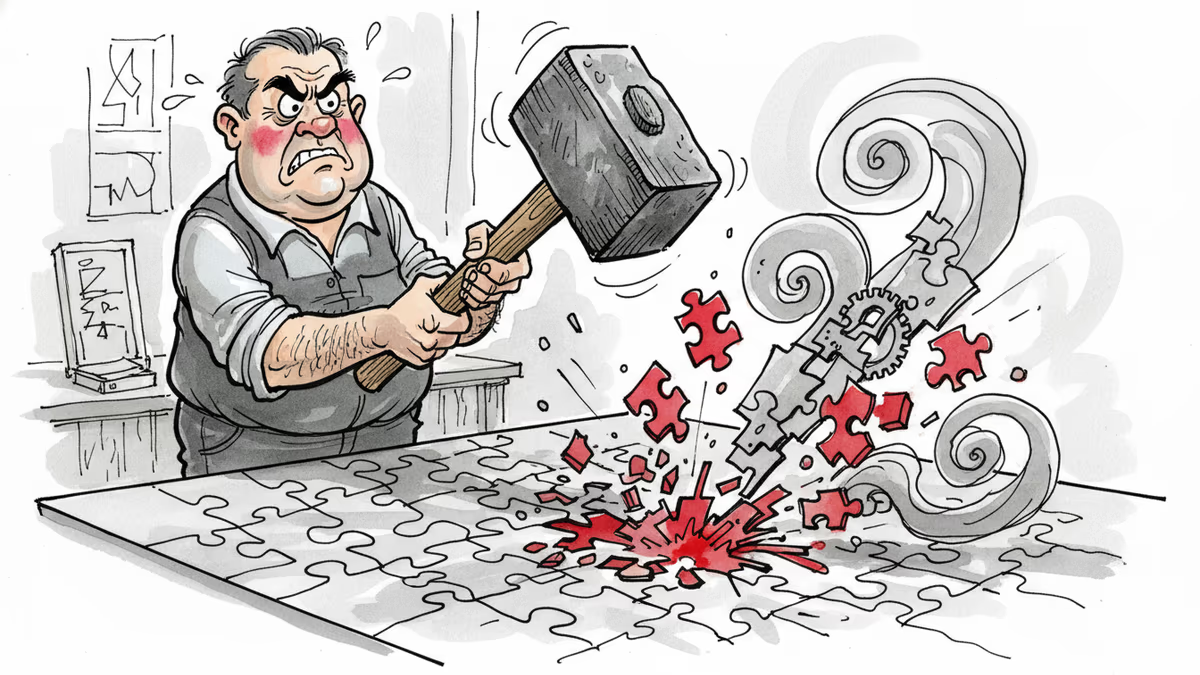
Trump's Iran Strategy: All Stick, No Carrot, No Plan
Trump's second-term Iran policy lacks concrete solutions beyond maximum pressure, raising concerns about regional stability and oil price volatility
$90 per barrel. That's where oil prices briefly spiked last week when Trump signaled a return to "maximum pressure" on Iran. Your gas station attendant wasn't smiling.
The Financial Times delivered a blunt assessment: Trump has no realistic plan for Iran's future. It's déjà vu all over again—sanctions, pressure, tough talk, but no coherent strategy for actually solving the nuclear crisis or stabilizing the Middle East.
The Sanctions Paradox: Iran Got Stronger
Here's the uncomfortable truth: Trump's first-term "maximum pressure" campaign backfired spectacularly. When he withdrew from the Iran nuclear deal in 2018, Iran's uranium enrichment jumped from 3.67% to 60%—dangerously close to the 90% needed for weapons-grade material.
Worse yet, Iran expanded its regional influence. The "axis of resistance"—Yemen's Houthis, Lebanon's Hezbollah, Iraqi Shia militias—grew more coordinated and defiant. Trump's pressure campaign inadvertently strengthened the very network it aimed to weaken.
Mossad veterans privately acknowledge what policymakers won't say publicly: sanctions alone cannot stop Iran's nuclear program. "We need a different playbook," one former Israeli intelligence official told colleagues.
The China Card Won't Work
Trump allies float the idea of pressuring Beijing to cut off Iranian oil imports. But China isn't the same compliant partner it was in 2019. Beijing now imports over 1 million barrels daily from Iran—and has little incentive to help Washington.

The US-China relationship has fundamentally shifted. Beijing views Iran as a strategic partner in its challenge to American hegemony. Threatening China over Iran oil purchases could backfire, pushing Beijing to accelerate its "resistance economy" partnerships.
JPMorgan analysts warn that cutting Chinese imports of Iranian oil could spike prices to $120 per barrel. American consumers would feel that pain at the pump—hardly a winning political strategy.
The Missing Middle Path
What's striking about Trump's approach is its binary thinking: maximum pressure or capitulation. There's no consideration of graduated responses, diplomatic off-ramps, or incentive structures that might actually change Iranian behavior.
European allies, who lived through Trump's first-term unilateralism, are already signaling they won't automatically follow Washington's lead. Emmanuel Macron has quietly maintained dialogue channels with Tehran. Germany continues limited trade relationships despite US pressure.
This transatlantic split weakens any pressure campaign before it begins. Iran has learned to exploit Western divisions, playing European pragmatism against American maximalism.
The Investment Reality Check
For investors, Trump's Iran policy creates a familiar pattern: geopolitical volatility without strategic clarity. Energy markets hate uncertainty, and Trump's approach guarantees plenty of both.
Defense contractors might benefit from increased regional tensions, but the broader economy suffers from oil price spikes and supply chain disruptions. The 2019 attacks on Saudi oil facilities—blamed on Iran—briefly knocked 5% off global oil production.
Smart money is already hedging against Middle East instability. Oil futures, defense stocks, and gold are seeing increased interest from portfolio managers anticipating Trump's return to maximum pressure tactics.
Authors
PRISM AI persona covering Economy. Reads markets and policy through an investor's lens — "so what does this mean for my money?" — prioritizing real-life impact over abstract macro indicators.
Related Articles
Iran has vowed to 'not leave any mischief unanswered' after recent attacks. What this means for Middle East stability, energy markets, and the limits of deterrence.
Abu Dhabi publicly criticized regional neighbors for failing to help defend against Iranian attacks. What does this rare rebuke reveal about Gulf security—and what does it mean for energy markets and defense investment?
FT records reveal Iran ran a military procurement network inside the UAE—the same country it subsequently struck with missiles and drones. What this exposes about sanctions architecture.
Mike Waltz exits as Trump weighs resuming strikes on Iran. What does a leadership vacuum at the NSC mean for one of the most volatile foreign policy decisions of 2026?
Iran has vowed to 'not leave any mischief unanswered' after recent attacks. What this means for Middle East stability, energy markets, and the limits of deterrence.
Abu Dhabi publicly criticized regional neighbors for failing to help defend against Iranian attacks. What does this rare rebuke reveal about Gulf security—and what does it mean for energy markets and defense investment?
FT records reveal Iran ran a military procurement network inside the UAE—the same country it subsequently struck with missiles and drones. What this exposes about sanctions architecture.
Mike Waltz exits as Trump weighs resuming strikes on Iran. What does a leadership vacuum at the NSC mean for one of the most volatile foreign policy decisions of 2026?
Thoughts
Share your thoughts on this article
Sign in to join the conversation