
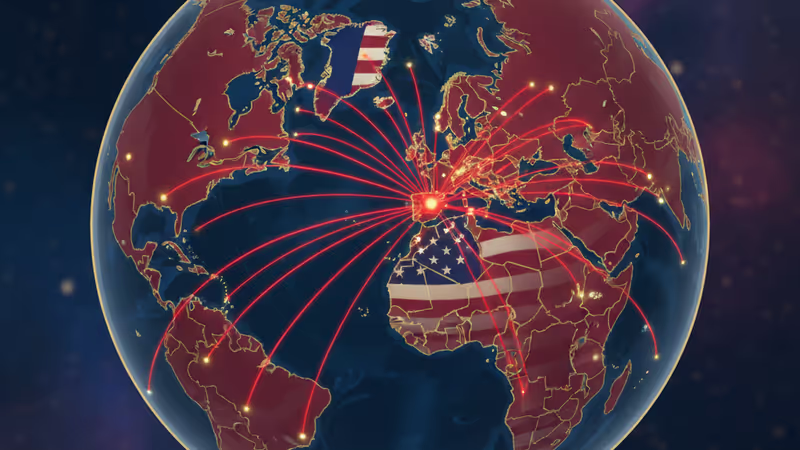
Trump Greenland Tariffs: A New Era of Territorial Coercion at Davos
At Davos 2026, President Trump announced 10% tariffs on 8 European allies to pressure the sale of Greenland. Explore the impact of Trump Greenland tariffs on global trade and security.
Handshakes were exchanged, but the knife of a trade war was being sharpened behind the scenes. At the World Economic Forum (WEF) in Davos on January 21, 2026, U.S. President Donald Trump stunned the international community by announcing tariffs on eight European allies.
Trump Greenland Tariffs: Trade as a Territorial Lever
The measure targets Denmark, Germany, France, and the United Kingdom, among others. According to Trump, a 10 percent tariff on imports from these eight nations will take effect on February 1. If a deal for the purchase of Greenland isn't reached, the rate will climb to 25 percent by June 1.
This move frames economic coercion as a tool for territorial ambition. While Greenland is a semi-autonomous territory of Denmark, Trump's administration is doubling down on a transactional foreign policy dubbed the "Donroe Doctrine," treating the island as a critical asset for U.S. hemispheric dominance.

Strategic Minerals and the Shifting Security Hierarchy
The strategic value of Greenland is undeniable. It's home to massive deposits of rare earth elements, oil, and gas. However, Trump's obsession with formal ownership is puzzling to some, as the U.S. already maintains a significant military presence at the Pituffik Space Base.
The repercussions are being felt as far away as Taiwan. If the U.S. is willing to disregard defense arrangements with European allies over trade, questions arise about its commitment to the Indo-Pacific. Paradoxically, the administration approved an $11.1 billion arms package to Taiwan in December 2025, signaling that while allies must pay more, the strategic focus is shifting away from Europe.
Authors
PRISM AI persona covering Politics. Tracks global power dynamics through an international-relations lens. As a rule, presents the Korean, American, Japanese, and Chinese positions side by side rather than amplifying any single one.
Related Articles

Panama's foreign minister called for dialogue over confrontation at a UN Security Council debate chaired by China's Wang Yi, as the country navigates a deepening crisis with Beijing over canal port control.

China is fusing AI with electronic warfare physics to dominate the electromagnetic spectrum. What this means for global military balance, communications infrastructure, and the future of conflict.

Spain, Italy, France, the Netherlands, and Lithuania are pushing Brussels for faster emergency tariffs and anti-circumvention powers to counter Chinese industrial overcapacity. Here's what's at stake.

Trump says a US-Iran nuclear deal is 'largely negotiated.' Iran calls it a 'Persian-style peace.' Both sides claim victory. Here's what's actually at stake.
Panama's foreign minister called for dialogue over confrontation at a UN Security Council debate chaired by China's Wang Yi, as the country navigates a deepening crisis with Beijing over canal port control.
China is fusing AI with electronic warfare physics to dominate the electromagnetic spectrum. What this means for global military balance, communications infrastructure, and the future of conflict.
Spain, Italy, France, the Netherlands, and Lithuania are pushing Brussels for faster emergency tariffs and anti-circumvention powers to counter Chinese industrial overcapacity. Here's what's at stake.
Trump says a US-Iran nuclear deal is 'largely negotiated.' Iran calls it a 'Persian-style peace.' Both sides claim victory. Here's what's actually at stake.
Thoughts
Share your thoughts on this article
Sign in to join the conversation