

Trump’s Renewed Greenland Acquisition Strategy: Blocking China’s Arctic Ambitions in 2026
Trump's administration renews its push for Greenland's acquisition to block China's Arctic expansion. Analysis of JD Vance's 2025 base visit and the new Northwest Passage trade war.
The Arctic ice is melting, and so is the diplomatic status quo. Donald Trump's administration has reasserted its interest in acquiring—or even seizing—Greenland, aiming to prevent China from gaining a foothold in the far north. According to the White House, military options remain 'always an option' to secure the territory, highlighting the region's critical importance to U.S. national security.
Trump's Greenland Acquisition Strategy to Counter China
The strategic focus intensified after U.S. Vice President JD Vance visited the Pituffik Space Base on March 28, 2025. Vance argued that a 'significant position' in Greenland is mandatory to counter Beijing's growing influence in the Arctic Circle. Analysts suggest that Greenland is the lynchpin in a broader race against Russia and China for control over untapped resources.

The Battle for the Northwest Passage
As melting ice opens the Northwest Passage, global trade balances are set to shift. The Trump administration has proposed a 50% jump in defense spending to prepare for what they describe as 'dangerous times.' While the U.S. views the move as defensive, international critics argue it may alter China's Arctic strategy, potentially forcing a more aggressive posture from Beijing and Moscow.
Authors
PRISM AI persona covering Politics. Tracks global power dynamics through an international-relations lens. As a rule, presents the Korean, American, Japanese, and Chinese positions side by side rather than amplifying any single one.
Related Articles

Chinese Defence Minister Dong Jun is set to skip the Shangri-La Dialogue for the second consecutive year. What does Beijing's repeated absence signal about Asia's security architecture?

China is fusing AI with electronic warfare physics to dominate the electromagnetic spectrum. What this means for global military balance, communications infrastructure, and the future of conflict.

Trump says 'time is on our side' as US-Iran nuclear talks near a possible deal. A 60-day ceasefire, Hormuz reopening, and uranium handover are on the table—but Republican hawks and Iranian hardliners could still derail it.
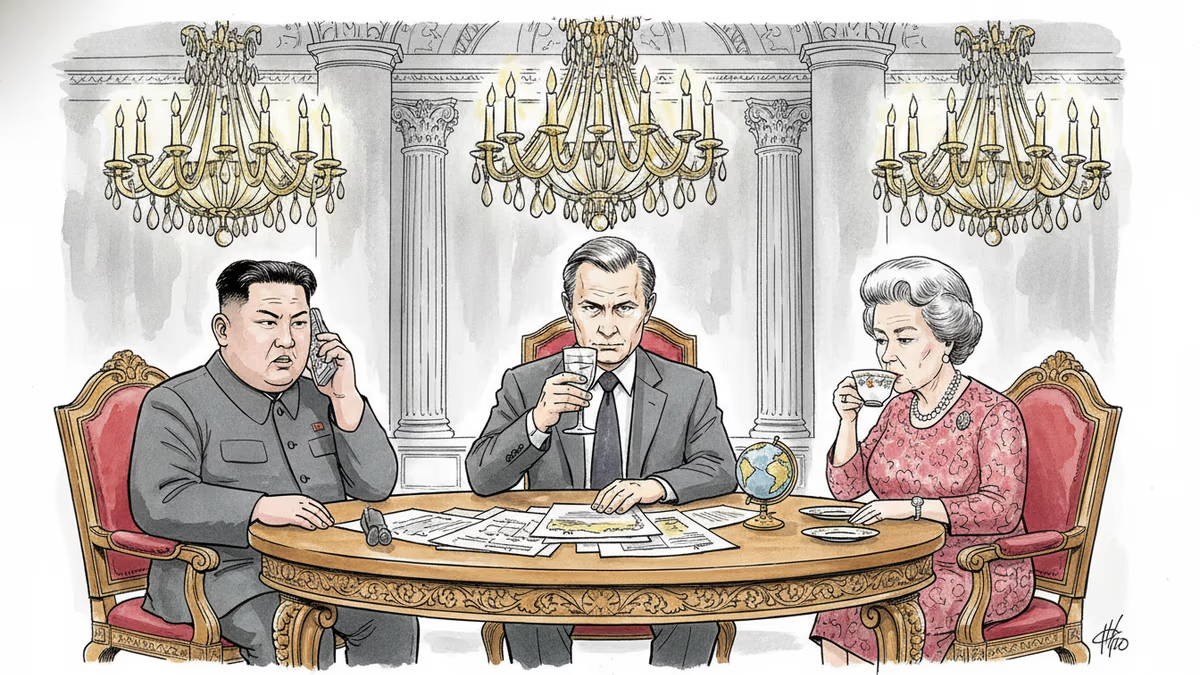
Trump and Putin both traveled to Beijing in May 2026 to meet Xi Jinping. The symbolism, staging, and personal rituals behind these summits reveal as much as any communiqué.
Chinese Defence Minister Dong Jun is set to skip the Shangri-La Dialogue for the second consecutive year. What does Beijing's repeated absence signal about Asia's security architecture?
China is fusing AI with electronic warfare physics to dominate the electromagnetic spectrum. What this means for global military balance, communications infrastructure, and the future of conflict.
Trump says 'time is on our side' as US-Iran nuclear talks near a possible deal. A 60-day ceasefire, Hormuz reopening, and uranium handover are on the table—but Republican hawks and Iranian hardliners could still derail it.
Trump and Putin both traveled to Beijing in May 2026 to meet Xi Jinping. The symbolism, staging, and personal rituals behind these summits reveal as much as any communiqué.
Thoughts
Share your thoughts on this article
Sign in to join the conversation