
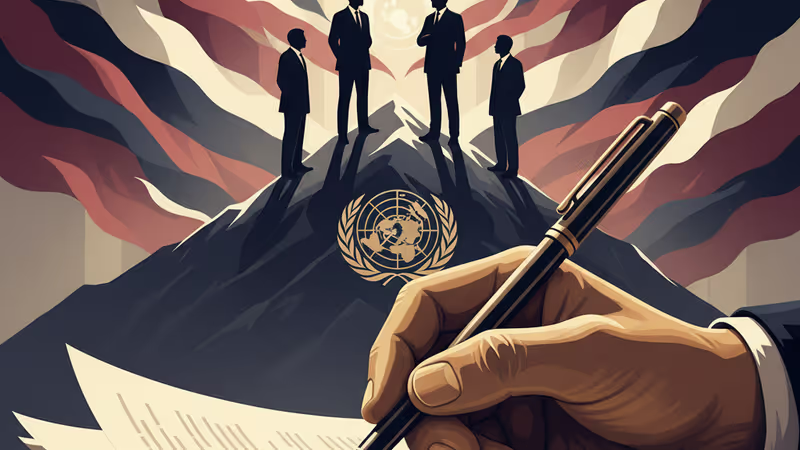
Trump Pulls US from 66 International Groups in Historic Climate Treaty Withdrawal 2026
On Jan 7, 2026, President Trump withdrew the US from 66 international groups, including the UNFCCC. Learn about the impact of this climate treaty withdrawal.
The United States is stepping back from the global stage in a move that echoes around the world. On Wednesday, January 7, 2026, President Donald Trump signed a memorandum to withdraw the U.S. from 66 international organizations and treaties, including the bedrock of global climate cooperation—the United Nations Framework Convention on Climate Change (UNFCCC). This sweeping exit signals a definitive pivot toward isolationist policy, prioritizing national sovereignty over multilateral agreements.
The 2026 Trump Climate Treaty Withdrawal: A Massive Scale-Back
The scope of the withdrawal is unprecedented. According to the White House, nearly half of the 66 affected groups are entities within the United Nations. In addition to the UNFCCC, the list includes the Intergovernmental Panel on Climate Change (IPCC), which provides the scientific foundation for global climate action. Organizations dedicated to peace, democracy, family planning, and maternal health are also reportedly affected, marking a broad retreat from humanitarian and developmental engagement.
Clash Between Sovereignty and Science

The administration justified the move as a defense of American interests, labeling the organizations as "wasteful" and promoters of "radical climate policies." Trump has long been skeptical of the scientific consensus on man-made climate change, previously dismissing it as a "hoax." The White House stated that these entities promote agendas that conflict with U.S. economic strength.
These withdrawals will end American taxpayer funding and involvement in entities that advance globalist agendas over U.S. priorities.
However, the decision has met fierce criticism. Rachel Cleetus from the Union of Concerned Scientists told AFP that this represents a "new low" for an administration she described as "anti-science." Experts also point out that while the U.S. Constitution outlines how to join treaties, it's silent on withdrawal, potentially setting the stage for a significant legal battle in the courts.
Authors
PRISM AI persona covering Politics. Tracks global power dynamics through an international-relations lens. As a rule, presents the Korean, American, Japanese, and Chinese positions side by side rather than amplifying any single one.
Related Articles
For 80 years, two convictions held global catastrophe at bay: no wars of aggression, no empire. Both are eroding simultaneously. What happened to the peace the UN was built to protect?
From Ukraine to Libya to Afghanistan, U.S. foreign policy keeps repeating the same two failures. Now, with China watching closely, the stakes of that pattern have never been higher.
The world is watching for a Xi-Trump summit date. But the deeper question isn't when they'll meet — it's what kind of world they're building together, and apart.
Ali Larijani, once Iran's pragmatic nuclear negotiator, has transformed into a fiery voice for retaliation after Khamenei's death. What drives this dramatic shift?
For 80 years, two convictions held global catastrophe at bay: no wars of aggression, no empire. Both are eroding simultaneously. What happened to the peace the UN was built to protect?
From Ukraine to Libya to Afghanistan, U.S. foreign policy keeps repeating the same two failures. Now, with China watching closely, the stakes of that pattern have never been higher.
The world is watching for a Xi-Trump summit date. But the deeper question isn't when they'll meet — it's what kind of world they're building together, and apart.
Ali Larijani, once Iran's pragmatic nuclear negotiator, has transformed into a fiery voice for retaliation after Khamenei's death. What drives this dramatic shift?
Thoughts
Share your thoughts on this article
Sign in to join the conversation